

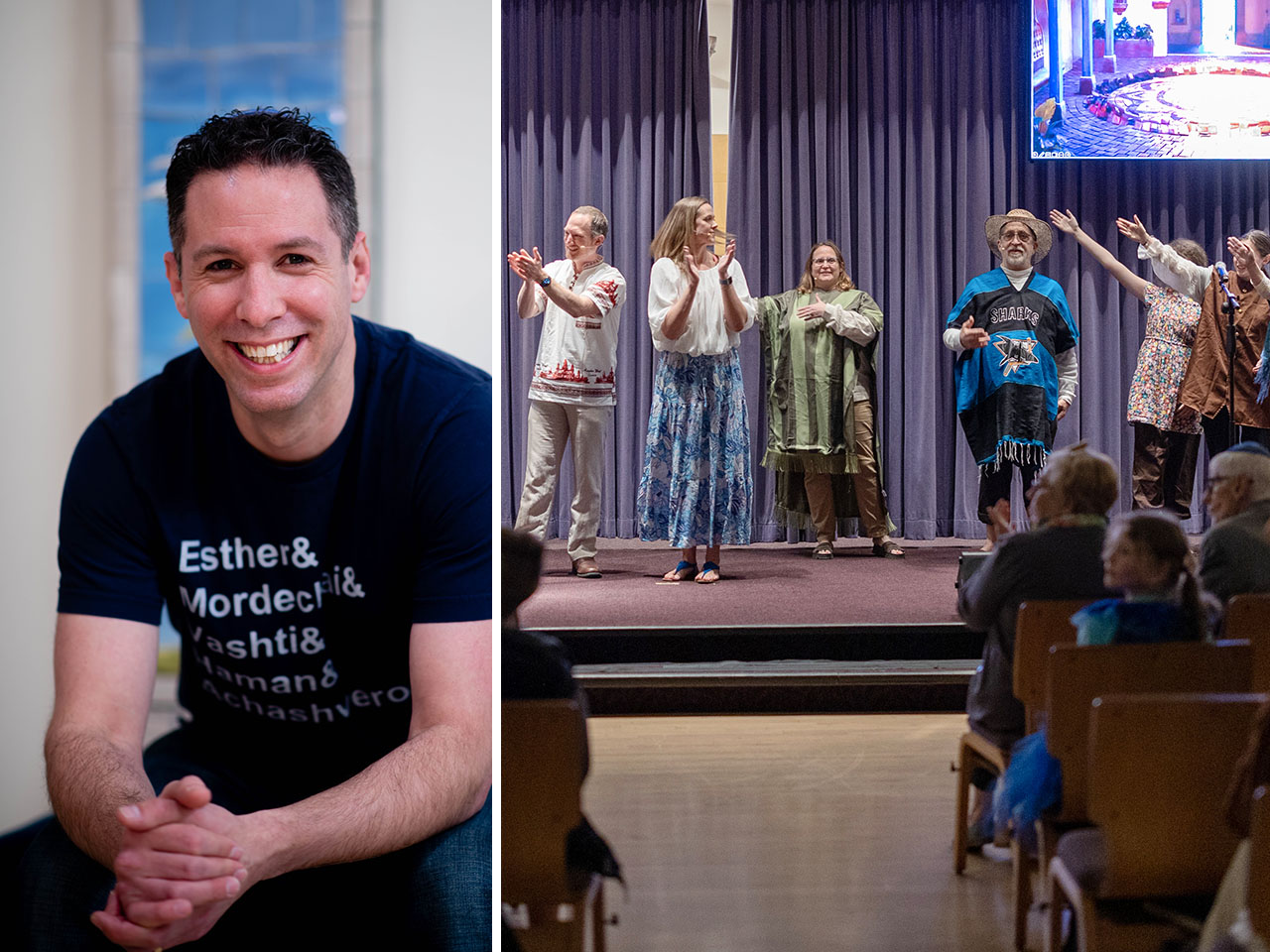
For the past nine years, some 450 synagogues across the world, including many in the Bay Area, have relied on “The Spiel Guy” for behind-the-scenes help to put on witty and relevant Purimspiels.
“The Spiel Guy” is former Bay Area resident Jamie Marx, who runs an online store for Purimspiel scripts, sheet music, posters and more.
Marx, 44, is a cantor at Temple Sholom, a Reform synagogue in the Philadelphia suburb of Broomall. Originally from San Diego, he and his family moved to Concord when he was 12, where he attended Oak Grove Middle School and Ygnacio Valley High School. He stayed in California until he left for cantorial school after college.
He co-wrote his first parody with his best friend when he was 8 years old. It was a twist on Michael Jackson’s hit song “Man in the Mirror.” Marx grew up to become a songwriter and composer in addition to his main gig as a cantor.
He got into spiel-writing leading up to Purim 2014 when he updated an existing Disney-themed Purim script by Norman Roth, a prolific New York-based spiel writer and distributor, to include songs and dialogue from the popular animated film “Frozen.”
“I had a 2-year-old who was obsessed,” he told J.
The script was a big hit. Then in 2016, when the nation had become obsessed with Lin-Manuel Miranda’s Broadway hit “Hamilton,” Marx’s wife, Anna, encouraged him to try to parody the rap-musical in a Purimspiel. Marx wrote it and even made it available for sale.
“It sold really well that first year,” he said. “I was super surprised, and I thought, ‘Oh, maybe I should write another one.’”
Today, it’s a real business. With help from Anna, who works in nonprofit management, Marx set up online in 2020, becoming a go-to guy for Purim parodies.
Marx recently spoke with J. about the inspiration and process behind more than two dozen spiels he’s written over the years, as well as about his Bay Area roots. The interview has been edited for length and clarity.
J.: You were born in San Diego, but your family relocated to the Bay Area when you were 12. Tell me about your time growing up in the Bay Area.
JAMIE MARX: I lived in Concord and my family belonged to B’nai Shalom in Walnut Creek. I was in Midrasha, which was actually a really huge part of my teen years and my Judaism.
My wife and I met in high school, originally at a Kesher retreat. We met again in college [at Cal Poly San Luis Obispo]. And we had that little connection. We had a lot of friends in common. It was meant to be. And after college, my wife and I joined B’nai Tikvah in Walnut Creek.
When you’re writing a spiel, how do you draw the connection back to the story of Purim?
As a cantor, I’m a big believer that we should be faithfully telling the Purim story. I don’t want anyone to come away and hear a different story than the one that we’re intending. I’m not really telling the story of “The Wizard of Oz” or “Wicked.” I’m telling the story of Esther, and the tools I use to bring that out and the way that we highlight what’s within the tale is the real pleasure of writing a Purimspiel.
The Bible includes all the details you need and nothing you don’t. What that means is that sometimes you’re looking for an explanation for why a thing happened, and there’s room there to create a midrash, an interpretation of that story that fills out the characters.
So the question is: Esther shows up at the king’s palace early on in the story to potentially be the new queen. But how did she feel about that? Like, was she excited? Maybe she was excited to have a life of wealth and to live in the palace? Or was she nervous? Was she scared? Was she indifferent or annoyed?
All those emotional options are available when I write a spiel.
Last year for Purim, during the height of fandom over Taylor Swift’s Eras concert tour, you wrote “Esther’s Story (Taylor’s Version),” a spiel parodying Swift’s most popular songs. What was that process like?
It’s interesting, I didn’t know a lot of Taylor Swift music, but a lot of my students and former students are huge Swifties. I literally texted two of my college-age kids and said, “Hey, I need the Top 20 most well-known Taylor Swift songs. Send it to me.” I made a playlist of all their suggestions and just played it through until I got 10 songs that I could work with and make great parodies from. Frankly, it really heightened my appreciation for her craft as a songwriter.
Your newest spiels for this year are parodies of “The Wizard of Oz” and “Wicked.” You’re really tapping into pop culture and what’s interesting to people in the moment. How many do you typically write each year?
I started off by doing one a year for my first two years, but now I tend to do somewhere between two and four.
The themes come to me in a couple of ways. Sometimes it’s obvious. The universe had been talking about “Wicked” for a year before the movie came out. I knew that was going to be a big thing. And sometimes it’s just what I’m interested in.
So this year, I wrote a classic Broadway Purimspiel called “West Side Shpilkes” just because I love Broadway. It was just super fun to write. And sometimes, people hire me for commissions.
Your next big project is launching the Philadelphia Jewish Musical Festival in May 2026. What’s the story behind that?
It’s a really exciting thing, highlighting both Jewish musicians and Jewish music. Especially post Oct. 7, the Jews need to be loud and proud a little bit more, and we need to gather with not only our fellow Jews, but with the broader communities around us. And there’s absolutely no better way to do that than through music.
Everyone can find a way in and can find something, even if they’re not Jewish. That is a way to build bridges between people that you just can’t do any other way.