

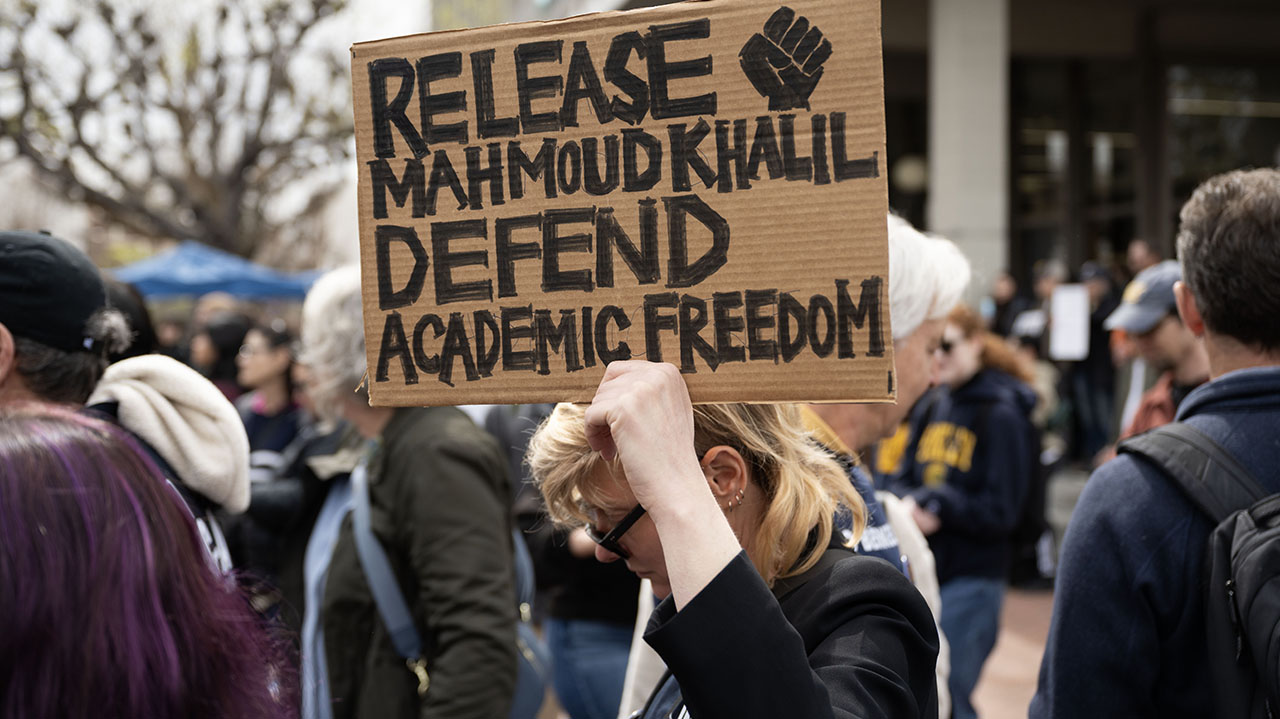
Around 300 people gathered on the steps of UC Berkeley’s Sproul Plaza on Wednesday to defend academic freedoms they say are under threat by the Trump administration, which has targeted universities specifically for how they have handled antisemitism.
Alarmed by the March 7 canceling of $400 million in federal research grants at Columbia University, and fearing UC Berkeley is next, a coalition of Cal faculty called the rally to express their commitment to “the freedom to speak, to teach and to learn.”
What happened at Columbia “is only the beginning,” law professor Claudia Polsky told the crowd.

None of the speakers mentioned the multiple federal investigations UC Berkeley is facing over claims that it has failed to properly respond to antisemitic incidents on campus — the same issue that led to the revocation of funding for Columbia.
English professor and rally organizer Colleen Lye told J. that she sees the Trump administration’s actions as a “weaponization of the charge of antisemitism to destroy universities in general.”
“Of course, we want to have a situation in which we don’t tolerate discriminatory violence of any kind. Any hate acts would be prosecutable under criminal law,” Lye told J. after the event. “What gets more tricky is what counts as hate speech or not hate speech. That needs to be procedurally determined, rather than preemptively decided and weaponized politically.”
Both students and faculty attended the rally, which was organized by Berkeley Faculty for the Freedom to Learn in concert with several academic associations. The coalition formed last week after President Trump announced on his social media that he intended to pull Cal’s funding, and in advance of the UC Board of Regents meeting held yesterday in Los Angeles. The Regents voted to impose a systemwide hiring freeze and stop requiring diversity statements in faculty hiring procedures.
The ‘free speech except for Palestine’ exception shows us that we are living in a moment of tenuous freedom and unequal protection. Professor Hannah Zeavin
Assistant history professor Hannah Zeavin used her speech to read an excerpt from a letter written by Mahmoud Khalil, the Columbia University graduate student detained by immigration officers over his involvement in pro-Palestinian and anti-Israel protests. Khalil dictated the letter to his lawyers while in detention in a Louisiana facility.
“Let us not forget the ‘free speech except for Palestine’ exception shows us that we are living in a moment of tenuous freedom and unequal protection,” said Zeavin, who is Jewish. “It’s leaving our most vulnerable community members open to harassment and now to deportation.”
Last week, over 100 Jewish Berkeley professors signed a statement denouncing the Trump administration’s plan to deport foreign-born students who are deemed “supporters of terrorism or terrorist organizations.”
Rally-goers held signs with pro-free speech slogans, including “defend academic freedom” and “education not censorship.” Other signs and banners called for Khalil’s release.

“No U.S. aid for genocide,” read one banner held by demonstrators wearing kaffiyehs who stood to the side of the Sproul steps during the rally. Others held Palestinian flags, one of which included the text of the Shahada, the Islamic declaration of faith.
One rally-goer chose to promote a more moderate, patriotic message.
River Richart, a senior political science student at Berkeley, brought an American flag to the rally to counter the criticism from the political right, so leftists are “not painted as godless Commies who hate America.”
The flag, he said, “shows that this is a deeply American cause, that [Trump’s threat] is an attack on our Constitution, and what makes this country great.”

Berkeley Faculty for the Freedom to Learn organized yesterday’s rally in partnership with the university’s academic senate, the Berkeley Faculty Association, the University Council for the American Federation of Teachers, and UAW Local 4811, the union representing all academic student employees in the University of California system.
At the end of the rally, organizers announced they will return to Sproul Plaza on April 8 for a national day of action to protest cuts to higher education and research.