

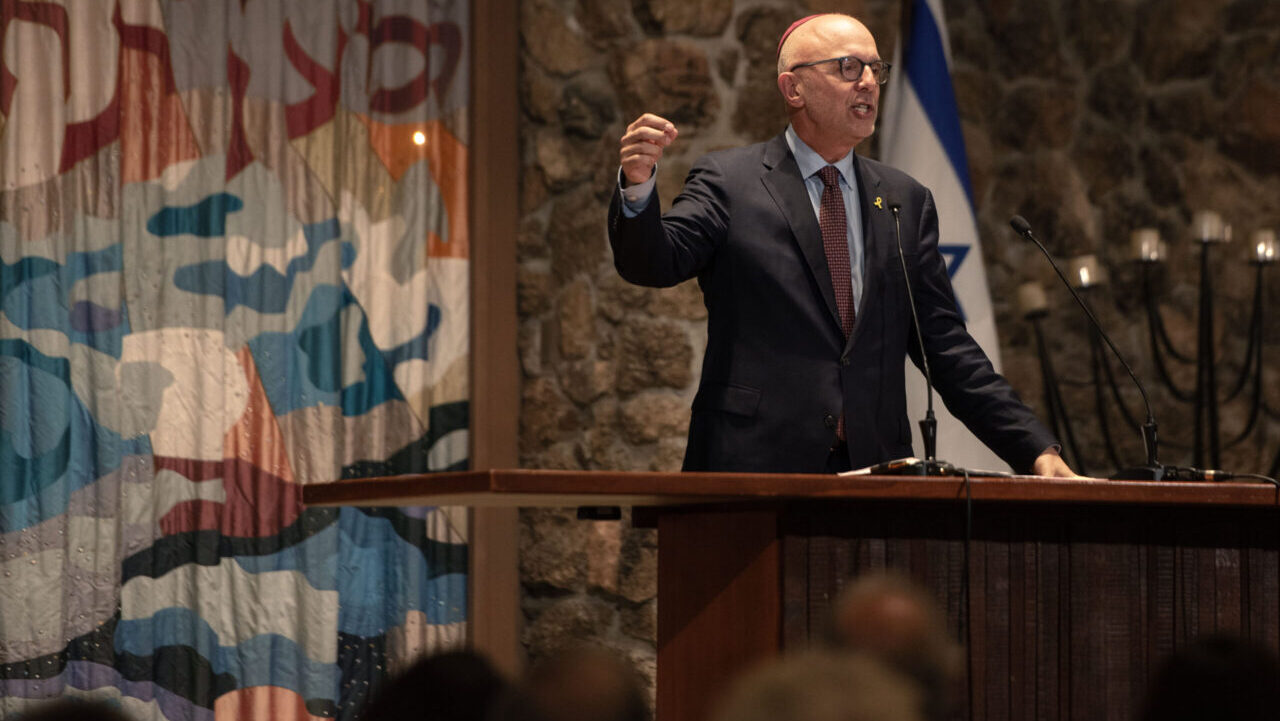
Ted Deutch, a former Democratic member of Congress from Florida and now CEO of the American Jewish Committee, told a packed Bay Area synagogue audience on Thursday that he considers the Trump administration a supportive partner in the fight to combat antisemitism.
“Regardless of how anyone feels about President Trump or his administration, whether you love him and everything he does, or you find you have great concern over any number of his actions, there’s one thing that AJC, and I would suggest the community as a whole ought to do, and that is acknowledge that the White House is making the fight against antisemitism a priority,” Deutch said in Los Altos Hills.
Following his 12 years in Congress, in 2022 Deutch took the top job at AJC, a nonpartisan Jewish advocacy organization focused on civil rights. In his talk at Congregation Beth Am, he also addressed his work with the Biden administration developing and implementing the first-ever U.S. National Strategy to Counter Antisemitism.
“There are positives and negatives in every administration, and I think it’s important for us to acknowledge that we worked closely with the Biden administration on issues and opportunities that were important to the Jewish community, and we were critical when we needed to be,” Deutch said. “It’s the same approach that we’re taking with the Trump administration.”Deutch focused his remarks on AJC’s recent report on “The State of Antisemitism in America,” and offered guidance to combat antisemitism in schools and on college campuses.
“Antisemitism in education is not just a Jewish issue,” he told the audience. “Ultimately, it is a test of our democracy.”
In a letter earlier this month, Deutch expressed appreciation to the new federal task force on combating antisemitism for holding Columbia University accountable for “its egregious record of antisemitism.” But the letter also spelled out AJC’s concern over the targeting of federal research funding.

“Life-saving scientific research, and other critical fields that have little connection to the areas where the antisemitism at Columbia was happening, could be hurt by across-the-board cuts,” he said.
During an audience Q&A, 23-year-old Ben Rubin of San Francisco asked Deutch for his views on actions the Trump administration has taken against Mahmoud Khalil, the Columbia University graduate facing deportation for his role in leading campus protests against Israel.
“Do you support the limiting of due process in the fight against antisemitism?” Rubin asked.
Deutch responded by first pointing out to the audience that Khalil’s anti-Israel activism on campus was “horrific and odious” and that Columbia University should have taken action against him.
At the same time, Deutch continued, “that doesn’t mean that due process goes away.”
“We respect the judicial system in enforcing due process as they will, and we’re going to respect what the court says, and we would certainly expect that the administration would respect what the court says as well,” he said.

After the talk, Rubin told J. he found Deutch’s answer “a bit contradictory. I was unclear on his stance. It would be interesting to hear a little bit more specific, and less the principles of how they (AJC) feel,” Rubin added.
While in the Bay Area, Deutch met with the board chair of Stanford, where 13 people were arrested during a raucous campus protest last spring. An audience member asked Deutch how his meetings went, and what steps Stanford is taking to address antisemitism.
“There are some significant steps that we’re particularly excited about because they go beyond what other campuses have done,” Deutch said, noting that Stanford issues letters to incoming students laying out “what’s expected of students on campus” and detailing enforcement of the university’s code of conduct. He said Stanford has also made curriculum changes to facilitate “difficult conversations” among students.
Deutch later told J. his visit to the Bay Area was “very fruitful” and that speaking directly with audience members “helps to inspire me and the work that we do.”
Bringing Deutch to Beth Am was a joint effort spearheaded by the Reform synagogue’s Jewish and Israel Advocacy Committee, which spent nearly 18 months preparing for his visit, according to Rabbi Heath Watenmaker.
The event was also a community effort, co-sponsored by seven synagogues across the Bay Area from Morgan Hill to Petaluma.