

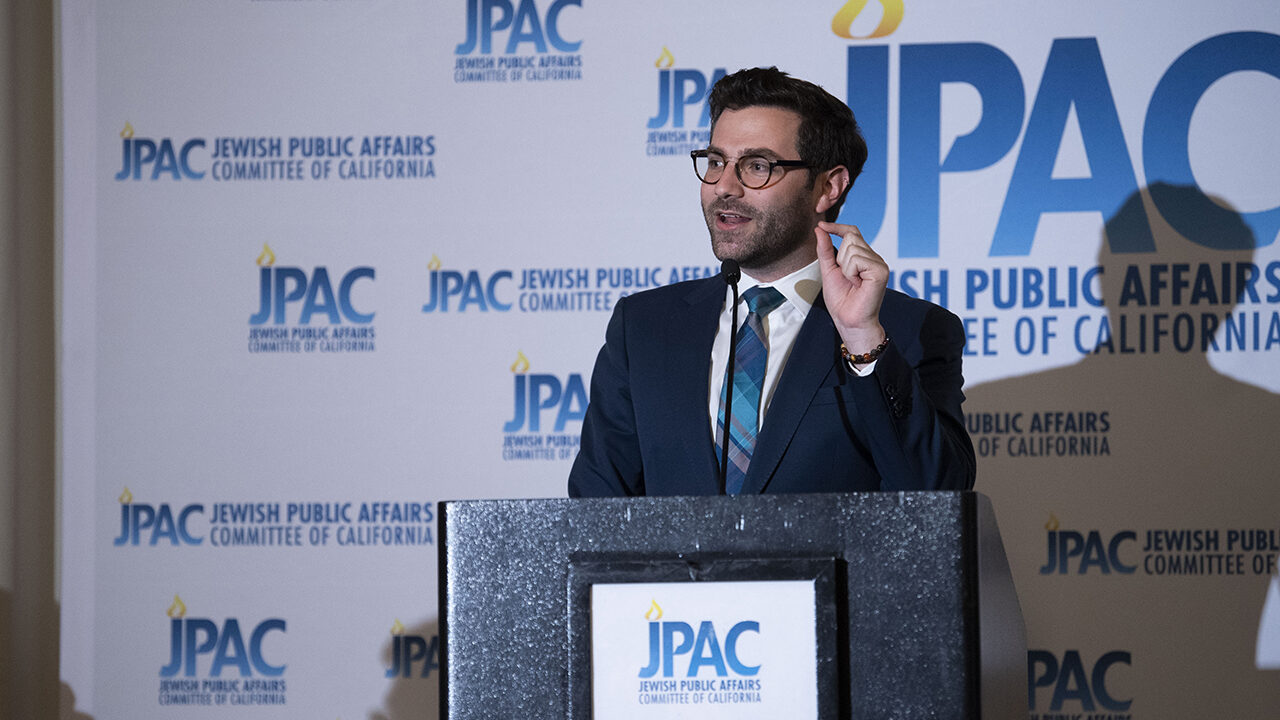
A bill to set curriculum standards for ethnic studies instruction in high schools is one of the top priorities for the Jewish Public Affairs Committee of California as the organization prepares to lobby lawmakers at JPAC’s annual Capitol Summit on May 5 and 6.
Assembly Bill 1468 would require the State Board of Education to “develop and adopt academically rigorous content standards” for ethnic studies courses. The bill is opposed by groups such as the United Teachers Los Angeles and the California Council on American-Islamic Relations. According to CAIR-CA, which focuses much of its attention and resources against Israel, the bill “strips control from educators, imposes political censorship, and erases critical histories—including the Israeli occupation of Palestine and the genocide in Gaza.”
AB 1468’s co-author, Assemblymember Dawn Addis (D-Morro Bay), describes the bill as crucial to preventing antisemitic and anti-Israel bias in ethnic studies courses. Addis introduced the bill in February with co-author Assemblymember Rick Chavez Zbur (D-Los Angeles). In addition to Addis and Zbur, 29 lawmakers in both houses are backing the bill.
Given the opposition so far, JPAC executive director David Bocarsly expects an uphill climb for AB 1468, although he is impressed by the support from lawmakers and Jewish organizations.
“We have already secured 54 Jewish organizations who have signed on in support of this bill,” Bocarsly told J. “I’ve never seen this many Jewish organizations sign onto a state bill in 10 years of working in the Legislature.”
JPAC rolled out its legislative agenda on April 15 for the 2025 California legislative session, shifting its focus from higher education to K-12 schools, as well as on closing loopholes in criminal laws and securing public assistance for the elderly.
Here are other top priorities for JPAC this year:
Improving public awareness of antisemitism
Another bill on JPAC’s agenda for this year is Senate Bill 472, which would require the state’s superintendent of public instruction to establish a Holocaust and genocide education grant program for school districts, county education offices and charter schools.
SB 472 builds on existing state laws that require the use of age-appropriate materials to teach about genocide and the Holocaust. Bocarsly sees it as an important part of promoting empathy toward Jewish and other minority groups,
“Holocaust and genocide education is contemporary education around combating antisemitism and hate,” Bocarsly said. “It teaches the stories of what happens when people don’t stand up to bias and bigotry.”
Bolstering public safety laws
Two more bills on JPAC’s agenda, AB 237 and SB 19, aim to make it easier to prosecute people who threaten schools, day care centers, houses of worship and other public venues.
“Right now, if you call a school or a house of worship and make a threat, but you don’t threaten a specific person, you actually are not eligible to be punished on the same criminal statutes that would be for a threat against an individual,” Bocarsly said. “There have been missed opportunities for people who have made threats to institutions.”
AB 237 would add a new section to the California Penal Code that would criminalize threats against such facilities at the same level as threats to individuals. SB 19 is the Senate version of the law.
Supporting elderly Jews
As the last living generation of Holocaust survivors continues to age and requires more assistance, JPAC is working to secure public services for survivors who live in California.
With funding for that state’s Holocaust Survivor Assistance Program set to expire in June, JPAC is advocating for $36 million over the next three years. Operated through five major Jewish family service agencies in the state, including in San Francisco, the East Bay and Silicon Valley, the program provides trauma-informed, at-home assistance, direct financial aid, social and cultural programming, and counseling, among other services.
San Francisco’s Campus for Jewish Living, which provides assisted living, memory care and skilled nursing housing for the elderly, is in need of updating, with some buildings over 50 years old, according to JPAC. The group will lobby for an additional $6 million from the state to supplement CJL’s $36 million, five-year building modernization project.