

A new bill aims to curb anti-Jewish hate in California schools by appointing a statewide “antisemitism coordinator” and strengthening the process for discrimination complaints.
AB 715, announced Saturday, has the backing of mainstream Jewish organizations and a coalition of four “diversity caucuses” in the Legislature. It quickly came under attack from left-leaning activists and staunch critics of Israel, including the Council on American-Islamic Relations-California and Jewish Voice for Peace, which contend that its purpose is to censor criticism of Israel.
The measure will replace a previous bill that focused primarily on ethnic studies. That bill, AB 1468, will be withdrawn, according to its supporters, because antisemitism in California schools extends beyond ethnic studies. AB 715 focuses on K-12 schools more broadly.
“Incidents have been coming out in all different subject areas, in all different venues,” said Assemblymember Dawn Addis (D-Morro Bay), who introduced the new legislation jointly with Assemblymember Rick Chavez Zbur (D-Los Angeles). Addis and Zbur, both members of the California Legislative Jewish Caucus, had also introduced AB 1468.
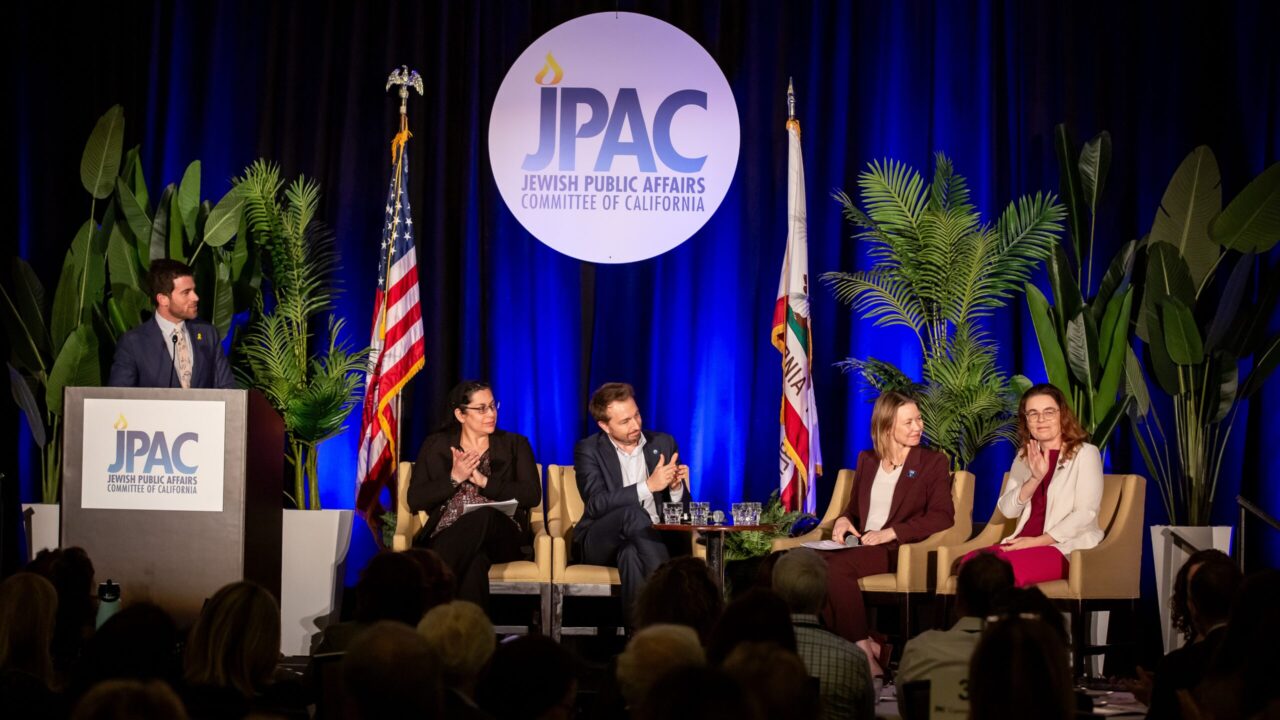
AB 715 will be heard in the Assembly education committee on Wednesday and may undergo amendments — some of its specifics are still being worked out, according to David Bocarsly, executive director of the Jewish Public Affairs Committee of California, a lobbying group that supports the legislation.
“Negotiations have been ongoing for a while,” he said, describing AB 715 as a “framework.”
The bill comes after a series of highly publicized incidents in schools which, in most cases, have revolved around the Israeli-Palestinian conflict. The incidents have raised concern among Jewish lawmakers, the Anti-Defamation League and mainstream Jewish organizations that teachers or other school leaders are injecting bias into the classroom.
Debates about how to teach the Israeli-Palestinian conflict in K-12 schools are not new. But since the Oct. 7, 2023, Hamas attack and start of the ongoing war, the debates have intensified. Some teachers and activist groups, arguing that it is urgent to teach about the crisis for Palestinians in Gaza, have tried to evade district leadership with unvetted curricula.
In December 2023, teachers in Oakland held an unauthorized “teach-in on Palestine” that relied on anti-Zionist materials, including a picture book for children that included “I is for Intifada.” Also that December, slides shown to students at Menlo-Atherton High School stated that Israel was created “on Palestinian land” and is “illegal.” Students in a second-grade class in Berkeley wrote “stop bombing babies” on sticky notes during a class led by a pro-Palestinian teacher, one among many incidents raised in a combative hearing on Capitol Hill with the Berkeley superintendent last year.
More recently, controversy has spilled into school boards during contentious public meetings. In Pajaro Valley last month, a school board member said during a hearing on ethnic studies that Jewish activists do not recognize “the economic power historically held by the Jewish community” relative to people of color. Another board member referred to Jewish activists as “you people” and said, “You only show up to meetings when it’s beneficial for you, so you can tell brown people who they are.”
A key aim of the new legislation is to expand the Uniform Complaint Procedures process — by which discrimination claims are adjudicated — to include contractors and school board members. Right now, complaints primarily focus on school employees, such as teachers. With California likely to mandate ethnic studies for high school students, many school districts are signing contracts with ethnic studies consultants.
“We know a lot of incidents aren’t just in the classroom,” Bocarsly said.
The proposed “antisemitism coordinator” would “further the intent of and compliance with Title VI of the Civil Rights Act of 1964,” the bill states.
“We would have someone focused on thinking about this issue from a holistic lens,” Bocarsly said.
The bill has earned support from a coalition of four “diversity caucuses” in Sacramento: the chairs of the Jewish caucus, the Black caucus, the Latino caucus and the Asian American and Pacific Islander caucus.
“There have been troubling reports of incidents of antisemitism happening within the very spaces meant to foster inclusion and critical thinking,” state Sen. Akilah Weber Pierson (D-La Mesa), chair of the Legislative Black Caucus, wrote to J. “We’ve heard allegations that some educators and even school board members have made comments that marginalize or exclude Jewish voices. As someone deeply committed to culturally competent education, I believe that the educational system must lift up all communities and foster mutual respect.”
The anti-Zionist group Jewish Voice for Peace came out strongly against the measure, as did a left-wing group called Jewish Educators Addressing Actual Antisemitism. The latter sent a statement to the Los Angeles Progressive on Monday, saying that the bill is “designed to protect Israel’s human rights crimes and violations.”
In the same article, JVP member Marcy Winograd described the proposed coordinator as an “antisemitism czar” meant to “police school discussion of Israel and Palestine.”