

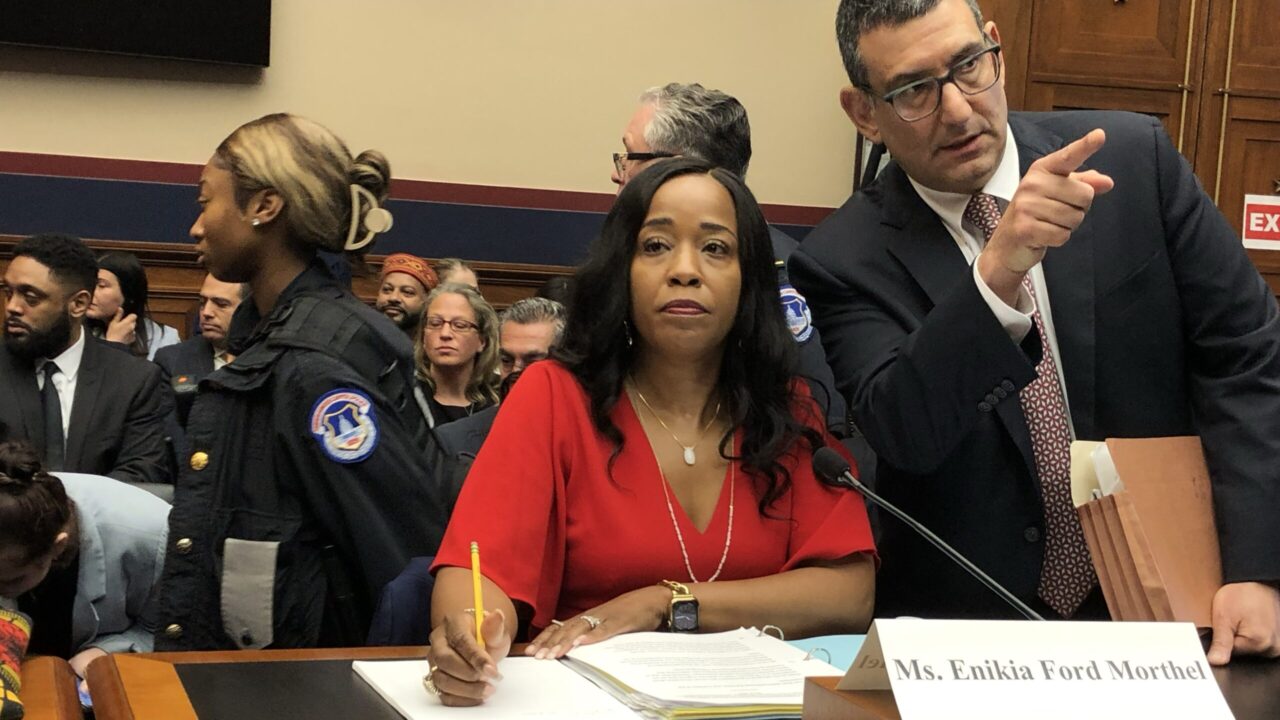
WASHINGTON — Berkeley Unified School District’s superintendent, who has become the public face of its struggles with allegations of antisemitism and anti-Israel animosity since Oct. 7, fielded a volley of tough questions from Republican members of Congress during a public hearing Wednesday.
Republicans called BUSD Superintendent Enikia Ford Morthel as a witness, along with two other leaders of what are considered progressive school districts: David Banks, chancellor of New York City Public Schools, and Karla Silvestre, board president of Montgomery County Public Schools in Maryland. The House Committee on Education and the Workforce hearing, which lasted two hours, was at times highly combative.
The Republicans grilled the three on their handling of antisemitic and anti-Israel incidents in their schools and accused them of not doing enough to stem the tide of vitriol that has made headlines and drawn complaints from Jewish families.
“Our history of activism, social justice, diversity, and inclusion is alive and well today,” Ford Morthel said in her opening statement. “I hope to share the ongoing work we are doing in Berkeley Unified to oppose antisemitism, Islamophobia and all forms of hate.”
Members of Congress interrogated Ford Morthel and the other panelists, hoping to pin them down on issues related to antisemitism in a similar way that university presidents were hammered in December.
“Does Israel have the right to exist as a Jewish state?” asked Rep. Aaron Bean (R-Florida), who is chairman of the Subcommittee on Early Childhood, Elementary, and Secondary Education that held the hearing.
“Yes,” Ford Morthel responded.
“Is the phrase ‘From the river to the sea, Palestine will be free’ — is that antisemitic?”
“It is, if it is calling for the elimination of the Jewish people in Israel,” Ford Morthel said. “And I will also recognize that it does have different meanings to different members of our community.”
Ford Morthel pushed back on the claim that antisemitism was running rampant in Berkeley schools, even as she acknowledged that the district had received nine formal complaints “alleging antisemitism… within our jurisdiction” since Oct. 7. She said that antisemitism “is not pervasive in Berkeley Unified School District,” a claim that would be criticized later in the hearing.

Ford Morthel tried to capture the affection that she and her teachers have for students, some of whom are as young as 4 years old. She repeatedly referred to students within the district as “my babies.”
“Our babies sometimes say hurtful things,” she said. “We are mindful that all kids make mistakes.”
Democrats, meanwhile, called Emerson Sykes, a senior staff attorney for the American Civil Liberties Union, to testify on legal considerations related to the First Amendment.
Students and teachers “do not lose their First Amendment right at the schoolhouse gate,” Sykes said, quoting a 1969 Supreme Court ruling, adding that students do not have a right to speech that disrupts learning.
Berkeley Unified School District has for years dealt with controversy related to the Israeli-Palestinian conflict, but tensions have flared considerably since the Oct. 7 Hamas massacre in Israel and the subsequent war.
Ford Morthel has walked a fine line in her role overseeing the diverse and politically progressive school district that has fielded calls from pro-Palestinian teachers and activist groups insistent that the school district “Teach Palestine,” as well as from pro-Israel Jewish families arguing that the district is rife with anti-Israel bias.
Since Oct. 7, Berkeley students have led unsanctioned walkouts against Israel and for Palestinians, with support from adult activists and allegedly from some teachers, and chanted “from the river to the sea, Palestine will be free.” A Berkeley High School art teacher was placed on administrative leave after allegedly showing an image to his class of a fist decorated with a Palestinian flag punching through a Star of David. A second-grade teacher at Berkeley’s Malcolm X Elementary School allegedly supervised students as they wrote “stop bombing babies” on sticky notes during an exercise to write “messages of anti-hate” and then placed them outside the classroom of the only Jewish teacher in the school.
These allegations and many more are included in a civil rights complaint filed Feb. 28 by the Anti-Defamation League and the nonprofit Louis D. Brandeis Center for Human Rights Under Law.
Ford Morthel told lawmakers she learned this week that the U.S. Department of Education’s Office for Civil Rights has formally opened a Title VI investigation into BUSD stemming from that complaint. Title VI of the Civil Rights Act of 1964 prohibits discrimination based on race and national origin in programs that receive federal funds.

Members of Congress asked Ford Morthel to address specific incidents likely to be scrutinized by the Department of Education in the months ahead. The amount of time for each representative’s questions was short — five minutes — so only a tiny fraction of the alleged incidents were addressed.
Rep. Kevin Kiley (R-California), whose district covers a vast strip of the California-Nevada border from north of Tahoe to Death Valley, delivered the most detailed line of questioning. He pushed back aggressively on Ford Morthel’s claim that antisemitism was not “pervasive” in the district.
He read from the federal complaint that listed a number of incidents, some of which J. has not independently confirmed. The complaint states that students have repeatedly heard antisemitic statements from classmates such as “kill the Jews”; that non-Jewish students have asked Jewish students “what their number is” referring to concentration camp tattoos; that Jewish students have been insulted for their physical appearance and “demonized as evil”; and that teachers promoted walkouts and “praised Hamas.” Kiley also referenced the second-grade sticky note incident and said that teachers were going on “antisemitic rants.”
“Jewish students report being worried about mob violence, including being jumped at school. Many have said they remove their Stars of David and no longer wear Jewish camp T-shirts, and they are learning to keep their heads down and hide their Judaism,” Kiley said. “If you’re not willing to acknowledge the problem, why can we be confident it’s being adequately addressed?”
Ford Morthel responded that the district takes allegations of antisemitism seriously.
“You can be confident that I am there in my schools every day,” she said. “In the schools — in the classrooms with the babies. And I am very clear that antisemitism — there have been incidents of antisemitism in Berkeley Unified School District. And every single time that we are aware of such an incident we take action and we follow up.”

In another heated exchange, Kiley questioned Ford Morthel about the Liberated Ethnic Studies Model Curriculum Consortium, a left-wing educational consulting group that has become a lightning rod for controversy.
The consortium is led by educators who helped write the first draft of California’s ethnic studies model curriculum that was widely panned by Jewish legislators and by Gov. Gavin Newsom for carrying an anti-Israel bias and excluding any serious discussion of antisemitism. The model curriculum has since been edited to remove support for the boycott, divestment and sanctions movement against Israel and to add two sample lessons about Jewish Americans that focus on antisemitism and ethnic diversity in the Jewish community.
BUSD contracted with the Liberated Ethnic Studies consortium, which stands by its original version of the model curriculum, for implementation in its district.
“Even Gavin Newsom said the curriculum was ‘offensive in so many ways’ and would ‘never see the light of day,’” Kiley said, quoting an interview Newsom gave to J. in 2019. “So it was revised. But the Liberated consortium offers the original version of it. They split off from the group, and said, ‘we’re gonna stick with the original antisemitic version.’ And that’s the version that you went out and decided to have in your classrooms. Is that right?”
“That is actually incorrect, Congressman,” Ford Morthel said. “Berkeley Unified School District has not purchased any curriculum from the Liberated Ethnic Studies consortium. In fact, our ethnic studies is created in-house, if you will.”
When Kiley pressed her, she conceded that Berkeley had hired the Liberated Ethnic Studies consortium “as a thought partner.”
She clarified that the Liberated Ethnic Studies consortium is “one of two experts in ethnic studies” that the school district has contracted with. A memorandum of understanding from June 2023 shows Berkeley committed $111,120 to work with the Liberated consortium “to promote the advancement and implementation of well-designed Ethnic Studies courses.”
Kiley argued the district’s hiring of Liberated Ethnic Studies consortium has contributed to the problems it faces today.
“You specifically chose to work with a group whose work product was rejected by political leaders throughout California as antisemitic,” he said. “So I don’t think it’s any wonder that you see antisemitism suddenly become rampant.”
The hearing room gallery was packed to capacity. A number of audience members wore yellow ribbons pinned to their shirts, a sign of support for the Israeli hostages that Hamas still holds captive in Gaza.
Ilana Pearlman, a Jewish Berkeley parent who’s been an outspoken critic of the district’s handling of antisemitism, traveled to Washington, D.C., to attend the hearing with another BUSD parent. She told J. she was “shocked” by Ford Morthel’s answers.
“She was the only person testifying that was unable to call out pervasive antisemitism,” Pearlman said. “She does not believe us. She does not believe our students. She basically thinks our students are lying.”
Asked to comment, Ford Morthel’s office said the superintendent would not be immediately available and directed J. to a statement sent to Berkeley families.
“Antisemitic incidents in our schools are deeply concerning and unacceptable, as are incidents of Islamophobia, racism, homophobia, bullying, othering, and all forms of hate,” the statement said. “As a district, and a community, we stand against hate.”