

Editor’s note: This story originally was published on June 13. It was updated on June 16 and again on June 24.
Members of Peninsula Sinai Congregation in Foster City had been preparing for months for their group trip to Israel, scheduled to start on June 16.
The six-day trip was supposed to have a mix of educational and volunteer programming, splitting time between Tel Aviv and Jerusalem.
“It really was a major effort,” Cantor Doron Shapira told J. “It took a lot of planning and emailing with Israel and talking back and forth. It became like a part-time job.”

The war began three days before the synagogue trip was scheduled to begin. The trip was canceled, but Shapira said there were a dozen or so congregants who were already in the country on June 13 when the war began. Some had come to Israel early to visit family and friends or to go sightseeing on their own. By the time Israel began bombing Iran and Iran began launching missiles and drones at Israel, a new reality set in.
“It’s a good thing to be in Israel, but not necessarily stuck there, and certainly not with missiles coming at you,” said Shapira, who set up a group chat with the congregants suddenly stranded there. “It’s been pretty much around the clock. Everyone is giving their tips or sharing their research, embassy updates. Any time someone gets something, we share it.”
As of Monday, June 23, all but two of the group members had managed to return to the United States.
Alan and Nancy Zorfas of Foster City arrived in Israel on June 11. They were staying at the Tel Aviv beachfront Renaissance Hotel when the war began.

“We were in this kind of contradiction,” Alan told J. on June 23. “We were in this beautiful hotel on the beach, and yet we also heard the action overhead. We heard the missiles and the intercepts.”
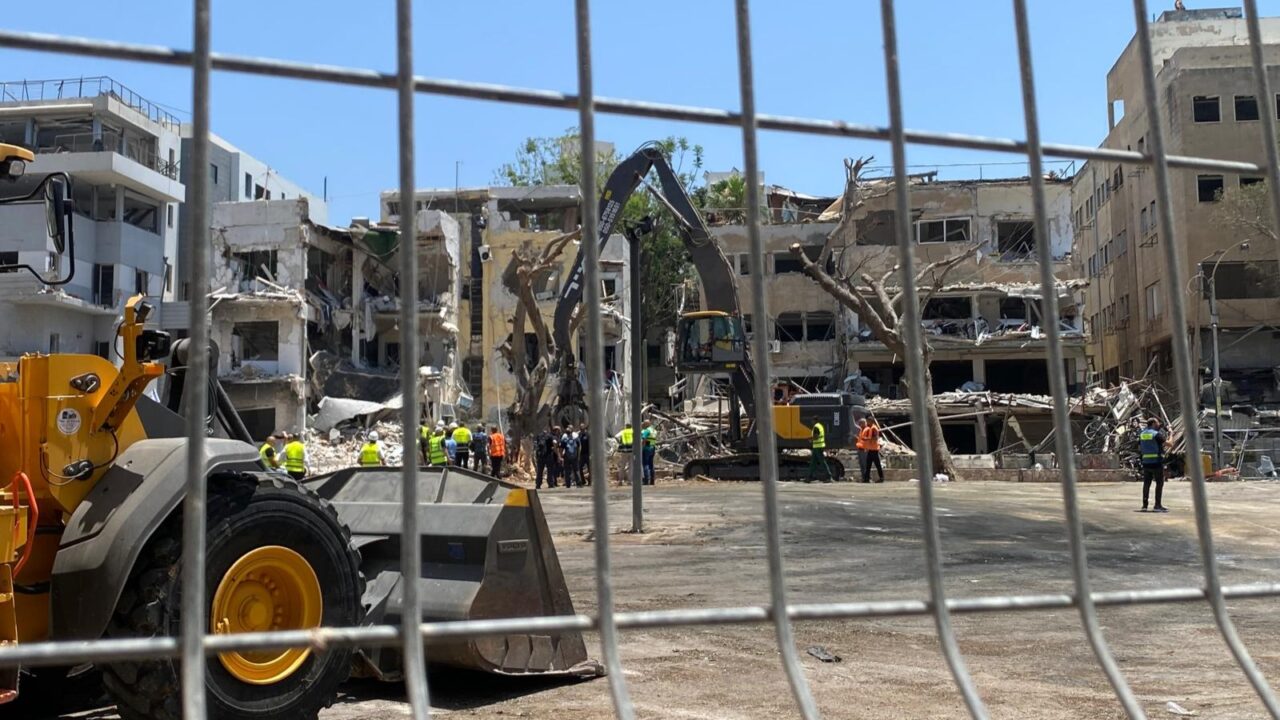
In the early morning of June 16, Iranian missiles hit several buildings near the U.S. consulate, just a 10-minute walk from the Renaissance Hotel. That strike, Alan said, “sounded like it could have been right outside the door.”
Through a connection with fellow visitors at the hotel, Alan and Nancy were able to secure seats on a repatriation flight bound for Vienna, Austria. After a short stay in Vienna and a connection in London, they arrived back home on Sunday, June 22.
Despite the tense days they spent in Israel, Alan and Nancy hope to return when it is safe enough to do so.
“We want to make it work,” Nancy said. “This was so important for us to be a part of and experience, especially with our community. We pray for a time where there’s an opportunity to do it again.”
—Niva Ashkenazi
June 13 interviews
Anastasia Torres-Gil was huddling in a stairwell with close Israeli friends on Friday, June 13, local time after Iran launched drones and missiles toward Israel. “We can hear some booms,” she said, speaking to J. on a video call over Zoom that night.
Torres-Gil, a Santa Cruz resident and former Bay Area prosecutor, is visiting Israel to help translate a friend’s book into English. She woke up around 3 a.m. Friday local time to the sound of sirens, after Israel launched an unprecedented wave of attacks on Iran, targeting nuclear installations, military infrastructure and top Iranian leaders. Israel placed its citizens on high alert, expecting a counterattack.
“It sounded like ghosts,” Torres-Gil said of hearing the sirens amid the fog of sleepiness.

Torres-Gil, a former national and current regional board member of the Zionist organization Hadassah, is staying with friends in a moshav near Netanya, north of Tel Aviv. The home doesn’t have a reinforced room that serves as a bomb shelter, so the safest alternative during an attack is the stairwell.
They were listening to Hebrew radio for the latest news on the security situation, as the threat of an all-out war with Iran loomed.
Despite the dire circumstances, Torres-Gil and her friends were keeping their spirits high. Sirens were sounding across the country after Iran launched two barrages of missiles and Israel’s defensive systems intercepted them, resulting in explosions in the skies over Israel. An unknown number of missiles hit the ground, according to media reports.

Torres-Gil and her two friends reflected a sort of gallows humor that has become a feature of Israeli resolve amid the constant threat of attack.
She said she didn’t know when she would be able to return home, as all flights at Ben Gurion International Airport have been canceled. “I’m lucky to be in a place with people I love,” she said. “Who happen to be gourmet chefs.”
She said her friend’s book, the story of how he helped thwart a terrorist attack aboard an El Al flight in 1970, would be on Amazon soon. She paused and laughed. “I hope to live to see it,” she said.
Torres-Gil added, “It’s amazing what the IDF and the Mossad have accomplished.”
— Gabe Stutman
For Zohar Schnaider, a 20-year-old San Franciscan studying government and counter-terrorism at Reichman University, the fighting has produced an “eerie energy” on her campus in Herzliya, just north of Tel Aviv. But it’s also been a learning experience.
Schnaider said she was up Thursday night, June 12, reading about the deterioration of negotiations between the U.S. and Iran on a nuclear deal and was anticipating an Israeli strike.
“I didn’t know when everything was going to go down,” she told J. on June 13, adding, “This is what I am learning about — it’s what’s in my lesson plans and textbooks. It’s what’s happening right in front of me.”
She said a number of her friends were out clubbing and partying in Tel Aviv late Thursday night and into the wee hours of Friday morning, which is when Israel attacked Iran. Many scrambled to bomb shelters, and some probably slept in them, she said.
Her phone started blaring around 3 a.m. Friday with an alert from the Home Front Command app, a warning system designed by the Israeli military that nearly everyone has downloaded on their phones. She called the alarm “very jarring.” But because the Reichman dorms have a bomb shelter on every floor, she knew she could get there quickly if necessary.
On Friday night, she did end up in a dorm bomb shelter. As Iran sent retaliatory missiles careening toward Israel, Schnaider and her classmates were “in and out of the shelter.”

She said many of her friends are frightened, as are their parents, particularly with all flights shut down to and from Israel. Her father served in the Israel Defense Forces, and she has an older sister living in Israel. Her family has “a lot of trust in the IDF” to protect the country, she said.
Schnaider, who graduated from the Jewish Community High School of the Bay in San Francisco, noted that she was in Israel during the Oct. 7, 2023, Hamas invasion and for Iran’s first missile and drone attack on April 14, 2024.
“So this isn’t my first rodeo,” she said.
— Gabe Stutman
June 16 interviews
Judy Goodman and her 13-year-old son, Julius, haven’t slept more than a few hours each night since they arrived in Jerusalem on Wednesday, June 11.
The Oakland mother and son came to Israel, along with her mother, to attend a relative’s bar mitzvah. The trip was also meant to celebrate Julius becoming a bar mitzvah last month at Berkeley’s Chochmat HaLev.
But violence between Israel and Iran has complicated the family’s celebrations, to say the least.

Early Friday morning, June 13, local time, Goodman received an emergency alert on her phone as the Israeli Air Force bombed Iranian military and nuclear targets. Disoriented and confused, she woke Julius up and headed to a bomb shelter, only to find out that this was only a warning of a possible need to take cover. When her phone sounded with a second alert a short time later, panic set in. Even the Israelis from the apartments nearby seemed flustered.
“That scared me a lot because we thought: [For Israelis] this is common now for the last few years. But the Israelis didn’t know what was going on,” Goodman told J. on Monday, June 16.
Since then, the bar mitzvah celebration at the Kotel was canceled. And yet, the family carried on and marked the occasion with help from the Chabad of the German Colony in Jerusalem.
“We as a Jewish people — we’ve had to adapt in the past. We’ve had to change,” Julius Goodman recalled his uncle, the father of the bar mitzvah boy, telling him. “The show must go on, even in dire conditions.”
Adding to their strain, while in Israel, Judy Goodman’s mother fell sick with Covid.
“It’s been really stressful,” Goodman said. “How do you go to the bomb shelter with Covid?”
Meanwhile, the family feels desperate to return home as soon as possible. Goodman’s mother needs to return to Oakland to care for her husband, who has multiple sclerosis. But all flights in and out of Ben Gurion International Airport have been canceled. It’s unclear when the airport will reopen.
“I spent three hours on the phone today and we’re hoping, fingers crossed, that the airport reopens and we have a flight to Athens on Saturday, and then from there back through Newark,” Goodman said.
— Emma Goss
Aliza Grayevsky Somekh traveled from Oakland to her native Jerusalem in late May to help her parents pack up their Jerusalem home and downsize to a smaller apartment. She expected to return home to her husband and her business within three weeks.
Somekh is the founder of Bishulim SF and shares her love of Israeli cuisine through catering and cooking workshops across the Bay Area.
For the past several nights, she and her parents have been woken up with alerts to head to the mamad, or reinforced room that serves as a bomb shelter.

The onset of another war has “changed everything,” she told J. on Monday, June 16.
Somekh and her parents have a reinforced room in their Jerusalem home, one with a couch and TV, which has helped them pass the hours inside.
“I feel that I’m one of the lucky ones because I do have a family here and some friends and a support system and a safe room in the house,” Somekh said.
Somekh travels to Israel fairly often, but fortunately hasn’t had to take cover in a bomb shelter or safe room since 1991 during the Gulf War, she said.
Coincidentally, while she was packing up her parents’ home, she and her parents found old gas masks from that war when people feared missiles with chemical or biological warheads.
“Everything was very confusing,” she said. “It felt like I was back in high school, and we were called to the safe room and walking around with our masks.”
— Emma Goss
Dennis Ybarra, 71, has been coming to Israel to celebrate Tel Aviv’s Pride festival every June for the past 15 years, at least. The Walnut Creek resident arrived in Israel on June 3 and has been staying in a house in Tel Aviv’s Florentin neighborhood.
When Tel Aviv Pride got cancelled in 2024 due to the ongoing war in Gaza, Ybarra decided to return to Israel in October to celebrate the High Holidays. Then too, he got caught in the midst of an Iranian missile attack.
“What I didn’t realize is the Iranians have a preference for waking everybody up,” Ybarra told J. on June 16. “In October, [the strikes were] in the evening, at a reasonable hour, but I’m guessing they want to rattle our cages more.”
Rather than feeling rattled, however, Ybarra feels defiant.
“The war is not a good enough reason to stay away from Israel. It has so much to offer,” said Ybarra, who has visited the Jewish state 35 times in total. “I get emotional about being here. I’m having the best time I’ve ever had in Tel Aviv.”
—Niva Ashkenazi
Paul Bessemer, a Modesto teacher, is spending part — too much — of his summer vacation in a bomb shelter on Israel’s coastal plain near Rehovot, south of Tel Aviv.
Bessemer’s wife is from Israel, and their son currently lives in Israel. They arrived Wednesday, June 11, with their daughter, planning to stay three weeks. But since Iran’s missiles began descending on Israel, their return home isn’t certain.
Over the last few days and nights, he and his family have been spending long hours in a shelter.
“We see missiles going overhead. If you’re foolhardy enough to stand outside the shelter instead of in it, you get a good light show at night,” he told J. on June 16, half-joking. “The biggest problem, I would say, has probably just been boredom.”
— Emma Goss