

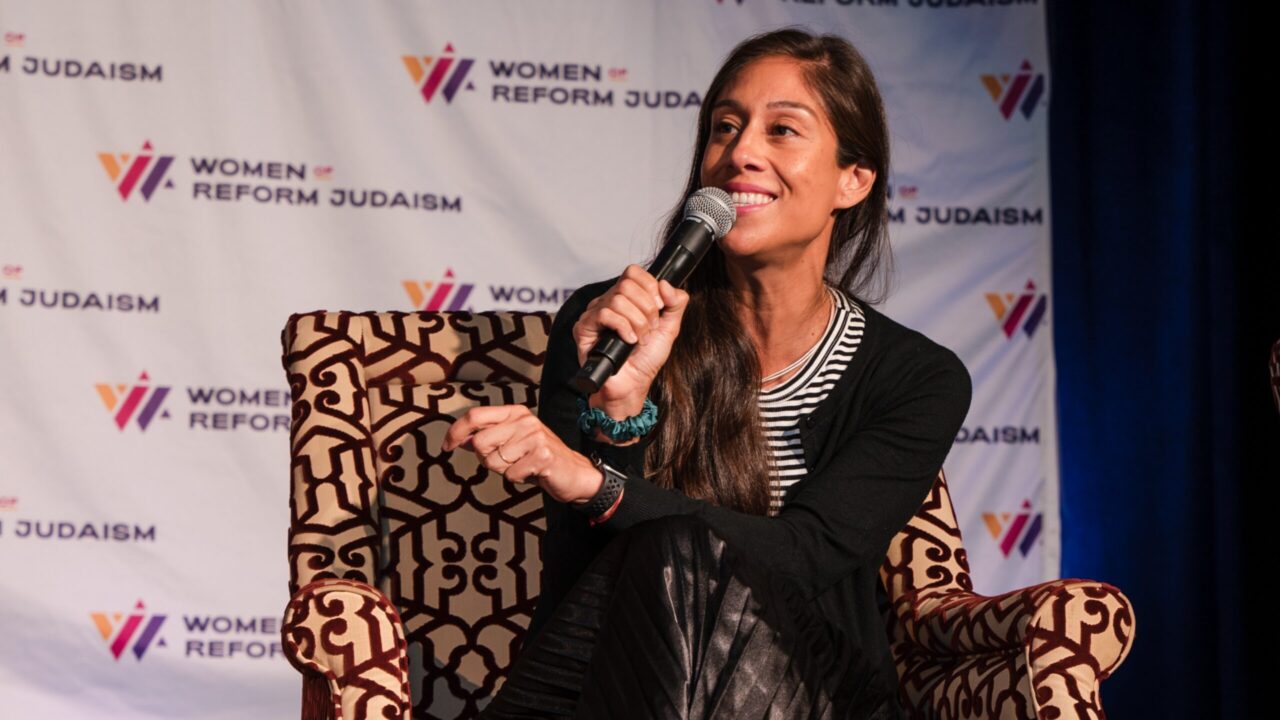
When J. caught up with Analucía Lopezrevoredo in late July, she was packing to fly home to San Francisco from Toronto, where she was on a Fulbright fellowship researching the Canadian Jewish community’s response to Jewish immigration from Latin America.
Immigration is no abstraction to Lopezrevoredo, who was born in Peru in 1985 to a Jewish mother and non-Jewish father. They immigrated to the U.S. via Spain when she was 5, and she grew up amid the Jewish and non-Jewish communities of Orange County, California, navigating a multicultural identity.
“We had a strong Peruvian identity and strictly spoke Spanish at home,” said Lopezrevoredo, a 39-year-old San Francisco resident.
But most of her peers had no concept of what a Peruvian was, and there was a great deal of xenophobic and anti-immigrant sentiment in conservative Orange County in the 1990s.
Lopezrevoredo was an undocumented U.S. resident throughout her youth. After becoming a citizen at age 20, she earned a doctorate in social work and traveled widely, learning five languages. She has forged a career studying the diversity of global Jewish cultures and advocating for closer ties within and between Jewish and Latin communities. In San Francisco, she’s played key roles in Jewish organizations such as JIMENA, OneTable and Bend the Arc, and in 2019 she founded the national nonprofit Jewtina y Co. to nurture Latin-Jewish community, identity, leadership and resiliency. Lopezrevoredo is its chief executive officer.
In a conversation with J., she reflected on the social and moral impact of the current American immigration policy on Latin Jews and the Jewish community at large, and spoke to how in the face of it we might rise to the challenge of upholding Jewish values. This interview has been edited for length and clarity.
How did immigration come to be a central concern of your life and work?
I’m an immigrant and the child of immigrants. I’ve been surrounded all my life by stories of immigration. What’s happening right now is painful because the United States is such an important place for me and so many others: It is a container for people’s dreams. And now it feels like the lid on that container has just been shut.
Growing up in the U.S., what was it like to carry aspects of identity from both Jewish and Latino backgrounds? What was the process of integrating them?
I think nurturing the Latino part was probably the most difficult, socially. A lot of my Latino peers tried to distance themselves culturally, because Latino culture was so stigmatized by people in authority. Given my name, I always stood out, and there were many times when I was younger that I wished I could just be like all the “Nicoles” in my class.
I really learned how to be a Jew in community, mostly here in the States. Being Jewish in Southern California in the ’90s was relatively easy. But to be fair, I mostly was being seen as Latina over Jewish by non-Jews. And even in Jewish spaces — my non-Ashkenazi last name always caught people’s attention.
As you delved more deeply into Judaism, how did it inform your concern for immigrants and shape your views?
A big part of how I have connected to Jewish life has been through learning about the migratory patterns of Jews all over the world. Jews are so deeply shaped by the experience of migration. Whether it’s the Exodus story, or the repeated exile and displacement Jews have experienced throughout history, it’s embedded in our collective spirit and memory. Jewish texts remind us repeatedly that we were once strangers, so we shall not oppress a stranger. It’s not just a metaphor, it’s a mandate.
Something that doesn’t get talked about as much is the erev rav — the mixed multitude. It refers to the fact that when we left Egypt, other peoples who were also enslaved left along with the Hebrews. I’ve always been moved by the idea that the Jewish people didn’t do it all on our own. No movement ever has. Our story of freedom and migration has always included people from outside. We need good allies, is what I’m getting at.
Are there ways your personal history comes into play?
My work is also informed by the modern Jewish diaspora and the stories of Jews who fled pogroms, war, dictatorships and persecution. My Jewish ancestors migrated over several generations from Spain, to Amsterdam, to Curaçao, to Chile. This long trajectory is just part of how I tell the story of who I am. It’s important for us to be fighting for a society that’s just and doesn’t cast certain people aside. Because all of us had someone who put their lives on the line for us to get to where we needed to go for safety.
How have you been affected by the changes in current U.S. immigration policy?
I’d like to think that I’m not at immediate risk myself, because I am a naturalized citizen. But it is still deeply impacting me as a human being. Many members of our Jewtina community can be easily identified as Latino, and when ICE agents can target people based on how they look, without any due process — that’s really scary. We’ve seen this happen before. It always starts with the most vulnerable, then it goes to the next most vulnerable, and before we know it — we’re it.
The legal penalties for interfering with an immigration process are severe. Is there anything you can recommend?
It’s probably not going to be the best thing for you to get in the way of ICE because, unfortunately, we know that they’ve been using force. We want to be able to be here for the long run. I think it’s important to know when it’s safe to step in, or instead step out. Understanding our rights is crucial. For those navigating uncertain immigration status, our guidance is: Take care of yourself, mitigate risk. We’ve got a whole team to ensure that our information is up to date and we deliver it to people who come to our programming.
What is your sense of the pulse of the Jewish community on this issue?
I think the Jewish response to what’s happening is still being written. It’s been great to see a number of synagogues that have opened their doors [to immigrants]. HIAS is still doing their work, even though they’ve had more than half of their budget slashed. But Jewish leaders and institutions are still trying to figure out how we can show up at this moment. I understand, though I might not agree, where people have real concern for political backlash or funding loss.
What can people do when facing these kinds of headwinds?
The number of people who have come forward within our community to help, especially immigration attorneys, is incredible. I would call on people who have the ability to support those most in need through representation, to think about how they can do that. Mental health professionals, psychologists, rabbis and artists could support people in making meaning of this really horrific moment. And obviously, resources. Funding is always important for the folks on the front lines of this work.
For Jewtina, it’s a big part of our work to not separate the Jewish story from the immigrant story or the Latin or Latino story: What’s happening to them is also happening to us. I think we need to continue to build coalitions, to work across lines of race, class, religion and [immigration] status, knowing that it’s going to take time. Resiliency is going to be key. But again, no group has ever prevailed on their own. We didn’t leave Egypt on our own. We’re part of the erev rav.