

A U.S. Department of Justice lawsuit can proceed against an Oakland coffee shop that allegedly refused to serve people perceived to be Jewish, a federal judge ruled earlier this month.
The DOJ filed the suit in June against the Palestinian-themed Jerusalem Coffee House, alleging that the business discriminated against Jewish customers. The cafe faces two other lawsuits over the alleged incidents that led to the DOJ suit.
In August, attorneys representing coffee shop owner Fathi Abdulrahim Harara and cafe parent company Native Grounds filed a motion to dismiss the suit in U.S. District Court for the Northern District of California. They argued that the allegations in the DOJ complaint do not demonstrate a pattern of discrimination against Jewish customers.
Judge Susan Illston disagreed, writing in an order dated Sept. 10 that “the government has sufficiently alleged a pattern or practice of discriminatory conduct at this stage of the case.”
The coffee shop drew widespread attention on Oct. 7, 2024, after posting a new menu on social media that included a juice blend called “Sweet Sinwar” and another drink called “Iced in Tea Fada.” The menu was decorated with inverted red triangles, a symbol used by Hamas to identify targets of violence.
A representative of the cafe told the SF Standard at the time that the drink was not named after Yahya Sinwar, the Hamas leader widely considered the architect of the Oct. 7, 2023, massacre in Israel. The Israel Defense Forces killed Sinwar in Gaza on Oct. 16, 2024.
The DOJ complaint describes incidents in 2024 involving customers who allege they were kicked out of the coffee shop because they were Jewish.
Michael Radice, who lives in Los Angeles and regularly comes to Oakland for work, was questioned by a coffee house employee in July 2024 when he entered the cafe wearing a cap with a Star of David on it, according to the complaint.
When Radice was asked whether he was a Zionist and refused to answer, the lawsuit states, the employee accused Radice of being “complicit in Israel’s military actions in the Gaza Strip” and “guilty of ‘killing children.’”
In August 2024, Radice said in the complaint, he returned to the coffee shop while attending a fundraiser next door. When he entered he was not wearing the Star of David cap, the complaint states. But the employee from the previous encounter recognized him and said, “You’re the guy with the hat. You’re the Jew. You’re the Zionist. We don’t want you in our coffee shop. Get out,” according to the complaint.
“Harara and the two other employees followed Mr. Radice outside, yelling ‘Jew’ and ‘Zionist’ at him,” the complaint continues.
Then in late October 2024, Oakland resident Jonathan Hirsch visited the coffee shop with his young son while wearing a similar cap displaying a Star of David. In a video that went viral on social media, Harara is seen confronting Hirsch over the hat.
“Are you a Zionist?” Harara says in the video. “This is a violent hat and you need to leave.”
Harara’s attorneys argued in an Aug. 30 brief that the incidents do not demonstrate a pattern, but rather that the allegations themselves are too “isolated, bizarre, and dissimilar” to count as violations of the Civil Rights Act. Title II of the Civil Rights Act prohibits discrimination on the basis of race, religion or national origin at “any place of public accommodation,” including restaurants and cafes.
The judge disagreed with the attorneys’ characterization of the allegations. In this stage of the lawsuit, the government does not need to prove its allegations are true — only that if true, they may constitute a violation of law.
“There are more similarities than differences in these incidents,” Illston wrote Sept. 10, referring to the manner in which both Radice and Hirsch were questioned because they wore caps displaying Stars of David, were told to leave the coffee shop and were followed by Harara while he allegedly shouted insults at them.
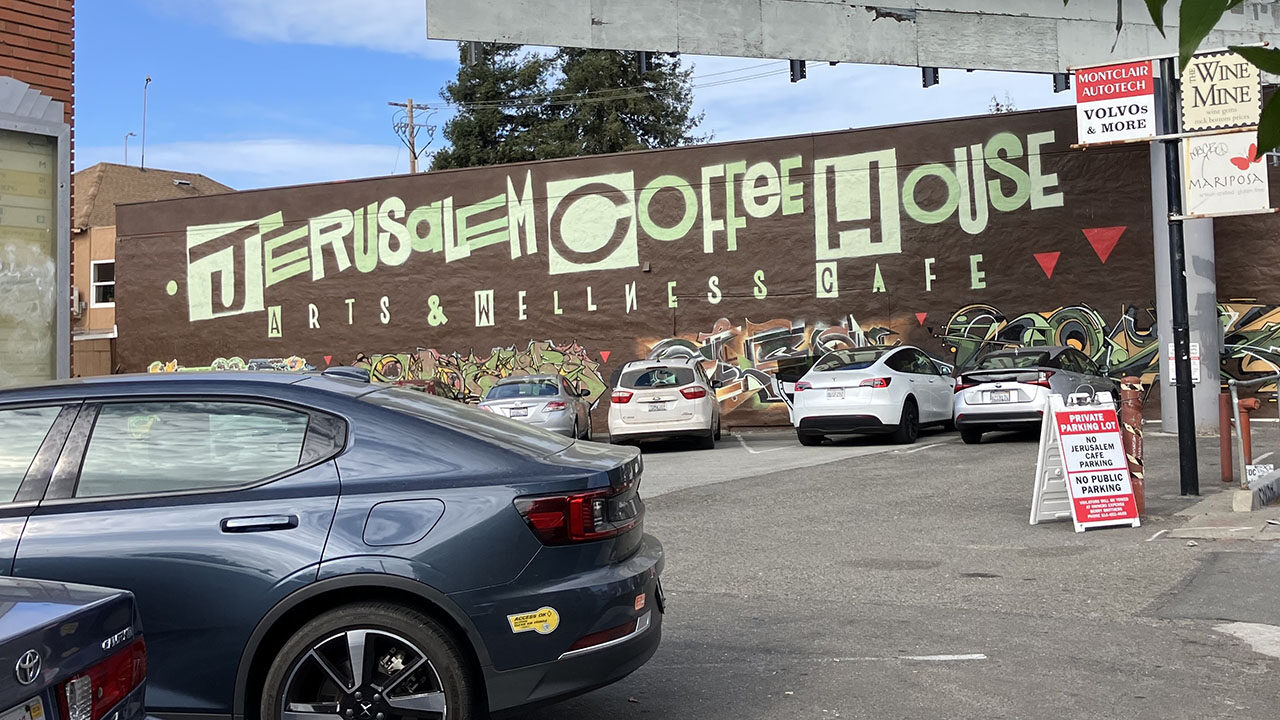
Jerusalem Coffee House, which often hosts political events, advertises itself as “rooted in revolution.” A mural on its exterior wall includes inverted red triangles.
The DOJ suit is one of three filed this year against the coffee shop. The Anti-Defamation League filed a lawsuit in U.S. District Court in February, representing Radice. The Brandeis Center for Human Rights Under Law sued the coffee shop in Alameda County Superior Court in March, representing Hirsch.
Both the Hirsch and Radice suits seek damages for civil rights violations, plus attorney fees and any “other relief” that the court may find appropriate. Title II of the Civil Rights Act does not authorize the DOJ to seek monetary damages, according to a DOJ press release announcing the lawsuit. Instead, the DOJ asked the court to require Harara and the Jerusalem Coffee House “remedy the effects” of their past conduct and prevent any discriminatory practices in the future.