

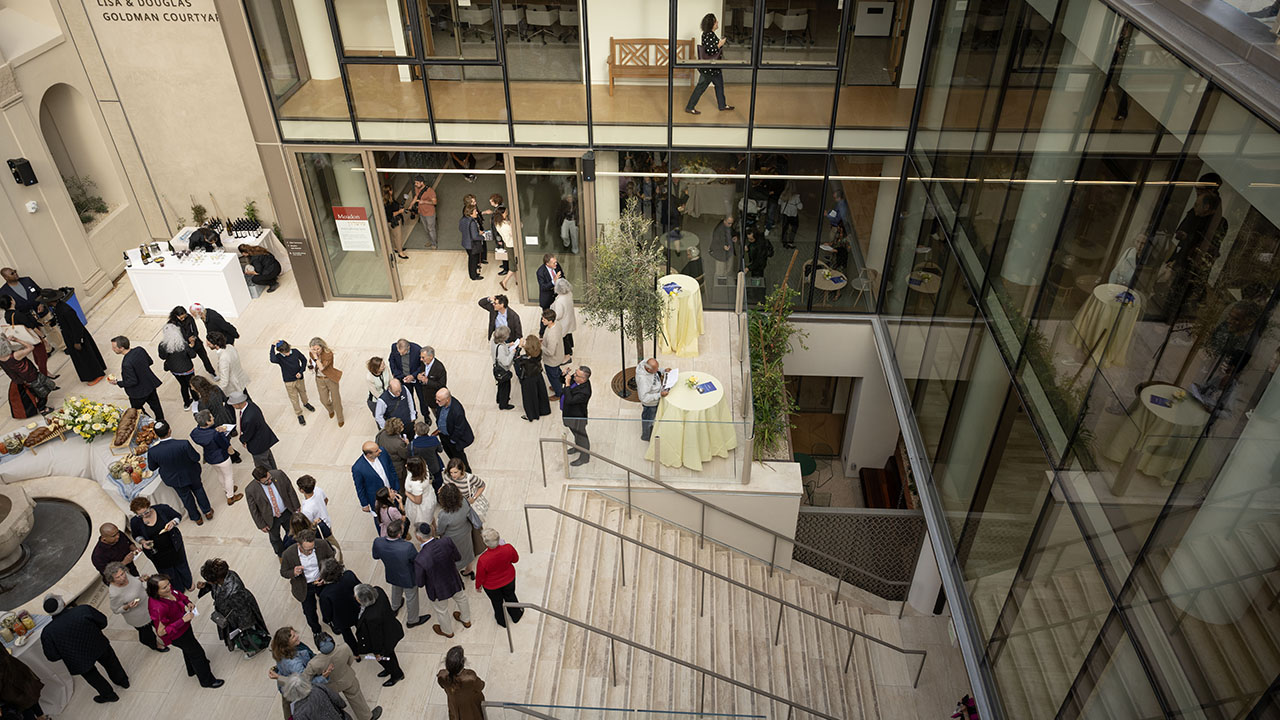
While hundreds milled about, admiring the newly built and radically renovated parts of Congregation Emanu-El in San Francisco, Dana Shapiro, 81, stood in a less trafficked hallway.
She was hunting for her own face among rows of confirmation class photos from decades of Emanu-El history — she couldn’t remember if it was 1959 or 1960.
Her husband, Gary Shapiro, 83, stood nearby. They married in Emanu-El’s grand main sanctuary in 1964. The reception was downstairs in what was then a basketball court.
In other words, Emanu-El has been a part of their lives for a long time.

“The sanctuary was always gorgeous. But the rest of it was just rooms, rooms,” Gary said. “Except for the basketball court!” he added with a smile.
And what do they think of the newly completed, $97 million renovation, expansion and seismic retrofit of their 175-year-old synagogue’s 100-year-old building?
“We think it’s great,” Dana proclaimed.
About 1,200 people attended the grand reopening and Shabbat service on Sept. 12. Visitors, synagogue members and civic and religious leaders from across the city shmoozed and noshed as they gushed over the results of the project.
Also in attendance were District Attorney Brooke Jenkins, S.F. supervisors and San Francisco Mayor Daniel Lurie, a member of Emanu-El.

Rabbis, staff and lay leaders who led the massive fundraising and construction project beamed all night. The mood was upbeat and partylike, as a brass band led by Jewish community musician-about-town Jonathan Bayer played in the Reform synagogue’s expanded central courtyard.
Perhaps unique in the history of synagogue building projects, there was no kvetching to be heard among the throng. Leaders of the 2,000-household synagogue, the largest in the region, said they had prepared for some nitpicking following such an expansive project.
“We spent a lot of mental energy on ‘What do we do when people ask why we didn’t do this, or fix that, or why did we change this?’” executive director David Goldman said. But so far, those complaints have not emerged.
Planning began over a decade ago when synagogue leaders realized they had a ticking seismic timebomb on their hands. (Indeed, Emanu-El’s previous building was destroyed by the 1906 earthquake.) Emanu-El was built, essentially, on sand — and well before modern seismic building codes. A seismic retrofit of the building would be a huge undertaking on its own, but Emanu-El went much bigger and further, adding 30,000 square feet of usable area under a plan created by the architectural firm Mark Cavagnero Associates.

In the end, just three spaces are recognizable: the massive domed main sanctuary, the midsize Martin Meyer sanctuary, and the small chapel. Everything else has changed.
There is a new floor below street level, including a warren of offices that seem to be magically illuminated by a pair of open-air light wells. The grand arched main entrance of the synagogue, long closed due to security and accessibility concerns, has been overhauled. And the social hall has been spruced up; its design includes a bar area an pieces of carved stonework that were saved from the courtyard during the renovation.
An existing two-story wing of classrooms now has a third floor, which will house Emanu-El’s preschool. It opens onto a roof-deck playground that offers a stunning, up-close perspective of the synagogue’s iconic dome.
For Goldman, that new view is the cherry on top of the whole project.
“There are now views of the main sanctuary, which is an architectural and historical treasure, that no member has ever seen until now,” he said. “There is awe and inspiration and beauty up there that no one has seen, ever. And you can see details on it that, maybe it’s just me, but I didn’t know they were there!”

The reopening of the main entrance makes the architectural symbolism intended by the building’s original designers more intelligible. Architect Arthur J. Brown, who also designed San Francisco City Hall, used symbolic elements of the ancient Second Temple in Jerusalem, including a grand approach to a central open space at the top of a stairway.
“I’ve oftentimes thought about our ancestors,” Senior Rabbi Ryan Bauer said. “They built those seats for us. … They had no idea what the next 100 years would bring, but they were thinking about us,” he said.
In updating what those ancestors built, Emanu-El had to think about the next hundred years of San Francisco Jews. Said Bauer, “We have no idea who they’re going to be — but what do Jews do? We care about the next generation.”
Some of the changes to the facility point not just to the growth of Emanu-El and the passage of time, but also to changes in what people need and want from their synagogues.
“In the ’20s, they kind of said, come to High Holidays and leave. We’ll see you next year,” said former Senior Rabbi Jonathan Singer. “Today, we’re creating smaller gathering spaces, stickiness, a sense that people can come and explore, that we’re teaching Jewish identity to people at every stage of their life.”

He and his wife, former Senior Rabbi Beth Singer, retired from Emanu-El last year — but they were the congregation’s leaders through most of the project.
“I am just ecstatic with how it turned out,” he said.
And the mood remained ecstatic throughout the Shabbat evening service that followed the poking around and shmoozing portion of the event.
There was a significant delegation in attendance from the San Francisco Interfaith Council, of which Emanu-El has long been an active member. A cavalcade of colorfully attired Christian clergy and one Muslim community member offered their well wishes from Emanu-El’s grand, multilevel bimah — including the Catholic Archbishop Salvatore Cordileone, his black and red robes a fine contrast to the white and green marble of the bimah.

During the service, Lurie spoke alongside his father, Rabbi Brian Lurie, a former Emanu-El senior rabbi. The mayor talked about the importance of the synagogue as a gathering place “in a very divisive time.”
“It’s places like Temple Emanu-El that bring us together, and we need more spaces like this,” he told congregants and guests.
“I will admit part of me wishes I had been able to come to Sunday school in a building like that,” the mayor joked, gesturing in the direction of the updated classrooms.
“But what matters most is knowing that the next generation will study here, prepare for their bar and bat mitzvahs and grow within this community,” he said. “This congregation has been part of San Francisco’s story for 170 years. Founded in 1850 during the Gold Rush, it has been part of every era, the aftermath of the 1906 earthquake, the Depression, the Loma Prieta earthquake, and the changes that have defined our city. Through all of it, Temple Emanu-El has been a place of faith, learning and refuge for Jewish families and non-Jewish families across San Francisco.”

When the project was announced in 2019, the estimated cost was $72 million. Then came the pandemic. By the time the Emanu-El broke ground in 2023, inflation and increased material and labor costs meant the price tag had grown. The final $97 million cost was completed within budget. Emanu-El raised another chunk of change on top of that: $18 million to replenish the congregation’s sizable endowment, which will be much needed as there is now a larger facility to maintain.
Even for a synagogue of Emanu-El’s size and wealth, it was an enormous undertaking and an expensive project. But many members were happy to contribute to the effort.
“We gave the largest charitable contribution we’ve ever given to any organization in our lifetime, but we really made a stretch because we felt this was worth it,” said Gary Shapiro. Added Dana, “This is about the future of Jewish children in San Francisco and the Bay Area.”