

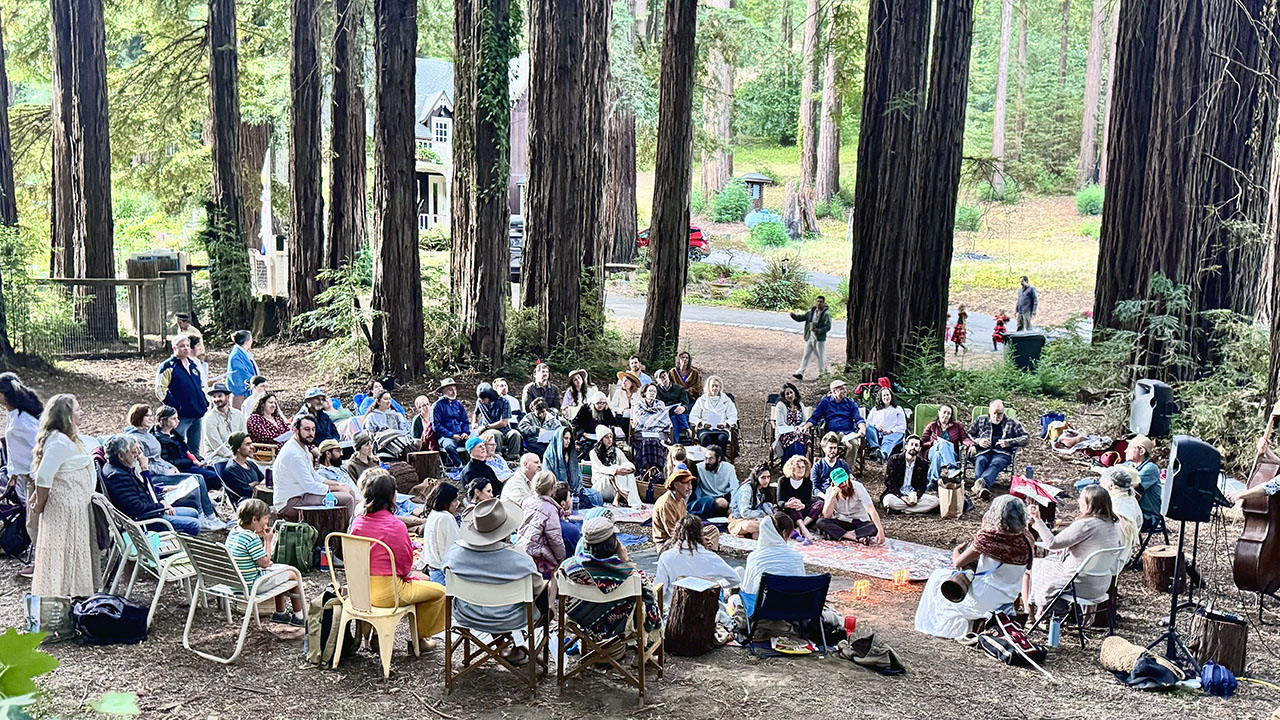
Inside a “fairy ring” of young redwoods that sprang up around the downed trunk of an older tree, a new congregation has begun praying together in the tiny, rural town of Occidental.
Makom Shalom — aka the Forest Synagogue of West Sonoma County — is the most recent addition to the local communities inspired by Earth-based Judaism and Jewish Renewal.
It’s led by Rabbi Zelig Golden, who has spent the past two decades in both camps, as founding director of Berkeley’s Wilderness Torah from 2007 to 2024 and as a rabbinic student at Aleph, the Renewal movement’s seminary, where he was ordained in 2018.

When Makom Shalom describes itself as a “new congregation,” it’s no exaggeration. Its website only went up in mid-August, and so far it has hosted three Kabbalat Shabbat services that have attracted scores of worshippers.
Founding board member Yael Marmar, a local real-estate agent who grew up at Conservative Congregation Kol Shofar in Tiburon, said that the core group of Makom Shalom are people previously involved in Wilderness Torah who wanted to continue in the same spirit in the North Bay. (Wilderness Torah has been restructuring over the past two years and just became part of the national Jewish environmental group Adamah.)
Marmar said that a number of Jews have recently moved to the area, mostly from the East Bay, and that there was already a small but active Jewish community in and around Occidental. The town, which has about 1,100 residents, is tucked into the redwoods roughly halfway between Santa Rosa and the coast.
The congregation invites Jews as well as non-Jews to join. “There are a lot of ‘Jew-curious’ people,” Marmar said.
Makom Shalom has secured indoor space at a local public school for the coming winter months, but congregants will pray inside only when absolutely necessary.

“I think the goal is never to have a building if we don’t have to, and to be able to pray outside, under the trees, under the stars, near water,” she said. “It’s pretty incredible. For example, during the Amidah [the central prayer of Jewish worship services], people disperse and find their place in nature. Someone sits by a tree, someone looks up, someone lays down in the grass. It’s connecting to God through nature.”
It might seem to those who know Golden that creating and leading a Jewish congregation was a slam-dunk decision for him, in line with his career up to now. In addition to Wilderness Torah, he has run Jewish men’s groups, officiated at lifecycle rituals, lectured widely on Jewish practice, and helped create Aleph’s Earth-based Judaism certification program, among other things.
However, he said, founding a congregation was never one of his goals. It all just came together “synchronistically” after stepping away from an adviser role with Wilderness Torah this spring and as a Jewish community began to take shape in Occidental, where he lives with his wife, Rachel Ruach-Golden, and their three children.
The core group that became Makom Shalom’s five-member board and its two part-time staff members — Golden and executive director Christina Leigh Penrose — put out the word on social media in May, inviting people to discussions focused on what they wanted spiritually.
Makom Shalom, which means “place of peace,” was the result.
So what does a Makom Shalom service look like?
“It’s a traditionally rooted Kabbalat Shabbat that is also in a Jewish Renewal spirit,” Golden said. “It’s similar to what we did at Wilderness Torah, but we’re tweaking and evolving.”

For example, he said, they chant the entire Lecha Dodi, the liturgical song traditionally used to welcome the Shabbat Queen, whereas most non-Orthodox congregations sing only some of the verses.
“We’re working on bringing some of the full liturgy back because there’s a yearning for some of the more traditional elements,” he said.
Marmar said the board recently created a membership structure and is also selling tickets for Rosh Hashanah and Yom Kippur at makomshalom.org. Services for both will take place outside, of course, in the redwood grove — weather permitting.
And Yom Kippur will feature something unusual: a “sacred fire” that will burn all 25 hours of the holiday.
Halachah, or Jewish law, prohibits the kindling or tending of fire on Shabbat or a holy day. But Golden wrote his “teshuvah,” Aleph’s equivalent of a rabbinic thesis, on why he believes such a fire is permissible within the context of Yom Kippur from an Earth-based perspective.
“If the essence of Rosh Hashanah is the shofar, then the essence of Yom Kippur is the Vidui, the confessional. And my approach to the confessional isn’t just words to be spoken, but energy to be moved,” he said. “We have to acknowledge the things we have done that have missed the mark, and feel deep remorse, but ideally we also move that energy so we can continue in our relationships and in our lives in a really good way.”
Building and using a fire for the purposes of helping people circulate energy as they pray is, he said, a powerful tool for renewal and key to the Yom Kippur experience.
“When you have good intention and you make a prayer and an offering into that fire, you actually can transform that energy,” he said. “The sacred fire offers us that. So why wouldn’t we put that fire in the middle of Yom Kippur?”