

Anita Friedman didn’t set out to make a murder mystery.
When the longtime executive director of the S.F.-based Jewish Family and Children’s Services first visited her father’s native village in Poland 20 years ago, she planned to document the story of her family and the other Jews who lived there before World War II, virtually all of whom were murdered in the Holocaust. She hoped to use what she came up with as part of Holocaust education in public schools, a major focus of the JFCS Holocaust Center.
“I wanted to use the story of my town as a lens through which to tell the story of the Jews of Poland,” she told J. “But things started to unfold.”
“Among Neighbors,” directed by award-winning Berkeley filmmaker Yoav Potash, tells the brutal tale of the murder of a Jewish family in the village of Gniewoszów after the war — not by the Nazi occupiers but by their own Christian neighbors, a horrific event that was repeated in about a dozen post-war Polish towns, with more than 1,000 victims.
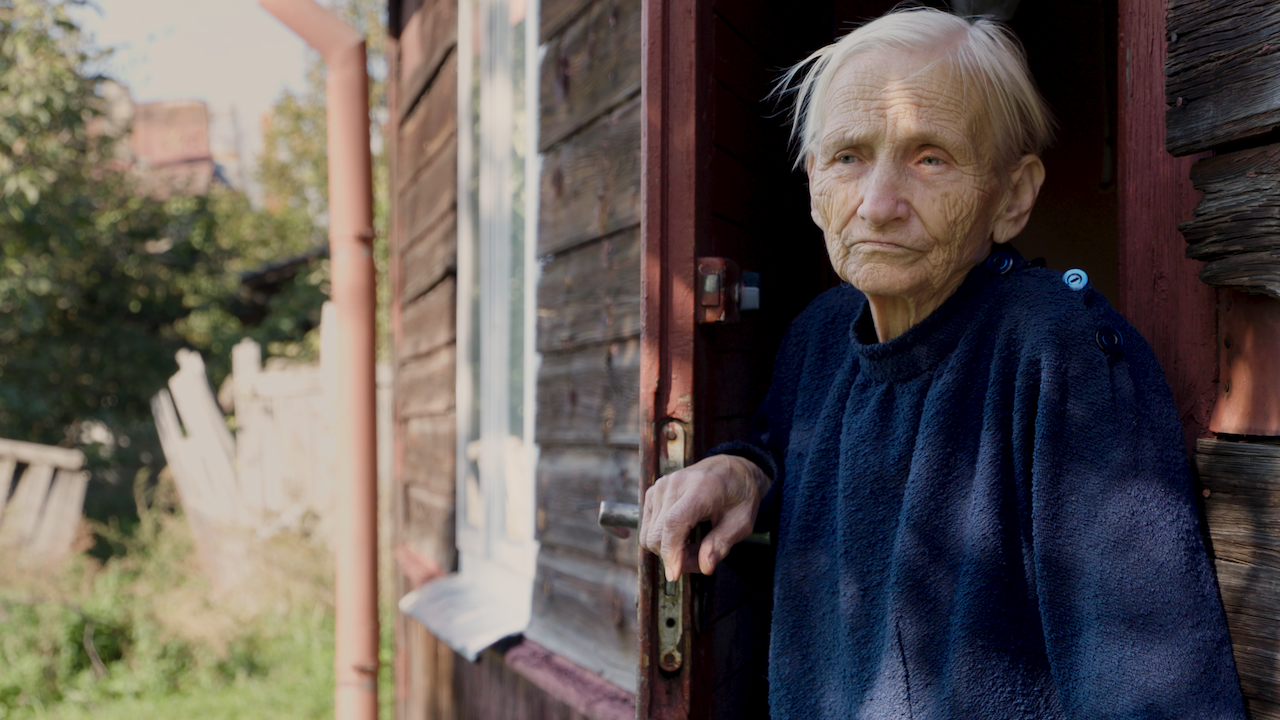
This disturbing chapter in the town’s history has never been publicly acknowledged, and it took 10 years for Potash and his team to complete the film. Through interviews with elderly villagers still living in the town, as well as with rabbis and experts on Polish Jewish history — notably the testimony of one brave non-Jewish woman who witnessed the killings — Potash weaves a powerful and, at times, beautiful tale of human suffering, longing and resilience.
“Among Neighbors” has screened at film festivals and other venues in Israel, Poland and the U.S. since last fall. It opens this month in theaters across the country, including at San Francisco’s Vogue Theater, where it will run from Oct. 24 to 30 and at the Lark Theater in Larkspur on Oct. 29 and 30. After most screenings, there will be a Q&A that includes Potash and Friedman, who became the film’s executive producer.
This all began in 2005, when Friedman and her three sons first visited Gniewoszów. Friedman, whose parents both survived the Holocaust, grew up listening to her father’s stories of pre-war life in the village, which was, he told her, more than half Jewish. Not all his memories were positive, but in general he recalled that the Jews and non-Jews got along well, living side by side. He was on a business trip outside Gniewoszów in September 1939 when the Nazis invaded; the rest of his family was murdered in Treblinka.
That first visit did not go well. Friedman and her sons were chased out of town by thugs who called them “Zhid,” Polish for “Jew.” But she returned several times, including in 2014 for a rededication of the town’s Jewish cemetery, which had been neglected and desecrated. This time, the whole village turned out to welcome her.

By then she had contracted with Potash to make a documentary. After the rededication ceremony, he decided to stay on, poke around and see whether any of the locals would talk to him. That’s when the story of the post-war Jewish murders began to emerge and the film took a darker turn.
A year later, the Jewish Historical Institute in Warsaw contacted Potash and Friedman to say they’d received a handwritten letter from an elderly woman in Germany who claimed to be from Gniewoszów. She said she’d witnessed the murders and “wanted to set the record straight,” Potash recalled.
Friedman paid to bring the woman, Pelagia Radecka, back to the town she had left decades earlier so she could be interviewed where it all happened.
“She had a lot of fear about being in the town,” Potash said. “She would go there from time to time, and she would snoop around, but she would never tell people about the murders. She felt that it was too much, too close to touching the third rail.”
But the killers were dead by 2015, and Radecka, no longer afraid of retribution, wanted a Jewish organization to help her find her lost love, the son of two of the people murdered after the war, the boy she’d spent her life searching for: Janek Weinberg.
“So now, the town’s dark secret that had compelled me to decide to make a documentary suddenly got elevated and deepened by the woman who knew that story best and was most intimately connected to it because she knew the victims. She admired them. She had a huge ache in her heart about the fact that they had been killed,” Potash said. “She went through a trauma herself as someone who had witnessed it, and as someone who was threatened by the killers and carried for her whole life this tremendous heartache about what had happened.”

Along the way, the film crew found another elderly person from Gniewoszów, a Jewish Holocaust survivor living in Israel named Yaacov Goldstein. In just one example of how stories are interwoven in this town’s history, Goldstein had attended the pre-war cheder (Jewish primary school) in Gniewoszów run by Friedman’s grandfather.
Goldstein’s and Radecka’s memories of life in Gniewoszów before and just after the war are illustrated in this film by gorgeous hand-drawn animation created by two international teams. That creative flourish lifts the tale from straight documentary into the realm of magic realism, evoking a lost world with beautiful delicacy.
The film is full of questions. Does Radecka ever find her lost love? Are the murderers ever brought to justice? Do the villagers come to grips with what happened in their town, or do they continue to obfuscate and deny?
The task of finding out what really happened is complicated by Poland’s own obsession with refusing to admit that any Poles collaborated with the Nazi occupiers. In 2018, in fact, a law was passed in Poland making it illegal to suggest such collaboration in public speech; criminal penalties were later removed, but the law remains in place.
“It’s a controversial topic,” said Friedman. “Many people in Poland today want to tell the story. On the other hand, another element of society, the nationalist element, does not want to acknowledge there was collaboration with the enemy. Like every other society, Poland is grappling with how to address its difficult history.”
Even before its theatrical release, Friedman said, the film has gotten “a lot of traction.” Through the State of California’s agreement with the JFCS Holocaust Center, it will be screened at every public high school in the state as part of mandated Holocaust education. Friedman hopes to replicate that nationally.
In April of this year, the film had a national primetime broadcast in Israel to coincide with Yom HaShoah, and the film began streaming in Israel. Now a deal is in the works for a national broadcast in Poland, and the film is beginning its theatrical release in the United States, including a campaign for all the major film awards. Friedman is pleased.
“When I brought Yoav in to make the film, I told him I wanted it to show the truth. I didn’t want to deify the Poles, or demonize them. I wanted [viewers] to understand it in all its complexity,” Friedman said.
“The truth is there is both tragedy and triumph in this story. That underlies why education is so important to understand the moral choices people make under difficult circumstances.”