

The oldest description of breast cancer dates back to about 3000 BCE in Egypt, but the disease wasn’t mentioned in our pages until 1953.
Three local doctors performed a groundbreaking (but now severely outdated) experimental surgical procedure for the first time on a human patient that year. It involved removing the adrenal glands and placing a small portion of one of them near the spleen to slow (though not stop) the development of breast cancer.
The understanding and treatment of breast cancer has changed dramatically, from rudimentary surgeries in the early to mid 20th century to targeted therapies, genetic testing and personalized medicine today.
October is recognized globally as Breast Cancer Awareness Month, a time dedicated to supporting those affected by the disease and promoting early detection and more research. Once taboo and little understood, breast cancer is now symbolized by the iconic pink ribbon and supported by awareness campaigns, fundraising and advocacy.
In a matter of decades, the survival rates and quality of life for many patients have improved dramatically. One crucial breakthrough was the discovery of the BRCA1 and BRCA2 gene mutations, which are strongly linked to hereditary breast and ovarian cancer. Ashkenazi Jewish women are disproportionately affected. They are about 10 times more likely than the general population to carry mutations in these genes, according to Sharsheret, a Jewish organization that supports people diagnosed with or at high risk of breast and ovarian cancer.
The breast cancer survival rate in the early 1950s is difficult to determine but at least one study from the MD Anderson Cancer Clinic estimates it was as low as 25%. That compares with today’s survival rate of more than 90%, according to the National Breast Cancer Foundation.
In 1955, a significant effort began at San Francisco’s Mount Zion Hospital (now a campus of the UCSF Medical Center) toward decreasing the fatality rate. That year, the same three doctors mentioned above — Donald E. Bernstein, Gerson R. Biskind and A. Lincoln Brown — made headlines again for their “discovery of a new surgery for cancer of the breast.”
This time, we wrote, they successfully removed and transplanted the “ovaries to a position next to the bowel wall where their secretions, particularly estrogen, are forced to filter through the liver. It was already known that the female hormone estrogen stimulates the growth of some breast cancer, and that the liver somehow rids estrogen of its cancer stimulating power.”
The surgery was performed on “a number” of unnamed women and was considered successful because “besides causing shrinkage or disappearance of some cancers, the operation has relieved patients of pain, restored their appetite, resulted in substantial gains in weight and sent some patients back to their normal useful routines.”
While on the cutting edge at the time, such transplantation procedures are now considered ineffective in treating breast cancer.
Over the next few decades in the U.S., radical mastectomies became standard practice. In this surgery, the entire breast, all of the lymph nodes under the arm, and sometimes the chest wall muscles were removed in a single procedure at the same time a biopsy was performed if cancer was found. Although radical mastectomies were a generally effective treatment, the procedure was intense, leaving patients disfigured and often traumatized.
By the 1970s, breast cancer became recognized as one of the leading causes of death for women in the U.S. and began to shed its taboo status.
In 1972, the first in a series of chilling advertisements by the Cancer Awareness Plan titled “Cancer Will Strike” were featured in our pages. The ads doubled as public service announcements that listed facts, symptoms and statistics about the disease from the National Cancer Institute. They warned that breast cancer “causes more deaths than any other form of cancer” and advised women to purchase separate cancer-specific insurance policies. In 1973, three years before the American Cancer Society began recommending routine breast cancer screenings, one of these ads urged readers to conduct monthly self-examinations to search for possible tumors.
The Bay Area Jewish community began organizing seminars, panels, classes and fundraisers that aimed to better understand, treat and prevent the disease.
In the 1980s, research showed for the first time that Jewish women had a slightly higher incidence of breast cancer than other women. Experts at the time believed that this was due to diet and health habits, we wrote, such as “eating richer, fatty foods, consuming little fiber and exercising little or not at all.”
Dr. Ernest H. Rosenbaum, a cancer specialist at Mount Zion Hospital, even theorized that “there is probably not a genetic predisposition for breast or colon cancer in Jewish women and they are probably at the same risk as other Caucasians.” (This is now known to be completely wrong.)
Although understanding and treating cancer had come a long way, the disease remained a mystery.
“After a hundred years of research we still don’t know the exact cause of cancer except for smoking-related diseases such as lung cancer,” Rosenbaum acknowledged in 1986.
“Jewish women should shop smartly and buy fiber and low-fat foods,” he advised. “They should learn to be clever cooks, using less butter and schmaltz, and to be conservative about their eating habits.”

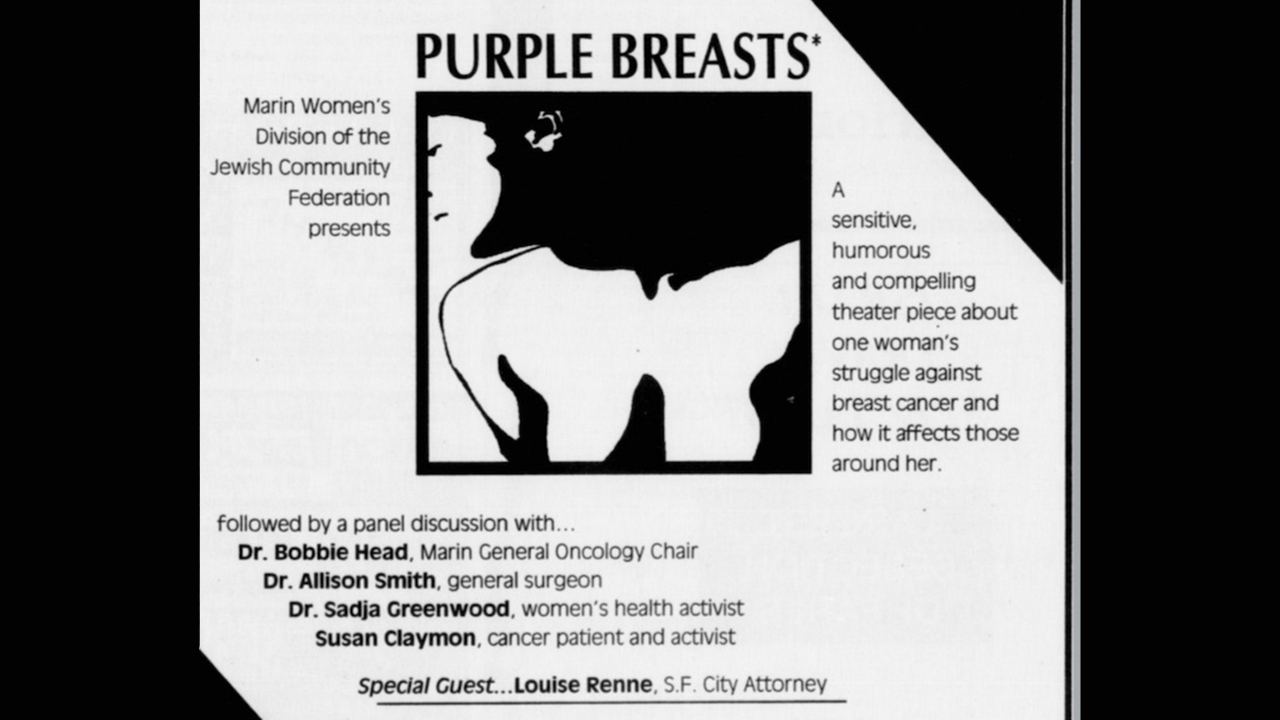
With the beginning of third-wave feminism in the early 1990s, more women than ever were speaking out about breast cancer, advocating for more research and better treatments and addressing the trauma of disease for patients and their loved ones. Our publication featured stories about plays, poems and memoirs that tackled topics like grief, faith, identity and even post-mastectomy sex.
In 1991, our staff reporter Tamar Kaufman wrote intimately about her battle with breast cancer.
“Officially, it’s not a ‘Jewish disease,’ but it feels like one,” she reflected. “While I was undergoing chemotherapy, it seemed everyone in the Jewish community knew someone who either had breast cancer or had had it in the past. The American Cancer Society says that being a Jewish woman of European ancestry is a high risk factor as are the high-fat, low-fiber foods central to Ashkenazi cooking. How much damage did Grandma’s grivenes do? My cousins and I used to fight over the combination of fried chicken fat, skin and onions; I have to admit, the memory has my mouth watering again.”
The next year, Kaufman wrote about the ethical questions raised by the Human Genome Project, an international scientific research effort partially based at UCSF to map and sequence all human DNA. There was much speculation about DNA and genetics during this time. Then, a huge breakthrough occurred with the discovery of the BRCA1 gene in 1994 and the BRCA2 gene the following year.
Tragically, also in 1994, Kaufman died at age 45 from her third bout of cancer, which had spread to her brain.
“Despite a new report warning that Ashkenazi Jews have a significantly higher genetic predisposition to breast cancer, researchers and activists say women should not panic,” reported then staff writer and now senior editor Natalie Weinstein on the matter in 1995.
“I don’t think all women should run out and get tested,” said Dr. Debu Tripathy, a medical oncologist in UCSF-Mount Zion Cancer Center’s breast care division. “We don’t quite know what to do with the information yet.”
The following years saw rapid advancements in breast cancer research and treatment as understanding grew about the BRCA1 and BRCA2 genes. Although Jewish women were not advised to receive genetic testing three decades ago, today it has become a common method of cancer prevention.
In 2000, a study of the BRCA genes found that while the mutation increased the chances of carriers developing breast and ovarian cancers, it also made them more responsive to chemotherapy. It was a long-awaited positive finding after years of bad news for Jewish women.
A 2008 cover story in our pages explored the plight of young Jewish women who carried BRCA gene mutations as they weighed their options for breast cancer prevention and treatment. While still an extremely difficult experience, women shared how they felt more empowered to choose the care plan that was best for them compared with breast cancer patients of the past.
Mara Langer, then 40, had faced cancer twice, the first time when she was 30. She had both her breasts removed after her first cancer diagnosis.
“You finally have a way of making a decision, of getting in front of the cancer and telling the cancer, ‘I’m taking care of this. I’m getting every last morsel of you out of me,’” she said.
Langer has now been cancer free for over a decade. She currently lives in Reno and is the director of community engagement for Jewish Nevada, and has continued to be an advocate for genetic testing and early cancer detection.