

In Silicon Valley, where technology is part of everyday life, one Jewish K-8 school is exploring what it means to integrate AI into the classroom.
Gideon Hausner Jewish Day School in Palo Alto has launched a pioneering “AI Tinkery” program, an interactive, student-centered initiative that aims to explore artificial intelligence through a Jewish ethical lens.
The program idea came from Smita Kolhatkar, Hausner’s assistant head for innovation, responsible AI and ed tech. Kolhatkar has been at the school for nearly a decade, but before she became an educator she worked in technology at Oracle for 15 years.

All schools are grappling with how or whether to incorporate AI into the classroom, but at Hausner, “we realized we needed to integrate AI into our school’s culture and values, not just teach it as a tech subject,” Kolhatkar explained. “That includes bringing it into the Jewish realm, into Hebrew and into ethical discussions.”
The inspiration came after Kolhatkar visited the Stanford Graduate School of Education’s “AI Tinkery” initiative. There, she saw how low-tech, hands-on approaches like sticky notes and bulletin boards could make AI more approachable and less intimidating, especially for younger students.
“What I saw there made me realize how accessible AI education could be,” said Kolhatkar, who oversees the school’s Hausner Makers. “We didn’t need fancy equipment to get started.”
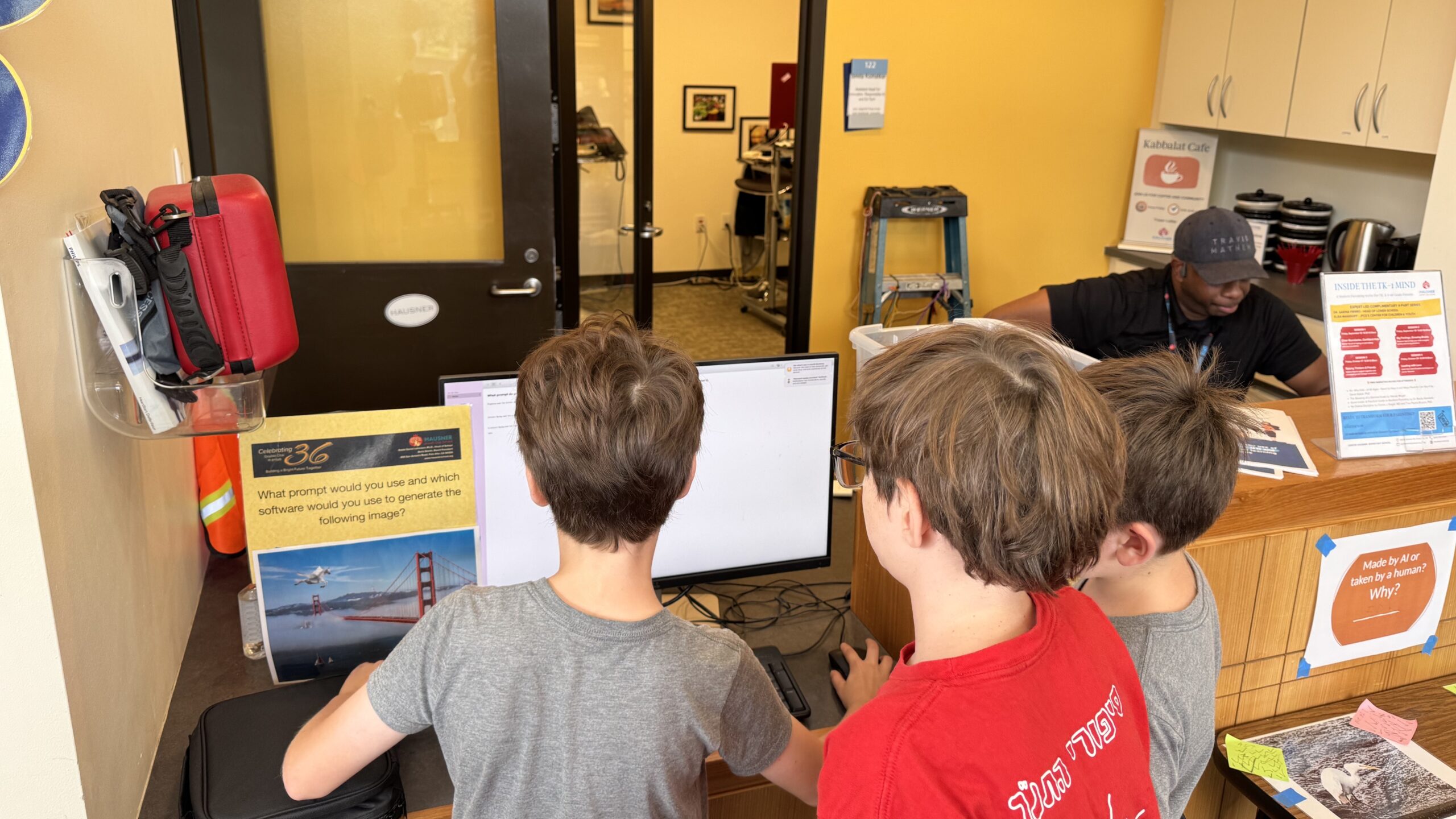
At Hausner, she identified an unused lobby area, repurposed it with bulletin boards and a screen, and launched what has now become a vibrant, ever-evolving space for students to explore and question the role of AI in their lives.
The AI Tinkery space is eclectic by design. There’s a rotating set of hands-on activities, from games and unplugged computer science puzzles to a whiteboard filled with student questions. They range from technical curiosity (“How much energy does a data center use?”) to philosophical depth (“Can AI ever develop empathy?”)
In the spirit of Jewish education and critical inquiry, nothing is off the table.
Recently, students analyzed pictures of pomegranates for Rosh Hashanah, practicing how to discern AI-generated images from human-made photographs. Another week, they were asked to reverse-engineer the prompt that might have generated a surreal AI image. There’s even knitting and braiding, which may seem unrelated at first, but actually introduces the foundational concept of pattern recognition, which Kolhatkar says is key to understanding both human creativity and machine learning.
“They have the world at their fingertips,” Kolhatkar said, noting that phones today have more computing power than a computer had a few years ago. “We have to teach them to search correctly and to use that device appropriately.”
She says that the nuts and bolts of integrating AI into teaching is not that different from previous waves of technological advances, but that the importance of subject matter is far greater than before.
“I think what is different in this case is that the risks associated are high,” Kolhatkar said. “The stakes are higher than they used to be.”
Tal Binyamin, Hausner’s marketing manager, noted that the school is uniquely positioned at the crossroads of millennia-old Jewish wisdom and the cutting edge of modern tech.

“We’re not just in Silicon Valley, we’re part of it,” Binyamin said. “But we also bring this deep tradition of ethical reflection. Our head of school Rabbi Danny Lehmann constantly emphasizes that we must root all this in our Jewish values.”
The connection between AI and Jewish values is not a new observation. In 2021, a Stanford University Ph.D. created an AI “Robo-Rabbi” to offer advice over the High Holiday season, and earlier this year J. ran a series exploring AI and Judaism.
In addition to the AI Tinkery space, the school is forming a parent-staff committee to draft guidelines around the use of AI in educational contexts. Kolhatkar and Binyamin stressed that due to the rapidly changing landscape of AI technology, broad and flexible guidelines that are regularly assessed are more sustainable than a rigid set of rules.
“AI isn’t all good or all bad. It depends on how we choose to use it,” said Kolhatkar. “And that’s what we want our students to start thinking about now.”
As AI rapidly becomes a part of everyday life, Hausner is committed to making sure students don’t just consume these tools passively, but understand them critically. The initiative includes a speaker series starting this fall, where industry professionals, including parents from the school community, will share how AI is impacting fields like health care, agriculture and human resources.
The school also recognizes the importance of parent involvement and cultural considerations. Binyamin said around 40% of Hausner families are connected to Israel, where children commonly receive smartphones earlier than in the U.S. To that end, the school is not only educating students but also working with parents to create a consistent message around digital and AI literacy.
“We need the village,” said Kolhatkar. “The school will do its part, but parents have to do theirs, and so do the students.”
Rather than adding AI education as an “extra,” the school is integrating it into existing programs. Beginning in second grade, “digital citizenship” lessons include age-appropriate discussions on AI. In grades 5-8, AI literacy becomes more explicit, folded into computer science classes.
Importantly, Hausner’s approach doesn’t aim to replace foundational skills like essay writing or penmanship. In fact, traditional skills remain front and center, even as the school adapts to changing times.
“It’s not about pushing the old stuff out,” said Binyamin. “It’s about building a bridge between timeless skills and modern tools.”
Ultimately, Kolhatkar says, the AI Tinkery program is about far more than technology. It’s about instilling a mindset of curiosity, responsibility and critical thinking and raising students who are not only ready for the jobs of the future but prepared to shape that future with wisdom and empathy.
“When people talk about AI in schools, they often focus on fear or hype,” said Kolhatkar. “But our approach is about understanding. The better we understand it, the more responsibly we can use it.”