
Food coverage is supported by a generous donation from Susan and Moses Libitzky.
Sometimes, you just want a burger. But you’re also a discerning eater who cares where your meat comes from — no factory-farmed meat for you.
Enter Roam Artisan Burgers, which has been catering to such consumers for many years now. It was founded by business partners Joshua Spiegelman and Lynn Gorfinkle, who cooked up their plan after a chance meeting at Congregation Emanu-El’s “Late Shabbat” in 2009. (Known for sparking romantic relationships, the Friday night service for young adults apparently can spark business partnerships, too.)
They first connected in 2004, when Gorfinkle was running a cooking school and Spiegelman had written a business plan for a “better-for-you” burger place while obtaining his MBA at UCLA. They talked about working together on the idea, but the timing wasn’t right.
When they met again five years later, they had both left their jobs and were ready to work on and improve Spiegelman’s plan. From the start, Gorfinkle said, it was clear that “we both share a similar passion for really delicious, high-quality, sustainable food, and trying to make a positive impact on the planet and thinking about how people can thrive from what they put in their bodies.”
Clearly, Roam Artisan Burgers is doing something right, as it just celebrated its 15th anniversary this past June. The fast-casual restaurant chain specializes in healthier burgers made from pasture-raised and grass-finished beef and organic ingredients from local farms. It now has five locations: two in San Francisco, two in the East Bay (Lafayette and San Ramon) and one in the North Bay (Corte Madera). Roam has also introduced a new catering menu featuring sliders.
Spiegelman, 49, grew up in Mill Valley and San Rafael, where his family attended Congregation Rodef Sholom. His mother did most of the cooking, he said, but on weekends he’d join his father and brother in the kitchen where they would collaborate on elaborate dishes like paella.

As a young man, he spent several years living abroad in Spain and Japan, and he came to see food as a gateway to learning about other cultures. While in business school, he developed a side interest in nutrition. It was eye-opening, he said, to see the contrasts between obesity-causing diets in America and healthy diets in Japan that allowed people to live longer lives.
In Japan, “no one thinks about dieting,” Spiegelman said. “The food is inherently healthy.”
Meanwhile, Gorfinkle grew up in the predominantly Jewish town of Mamaroneck in Westchester County, N.Y., where her home was kosher and she attended Jewish day school. Judaism was infused in everything her family did, she said, which included the food they ate. She said she also felt Judaism taught her about taking care of the planet.
While working for Viking Ranges, she wrote a curriculum for a Jewish cooking class that was taught around the country. “I worked with some folks in Mississippi who had little to no knowledge of Jewish holidays,” she said. “They had never had haroset before and said things like, ‘where has this been all my life?’”
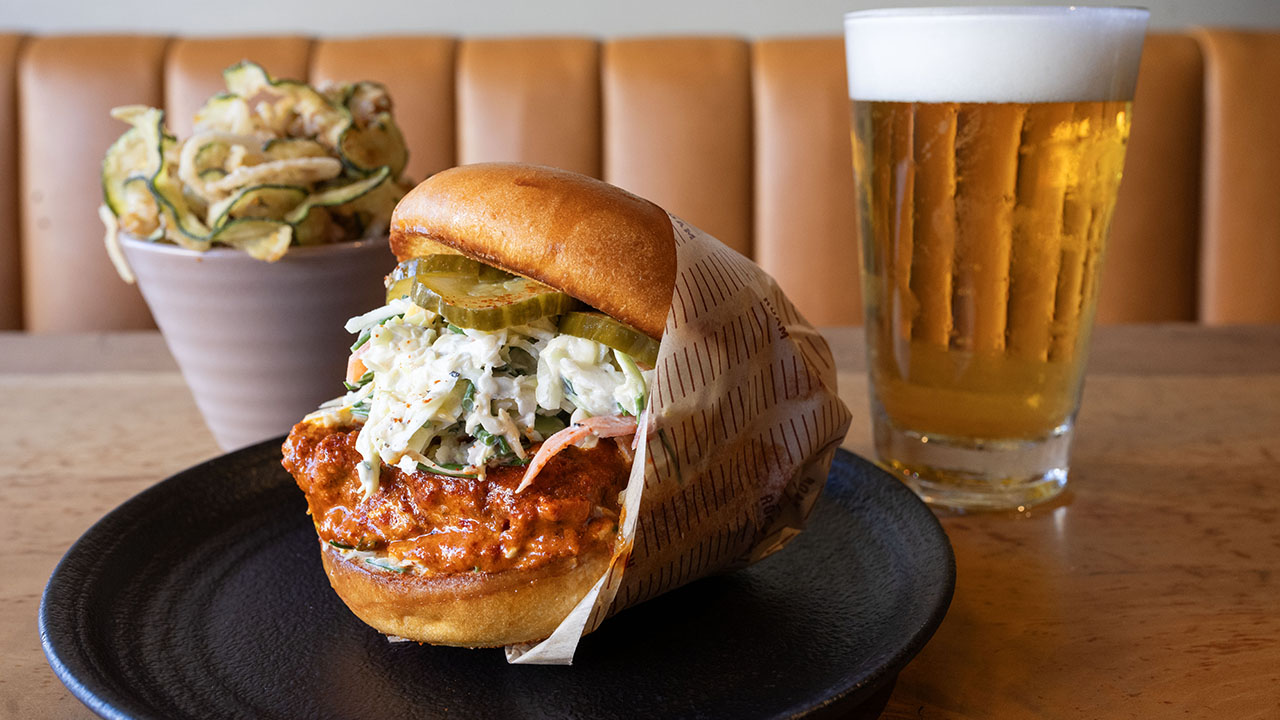
While there’s no haroset on the menu at Roam, diners can find four kinds of burgers — beef, turkey, house-made veggie and bison. There’s also fried chicken, fries and shakes on the menu, along with house-made sodas and local beer and wine.
Spiegelman admits that when thinking about healthy food, burgers and fries don’t usually come to mind. But Roam offers healthier options for these comfort foods, he said, like gluten-free buns and lettuce wraps.

“The food is not sacrificing taste,” he stressed. “You may not want to eat french fries every day, but when you do, we use high oleic, expeller-pressed sunflower oil, which is almost like cold-press olive oil, in that there are no bad chemicals on the potatoes. The shakes are made from Straus Dairy. Anytime we’re looking at animals that are humanely raised, the meat will be better — simple as that.”
What do the partners think makes the perfect burger?
Spiegelman said it has to be “really high-quality beef, grass-fed and finished, cooked medium rare. Fresh, crisp lettuce. Tomato. Onion. The bun should be toasted, soft, but a little crisp around the edges.” He adds, “I’m not a mayo guy. Is that a Jewish thing?”
Given how fickle the restaurant market can be, to what do the pair attribute their success? Both cited the Japanese philosophy of kaizen, which means making small, incremental improvements over time.
“We’re also staying true to our core, in serving great tasting, high-quality food to busy, health-conscious consumers,” Spiegelman said. “We have done this consistently for the past 15 years.”