

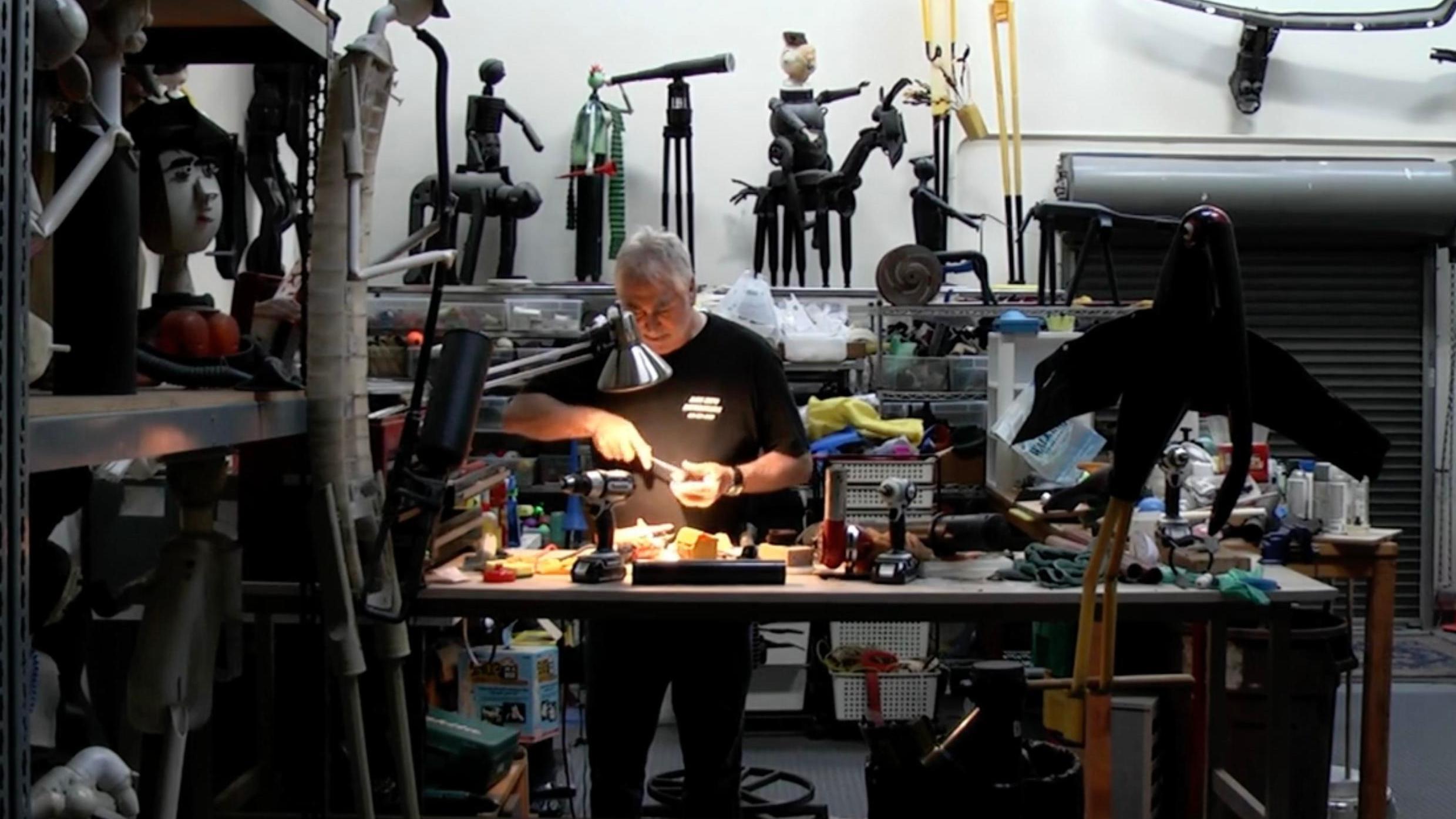
Jerry Ross Barrish has followed an unusually winding career path — from selling bail bonds to making films and acting to creating sculpture to sponsoring a film festival to being the subject of a documentary.
Though he is now known for his found-object sculptures, the San Francisco native was the first corporate sponsor of the San Francisco Jewish Film Festival in his previous life as a bail bondsman.
The documentary about him, “Plastic Man: The Artful Life of Jerry Ross Barrish,” which premiered 10 years ago, kicks off a small retrospective of his own films at the Berkeley Art Museum and Pacific Film Archive, better known as BAMPFA, from Dec. 6-14.
“Amazing that after 10 years, the [documentary] still has ‘legs’ and is as relevant now as it was a decade ago,” he told J. in an email. “I am always surprised that people, having viewed the film, always find it inspiring.”
“Plastic Man” was directed by William Farley, produced by Janis Plotkin and premiered in 2015. Plotkin first got to know Barrish in 1992 when she was the director of the S.F. Jewish Film Festival and he offered to be the festival’s first corporate sponsor. She told J. that Barrish Bail Bonds opened the door for other businesses to sponsor the film fest.
“I am continually struck by the way the film keeps finding new audiences — in theaters, museums and online,” Plotkin said.
According to a review of the film, published in J. in 2015 upon its premiere, Barrish, now 86, grew up in a Jewish working-class family in San Francisco.
“I grew up surrounded by tough Jews,” he says in “Plastic Man.”
His passion for art didn’t come from his parents, but from something inside, he says in the film. Barrish went into the bail bonds business in 1961 simply because someone recommended it. He joined the army and later studied sculpture and filmmaking at the San Francisco Art Institute.
In addition to “Plastic Man,” the BAMPFA series will include three films made by Barrish himself: “Dan’s Motel,” from 1981, in which a series of characters pass in and out of a seaside motel; “Recent Sorrows,” from 1984, about a meeting between a gay man and a straight man; and “Shuttlecock,” from 1989, about an introverted painter and an extrovert comedian. Barrish will be interviewed on stage after each film, as will the makers of “Plastic Man” after it shows.

The series “is a wonderful opportunity to reflect on the inspiring accomplishments of one of the Bay Area’s local treasures.” BAMPFA’s Kate MacKay, the curator who set up the series, said in a statement to J.
According to BAMPFA, Wim Wenders was such a fan of “Dan’s Motel” that the acclaimed filmmaker cast Barrish for a small role in his 1987 movie “Wings of Desire.”
Barrish told J. he was “really proud that these films were considered original when they were made and that they hold up decades later. At the same time there is sorrow, because so many of the cast and crew are no longer with us.”

As a bail bondsman, Barrish had a snappy slogan (“Don’t perish in jail — call Barrish for bail!”) and was a go-to bondsman for many protesters in the late 1960s, as well as serving regular clients.
The bail bonds business closed in 2013. But sculpture, for Barrish, has only grown. He continues to exhibit regularly in local galleries and beyond and work in his Mission District studio. A rusted old neon sign reading “Barrish — Bail Open” still hangs over the entrance.
In “Plastic Man,” he explains that his art comes from the way he sees images in the bits of discarded material he finds.
“Michaelangelo said the rocks speak to him,” he says. “Well, this plastic stuff speaks to me.”