

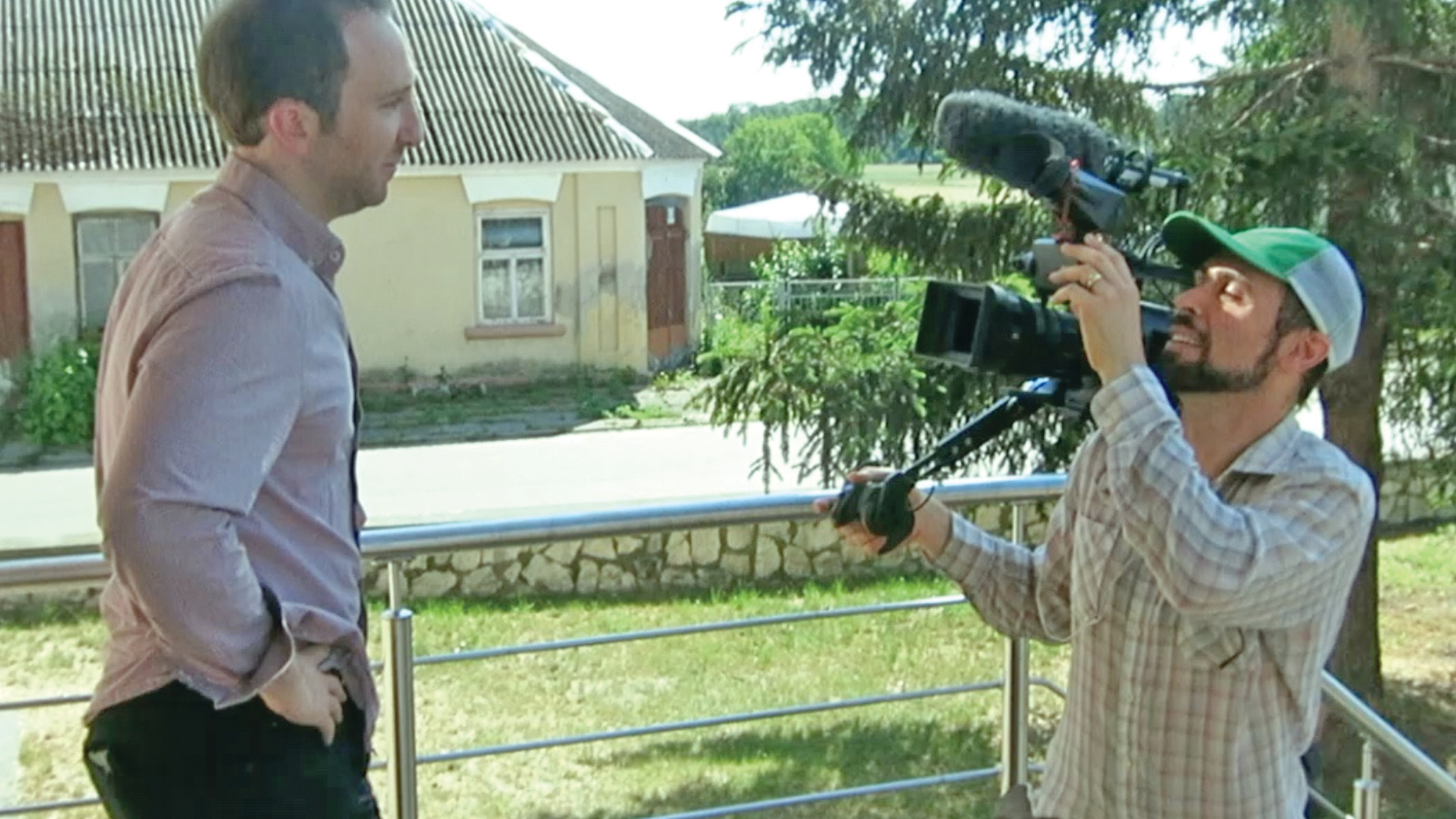
A Bay Area–made film about postwar Jewish murders in a small Polish town is being denounced as “anti-Polish” by leading political figures in Poland, and an investigation has been launched into the Polish TV station that broadcast it.
“I’m not terribly surprised,” Yoav Potash, the Berkeley filmmaker who directed “Among Neighbors,” told J. this week. “There’s a certain sector of Polish politicians that tend to react this kind of way anytime Polish complicity in the eradication of Jewish life comes up.
“They object to what they call the ‘pedagogy of shame,’ and what I and others call Poles reckoning with the complexity of their relationship to Jewish history,” he said.
“Among Neighbors,” which opened in U.S. theaters this fall, is set in the village of Gniewoszów, the ancestral home of Anita Friedman, longtime executive director of S.F.-based Jewish Family and Children’s Services. It focuses on the recollections of former resident Pelagia Radecka, who witnessed local men murder five of their Jewish neighbors after the end of World War II, as well as the memories of another former resident, Israeli professor Yaacov Goldstein, believed to be the town’s last living Holocaust survivor.
After garnering a special award at its world premiere at the Warsaw Jewish Film Festival in late 2024, “Among Neighbors” continued to rack up festival awards before opening in U.S. theaters on Oct. 10. Polish Television, the country’s oldest and largest television network, broadcast the film on Nov. 10.
Immediately after the broadcast, senior government officials and the right-wing media in Poland lashed out. Presidential Undersecretary Agnieszka Jędrzak denounced the film on X, calling it “anti-Polish historical manipulation.” Her opposition was amplified by government-aligned media outlets, and Poland’s National Broadcasting Council has opened an inquiry into the station, supported by members of the far-right Law and Justice Party. The council is required to do so after any complaint concerning Polish media.
The film’s critics are relying on the country’s Act on the Institute of National Remembrance, a “memory law” that governs narratives of historical events in Poland. The 1998 law criminalizes actions or statements, including works of art, that in the government’s opinion smear the good name of the Polish people — for example, referring to any Polish collaboration with the Nazis during World War II. The act has been wielded against writers and political opponents on many occasions.
One who ran afoul of the law was Polish exile Jan Grabowski, now a Holocaust historian at the University of Ottawa. As co-editor of a 2018 book that included an essay criticizing the wartime mayor of a Polish town for handing Jews over to the Nazis, Grabowski and his colleague were accused by a Warsaw district court of “defamation” and ordered to apologize in print. (The charges were later overturned on appeal.)
Grabowski told J. that it’s not unusual even for a foreign film like “Among Neighbors” to receive such treatment.
“There is a special outfit in Poland funded 100% by the state, the Institute of National Remembrance, and they are paid to hunt down and to expose thoughts and books and films which are perceived by the state as hostile to the national ethos,” Grabowski said. “So that’s what you have here. Yoav’s film is basically a victim of its own popularity because it was shown by Polish TV.”
Although the Law and Justice Party is no longer in power (current prime minister Donald Tusk is part of a center-right coalition), Grabowski said there is still widespread consensus around the party’s support for “defense of the dignity of the nation,” as enshrined in the institute and its legal arms.
Regarding the criticism of “Among Neighbors,” “I’d say 90% of Polish public opinion is strongly behind these condemnations, these knee jerk reactions,” he said. “This is something that consolidates Polish public opinion to an absolutely incredible degree.”
Meanwhile, Potash said he and the production team behind the film are not backing down. He pointed to the support he’s getting from numerous Jewish organizations, including the Claims Conference, which gave the film a grant, and the USC Shoah Foundation. Both have issued statements praising the film for its historical and artistic merit.
Claims Conference president Gideon Taylor told J. that “Among Neighbors” explores a “difficult but important” history. “It tells the stories that need to be heard, told by witnesses who were there,” he wrote in an email. “To be effective, Holocaust education has to be honest and speak about what happened, even when that runs counter to established narratives, whether in Poland or elsewhere. We are proud to have supported the making of this film and encourage people to see it.”
The film is still showing in theaters in North America but is not yet available to stream in the U.S.
Polish Television is also standing firm, Potash said. He has been in touch with the station by email, “and they basically said that solidarity is our approach,” he relayed. “We have to stick together.”
“The film is streaming now on the [Polish] station, so people can watch it whenever they want to,” he said.