

During a trip to Korea for her mother’s 80th birthday, Rabbi Angela Buchdahl met a Buddhist monk who asked her to explain Judaism to him. The Korean American spiritual leader was the first Jew he’d ever met.
She began to tell the monk the story of God calling on Abraham to leave the land of his birth and cross over to a new land, amid a promise of blessings. Buchdahl realized that she was also, in a way, telling her own life story.
Hers began in Korea and then shifted to Tacoma, Washington, at age 5 with later stops in Saratoga, California, and Israel. In 1999, she became the first Asian American cantor and, two years later, the first Asian American rabbi. She landed at Manhattan’s Central Synagogue in 2006 and became the first woman to serve as its senior rabbi less than a decade later.
The Reform rabbi reflected on her story Wednesday night in front of the packed sanctuary of San Francisco’s Congregation Emanu-El.
In conversation with Emanu-El Senior Rabbi Ryan Bauer, Buchdahl discussed key moments from “Heart of a Stranger: An Unlikely Rabbi’s Story of Faith, Identity, and Belonging,” her memoir published in October. The JCCSF co-presented the event with the Jewish Federation Bay Area, Jews of Color Initiative, Brandeis School of San Francisco, Lunar Collective and Books Inc.

From her own congregation’s bimah, Buchdahl reaches an audience made up not only of its 3,000 member households, but upward of 70,000 subscribers to its YouTube channel. Buchdahl’s livestreamed sermons often go viral, such as the one she gave on Erev Rosh Hashanah this fall that has amassed over 126,000 views.
Growing up in Tacoma with a Korean mother and Jewish father, Buchdahl certainly felt like the stranger mentioned in her book title. But being one of a handful of Jewish students at her high school was also a source of pride, she said.
“I felt different but also special, and I also felt like I was carrying Judaism,” Buchdahl told more than 800 people in the audience. “If I’m not doing this, then nobody knows what Jews are, what we stand for or what we care about. So I had this incredibly strong sense of responsibility.”
That passion led her to become deeply involved in her tight-knit community at Tacoma’s Temple Beth El, immerse herself in Jewish music at Camp Swig in Saratoga (now URJ Camp Newman in Santa Rosa) and dive into Jewish learning during a high school fellowship in Israel.
The trip to Israel was both life-changing (it was when she decided to become a rabbi) and sobering as Buchdahl encountered non-Reform Jews who did not recognize her as a Jew due to her patrilineal descent.
During her first two decades as a rabbi, Buchdahl said she refrained from talking about her experiences as a Korean American Jew. But after a Minneapolis police officer murdered George Floyd, a Black man, in 2020 in public view, Buchdahl felt compelled to call attention to a racial issue close to home: Jews of color in her own congregation felt unwelcome.
“I realized that the sermon that I needed to give was not about racial reckoning in America. It was about racial reckoning in the Jewish community, right here in my own house,” she said.

Speaking in San Francisco before an audience that she described as the most diverse she has seen on her book tour so far, Buchdahl proposed her idea for how Jews can move away from thinking of themselves as a “race” and toward a framework of familial belonging.
“You can be a part of a family by just being born into it … and you can also become family through what’s called a covenantal relationship,” such as between spouses, Buchdahl said. “We don’t share any blood, but we made a covenantal promise, and that made us into a family. Every one of us who wants to be a part of the Jewish community [is] in a covenantal relationship with our people and with God. What if we were to imagine that everyone who wants to be a part of that covenant is 100% fully Jewish?”
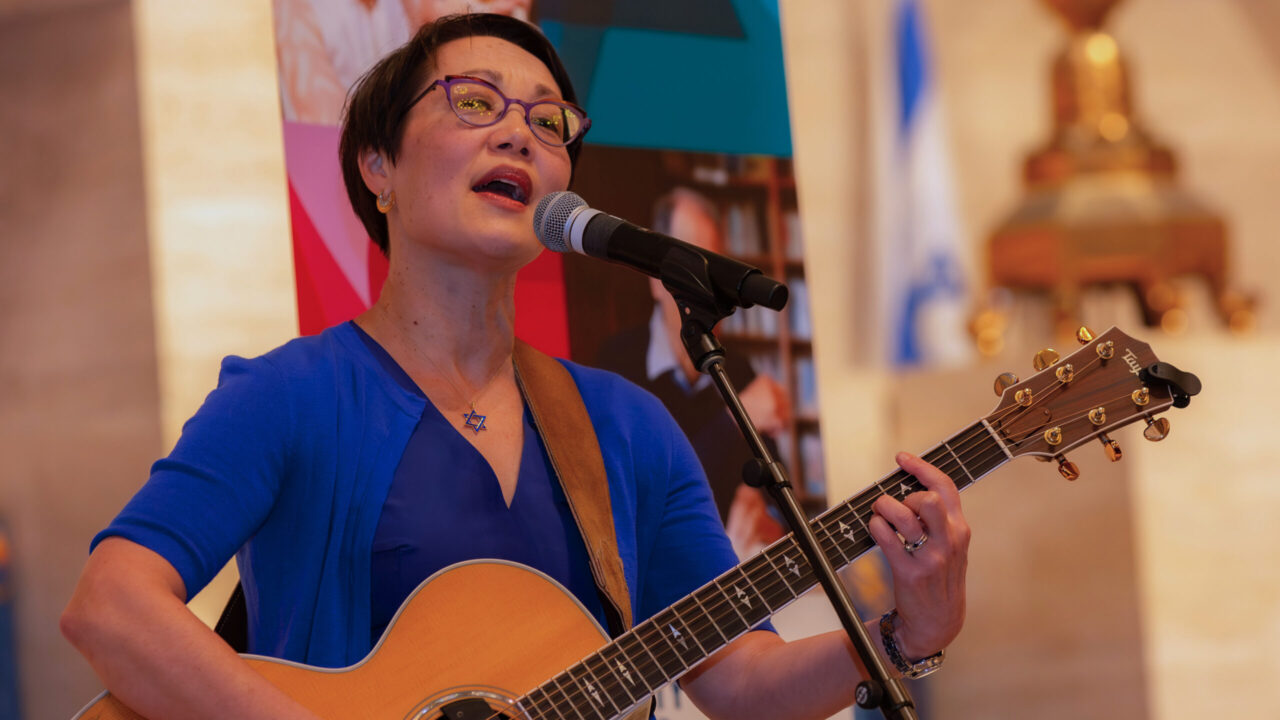
Just as each chapter of the audiobook version of “Heart of a Stranger” ends with a song performed by Buchdahl, she closed her appearance with an acoustic rendition of “Over the Rainbow.”
It was the same song — which, she mentioned, was written and composed by two Jews — that she sang to the Buddhist monk she met in Korea, to exemplify a concept at the core of the Jewish experience.
“It captures the idea that we had to leave home and go to this place that we did not know, but with this dream and promise of blessing,” Buchdahl said. “We needed to know what it was like to be a stranger to become Hebrews. Sometimes you have to leave your first home to find your truest home.”