

When I was a young camper at Camp Newman and Camp Tawonga in the early 2000s, I enjoyed quintessential Jewish summer experiences: We roasted kosher marshmallows for our campfire s’mores. We sang songs in our clean white clothes during Kabbalat Shabbat. And we returned home with tan lines and bug bites from our jam-packed outdoor activities.
Thousands of others have experienced at least some of the same traditions since the first Jewish sleepaway camp opened in Northern California 100 years ago.
When Tawonga hosted its first summer session in 1925, s’mores were probably not part of the camp experience. (The recipe for s’mores reportedly first showed up in the 1927 Girl Scout guidebook “Tramping and Trailing with the Girl Scouts.”)
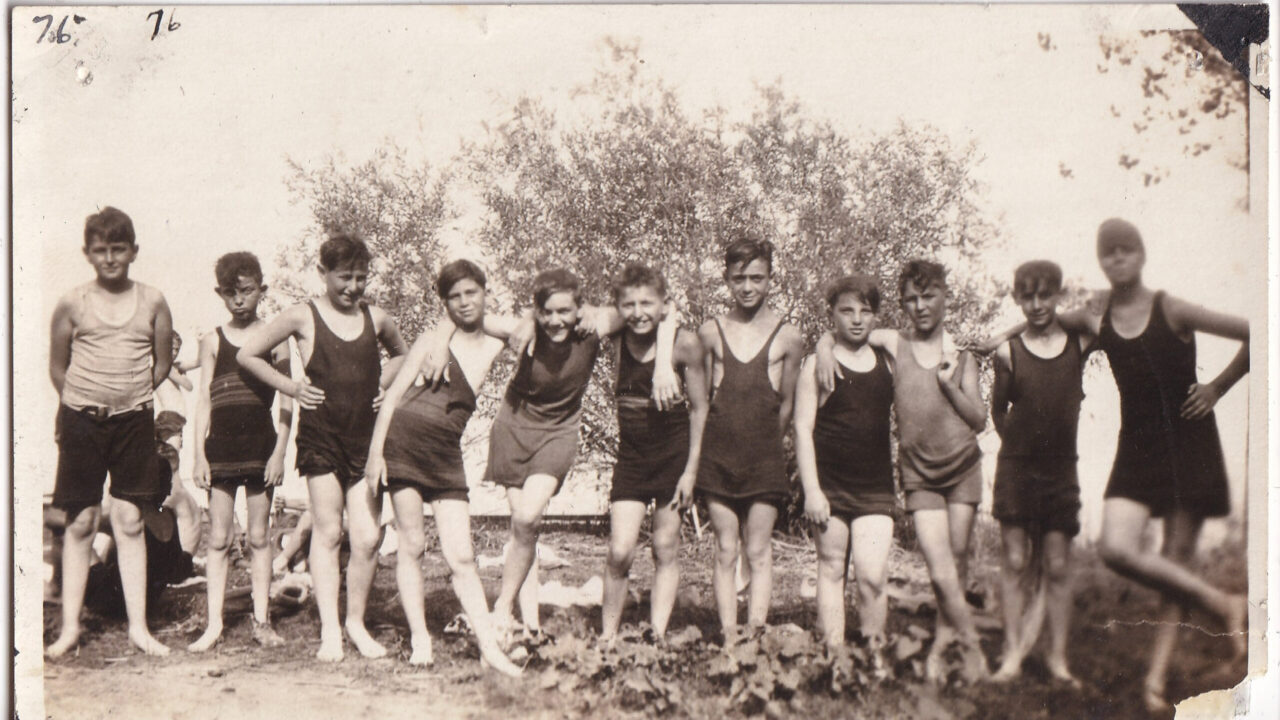
Tawonga was a boys camp when it opened on June 29, 1925. (That was rectified the following year when a girls session was added.) The very first group in 1925 consisted of 60 campers, ages 10 to 16, who attended the weeklong session at the cost of $9.
Tawonga opened in Clear Lake and moved frequently in the early years — to Quincy, Myers and then Lake Tahoe. It settled in its current location near Yosemite National Park in 1964.
In May 1925, our newspaper published Tawonga’s detailed daily camp schedule, which included inspections of the tents and cots (no cabins back then), baseball, volleyball, hiking, boating, fishing and swimming. There was also croquet, trips to the candy store, writing letters home and cozy evenings spent around the campfire, as well as morning groups for learning Jewish history, nature and, curiously, hygiene and sanitation.
It would be nearly 30 years before another Jewish overnight camp opened in Northern California.

Camp Swig, the Reform movement’s first summer camp in Northern California, opened in Saratoga in summer 1953 as … Camp Saratoga.
“Children here have an opportunity to live the Judaism that they have been taught in the religious schools of their congregations,” later recalled Rabbi Wolli Kaelter, who was the camp’s first director. Activities included music, festival and folk dancing, Jewish studies, athletics and arts and crafts.
In a 2003 article about the camp’s 50th anniversary, Kaelter reflected on its very first opening day “with 120 campers and three toilets and no dishes or plates and not enough mattresses or bunks.”
The camp was renamed in 1965 in honor of Benjamin H. Swig, a San Francisco real estate developer and philanthropist who engineered the purchase of the camp property.
“Open to children between 9 and 12 years old, the program is designed to help them find models for their own lives,” explained an April 1967 article in our publication. “These sessions will this year revolve around an ‘Experiment in Democratic Living.’ The campers will be organized as a Sanhedrin, a medieval Kahol, a Kibbutz, a modern congregation, and a UAHC for two or three days each, to learn self-government and the specific contributions which Judaism has made to democracy.”
High school sessions focused on Hagigah, a Jewish arts festival, as well as on the “search for identity.”
Inevitably, some of the teens started romances that led to marriage. In May 2008, J. featured three married couples who met at Camp Swig — one in 1965, one in 1985 and one in 1992. And naturally plenty of couples met at Tawonga and other camps, too.
In September 2000, J.’s own Alix Wall wrote about her fond memories of her six summers at Camp Swig in the early ’80s, five as a camper and one on staff as a babysitter. She described the camp as a “haven” for her 10-year-old self, who grew up in Riverside, feeling like an outsider among non-Jews.
“I’ll never forget that initial feeling my first summer as a 10-year-old, amazed that everyone around me was Jewish. No one here was going to make fun of me for something they didn’t understand,” Wall wrote.
Camp Swig sold the Saratoga property in 1998, moving much of its operation to the Santa Rosa area and changing its name to URJ Camp Newman after San Francisco philanthropist Raquel Newman.
The move from Saratoga “enraged” many campers and rabbis, our paper reported in October 1998. One reason given for moving north was earthquake safety. The Saratoga campsite sat on the Loma Prieta fault line, and camp leaders reasoned that Santa Rosa would be safer in the event of a major earthquake.
An op-ed in our paper at the time noted that the “earthquake fault has two main consequences. First, it limits our ability to significantly expand the camp. Second, it makes renovating the camp more expensive.”
Tragically, it wasn’t an earthquake but a major fire that ravaged the camp 20 years later.
In 2017, shortly after the camp injected $26 million into improvements, the Tubbs Fire raged through 36,000 acres across Sonoma County, leveling more than 80 percent of Camp Newman’s structures.
Pieces of the camp miraculously survived the fire — including sacred texts, prayerbooks, tallitot and, notably, an iconic 6-foot Star of David on a hillside where campers had a tradition of screaming “I love being Jewish!”
“They’re a reminder of our resilience as a Jewish people, and they point toward hope and our future, and the promise to create Jewish life through Jewish camping,” Newman’s then-executive director Ruben Arquilevich told J. in October 2017.
Newman campers returned to the site in 2021 after a major fundraiser helped the camp rebuild.
In 2018, J. published an article titled “S’more and s’more Jewish summer camps around the Bay,” noting that the Bay Area was experiencing a Jewish summer camp boom, with the opening of JCC Maccabi Sports Camp in 2014, Camp Ramah in Northern California in 2016 and Eden Village West in 2018. Camp Be’chol Lashon, a Petaluma camp for Jews of color and mixed-race backgrounds, opened in 2008.
While the Jewish summer camp activities, camp names and locations have all changed over time, the summertime blues that campers feel when it’s time to return home still ring true today, as articulated in a June 1954 article: “Many were loath to leave and all agreed that they were better for the rich spiritual and ethical values they had gained from participation in the camp program.”