

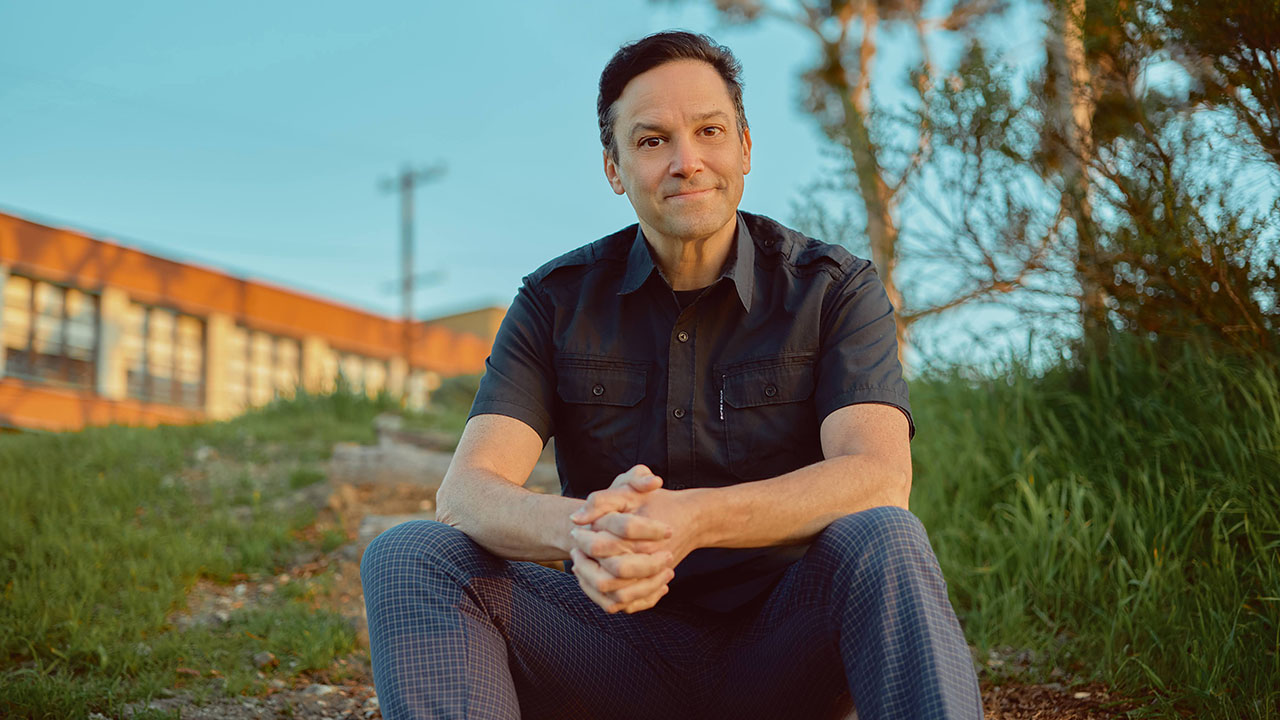
March 11, 2013, was a prophetic night for Corey Rosen. It was when he got to perform at the first-ever San Francisco show of The Moth, national storytelling competition since 1996 and today also a popular podcast and radio program.
The story he told was about his late 82-year-old cousin Norman, which he whipped up with less than a day’s notice, and it was a hit –– so much so, that he was soon invited to become an official host of The Moth’s StorySLAM shows in San Francisco and Berkeley. The open-mic nights feature people telling five-minute stories without notes, and on a given theme.
It was no random stroke of luck or creativity for Rosen, who has devoted his life to storytelling from a young age, attending a performing arts camp for many years and later studying radio, television and film production at Northwestern University.
After college, Rosen moved to the Bay Area and secured his first job at the visual effects company Industrial Light and Magic. He initially worked as a “creature supervisor,” overseeing the development of animated characters for major motion pictures including the “Star Wars” prequels, a “Jurassic Park” sequel and “The Chronicles of Narnia.”
Over the past five years, Rosen, 52, has taken on another role, going from a storyteller to a storytelling educator. “Your Story, Well Told,” his guidebook of strategies for developing and performing engaging stories on and off stage, was published in 2021.
Earlier this month, the San Francisco resident and father of two came out with his second book, “A Story for Everything,” which functions as a companion to his first book, with expanded resources for more diverse storytelling occasions.
On Feb. 19, Rosen will host a storytelling workshop at Urban Adamah in Berkeley.
Keep reading, or listen to the full interview below. This interview has been edited for length and clarity.
What was your Jewish upbringing like?
I went to Sunday school, Hebrew school, I was bar mitzvahed. Weirdly, the stories in the Torah and the way we celebrate, interpret and reinterpret over and over those same stories is the thing that has always kind of hooked me. I mean, Jews are always telling stories.
I didn’t go to a Jewish summer camp, because I was in performing arts, which was my interest from a very young age. I was lucky enough to go to a summer camp in the Catskill Mountains called French Woods Festival. I was acting in musicals before I was 10 years old. I went there for nine summers.
Some of my closest friends in the world are the people I went to that camp with. Many of those friends are also creative professionals using their theatrical backgrounds in their lives, whether on stage or behind the camera, in different capacities.
You’ve had several creative interests. How have they all complemented each other over the course of your life?
As a kid, I wanted to be more of an actor. I wanted to be on stage, I like to perform, I like to be creative. But I also liked to make films with my friends, so I went to film school, and I loved it. Even after I started working in the animation industry, my happy place was on improv stages, where I could show up without a script, without the fear of doing it wrong, and I could make up scenes and characters and stories. I think that everybody should take an improv class at some point in their life. Improvisation is not just a theater or comedy skill, it’s a life skill.

For example, for the last 15 years or so, I have been part of the team that helps craft The Kitchen’s Purimspiel. One of the things that we did this year that was particularly enjoyable was figuring out what resources we had in the community, then and there. And we happened to have Barry Kendall, the former executive director of the San Francisco Circus Center. So we set Purim in the big top, and we had circus performers and clowns and acts. It was incredibly messy, but it was a resonant, humorous, but also deeply moving and powerful way of telling and retelling that story.
The first job you had out of college at Industrial Light and Magic is listed as “creature supervisor.” What does that job entail?
To make special effects in the computer, it takes many specialists. People who are crafting and designing, people who are writing and voicing the characters, etc. But in between, there was this kind of nether region: how does it go from an idea and a drawing to an animation in a scene? That’s how the concept of a creature supervisor was born. I did a lot of helping and facilitating that creature through the pipeline, from its origin to its design, to showing up and looking correct on screen, being a sort of steward of a character in a movie.
You’ve had a lot of experience in developing both true and fictional stories. Any similarities between those two seeming opposites?
When I was a staff writer at Lucasfilm, I was looking at the themes that were emerging in the stories that I was writing. A lot of them were about being a young person, and discovering who you are. And I realized that these are my stories, I was just dressing them up with the adventures of a young character. Those fictional stories were about stepping out of your comfort zone and finding out who you are. So when you flip that on its head, the conclusion can be “Well, let’s just tell the real versions of those stories.” And The Moth is one of these platforms where anybody can get on stage and tell a true story.
These are true stories that are elevated beyond anecdotes. It’s not just a thing that happened, it’s a thing that happened for a reason.
When did you go from seeing storytelling as an artistic craft to seeing it as a skill that can be applied in many ways and places?
When I was hosting these story shows, one of the first things I realized is that the job of a host in that context was not to entertain per se. My job was to hold the stage as a kind of safe space for anyone to feel comfortable to come up and tell their story, because a lot of people are afraid of getting up and speaking in public.
While I was on tour promoting my first book, I was getting a lot of questions along the lines of, “Well, I’m not a storyteller, why should I learn about storytelling?” And I was like, of course you’re a storyteller! You have to write grant applications, or you’re applying for jobs, you’re going on dates, you’re giving feedback to your employees, etc. Whatever your job is, odds are you’re a storyteller, or at least you have to connect or communicate with other people. And what I’ve found is that doing it as a story is always better. If you can say not just what happened, not what the data is, but also frame it, and contextualize the “why,” the impact is really amazingly tangible.