

This piece was published in cooperation with the Forward.
Long before FIFA, the World Cup’s organizer, created a peace prize, an international roster of Jewish soccer players, many of whom would become refugees from fascist Europe, raced across American fields. Jewish media on both coasts helped readers follow along — sometimes even in Yiddish.
Sports coverage in the earliest days of the Forverts, America’s longtime Yiddish daily, was sparse and eclectic. Eventually its reporters would write about chess matches, cover boxing competitions, explain the ethos of baseball to new immigrants and, as late as the 1950s, even feature a column about fishing called “Yidn Khapn Fish” — “Jews Catch Fish.”
In November 1897, though, a mere seven months after the founding of the Forverts, front-page real estate was devoted to a dramatically violent story of a 17-year-old’s mishap with a soccer ball. The youth was shot by a police officer who attempted to stop him from advancing the ball down the Upper West Side and then charged the poor young chap with disorderly conduct.

In 1911, on the West Coast, a more playful soccer scenario was reported by The Emanu-El, the original name of J. As part of a series of vaudeville performances, a British act known as “Ninton and Wooten” would perform an exhibition soccer match on bicycles at San Francisco’s Orpheum Theatre, using their tires rather than their feet to kick it around.
A decade later, by 1920, the Forverts expressed its delight at how Polish Jewish youth were creating soccer clubs and reported on Krakow’s soccer match between Polish Jewish and Polish Gentile youth.
“Krakow’s Maccabee Club is in first place” the article stated. “It’s been in existence for several years already, and has several hundred members.” While the Maccabee Club was largely identified with Zionism, another club, Morgenshtern, belonged to the Jewish socialists.
A 1920 Emanu-El item shone the light of science on the nascent discussion of Jews and soccer, presenting data gathered by a recent Menorah Society study that showed Jewish soccer skills were among the talents helping Jewish boys find “respect” on campus.
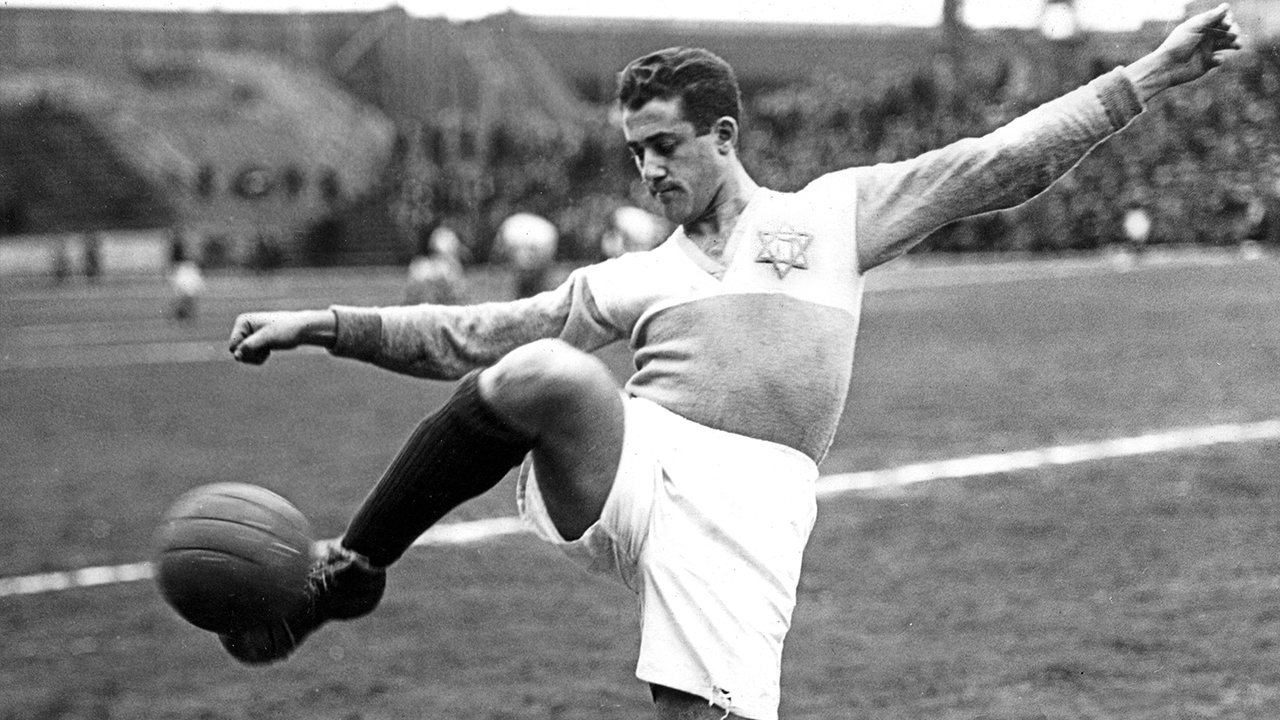
By the mid-1920s, with the rise of fascism in Europe, Jewish sports societies like Maccabi and Hakoah enabled talented Jewish players to find a home for their skills, and sent them on tour in America playing exhibition games. With the worsening situation in Europe, many who first came to tour and play in America later found themselves seeking asylum here as refugees from Hitler.
Enter Erno Schwarz’s mad soccer skills.
It was front-page news and of note on both coasts when Hungarian Jewish soccer star Schwarz’s Hakoah (“The Strength” in Hebrew) team played the Brooklyn Wanderers in 1926.
Again, Emanu-El presented data to back up the East Coast soccer nachas. Hakoah, Emanu-El told readers, had over 260,000 members. The Viennese club was about to become a prominent face of American sports, said the Bay Area’s Jewish paper of note.
Schwarz’s performance against the Brooklyn team that day in 1926 took place at Ebbets Field in Crown Heights, then home of the Dodgers. The Forverts made sure readers were on time for the match of the year, warning them: “The game starts promptly at 4 p.m. Should you happen to be even 5 minutes late, you’ll lose those 5 minutes of watching their splendid game.”
Schwarz, Hakoah’s acclaimed forward, manager and the first Jew to coach the U.S. men’s soccer team, was there, offering his talents. Their competition, the Brooklyn Wanderers, made a home for refugee players and local Jewish players who were unwelcome on other teams.
A bit of internal communal tsuris, or trouble, followed Hakoah though, when the Emanu-El reported that the team was scheduled to play on Shabbat: “The Board of Jewish Ministers has learned with great regret that the Jewish soccer team ‘Hakoah’ now visiting the United States, is scheduled to play and charge admission fees on the Jewish Sabbath in violation of the tenets of Judaism and deplores this failure of the ‘Hakoah’ team and management to respect the sensibilities of religious Jews.”
Hakoah left, according to Emanu-El, after playing 10 games against some of the best American teams, winning six, losing two and tying two, in front of 200,000 attendees. When they returned in the early 1930s, Schwarz was aided in securing refugee status and played exhibition games to fundraise for his fellow European Jewish refugees who no longer had homes to return to.
This year in June, the World Cup will be hosted by three countries: Canada, Mexico and the United States.
Echoes of fascism, refugees and soccer heroes rise up from Brooklyn’s old Ebbets Fields. Dos redl dreyt zikh — the wheel keeps turning — and so does dos fusbol.