

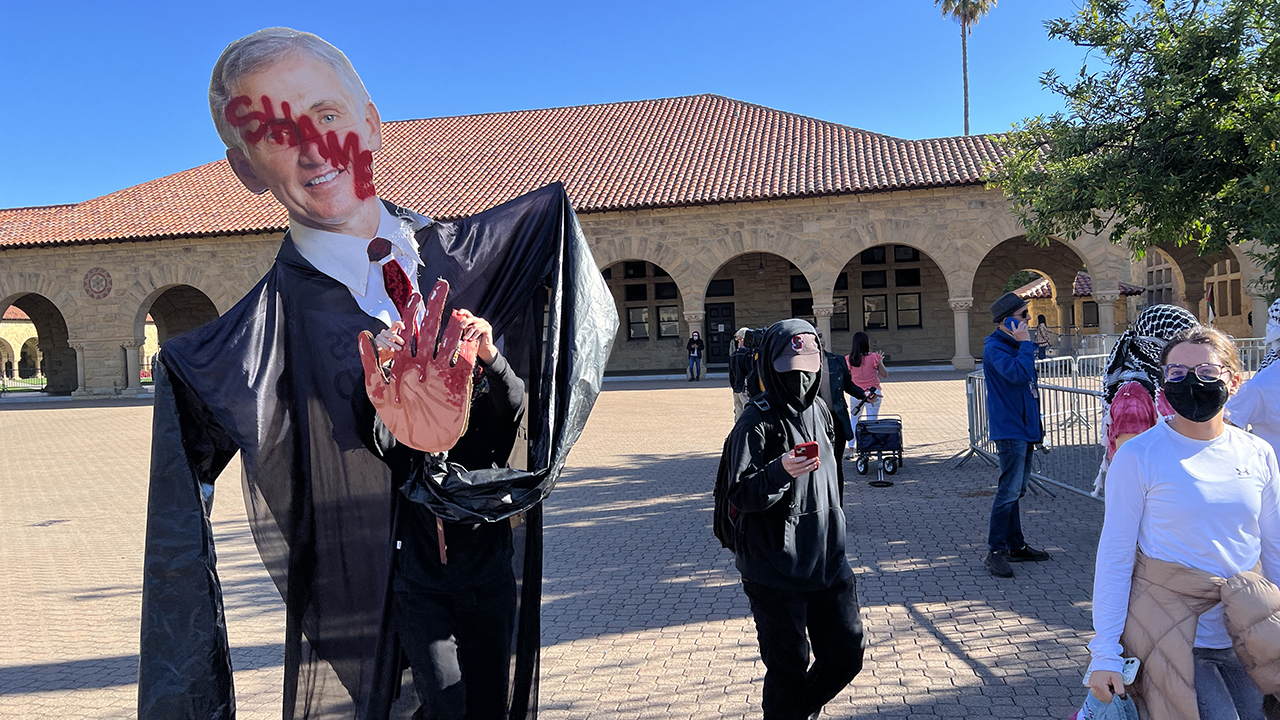
A jury was selected this week for the trial of five student protesters who were part of the break-in and occupation of a Stanford University building in June 2024. Opening statements and presentations of evidence are scheduled to begin Jan. 9 in Santa Clara County Superior Court in San Jose.
Eleven protesters, ranging in age from 21 to 33, were indicted in early October on charges of felony vandalism and conspiracy to trespass. Of the “Stanford 11,” three agreed to guilty pleas on reduced misdemeanor charges, and three others were granted mental health diversions.
Sparring between prosecutors and defense attorneys grew tense Monday and Tuesday during jury selection hearings, echoing disagreements that flared during pretrial motions in December.
One point of contention on Monday was over the defense team’s request to question potential jurors about their views on the Israel-Palestinian conflict in front of the full panel. Santa Clara County Deputy District Attorney Robert Baker objected, saying such questions should be asked “outside the presence” of other potential jurors “to avoid tainting the jury with hearsay.” Judge Hanley Chew allowed “limited” questioning of individual jurors on the conflict in a separate area, the Mercury News reported.
In December, Chew denied motions by the DA’s office that would have barred the defense from using the word “genocide” or discussing the motivations of the protesters, KQED reported. The judge made a measured ruling, limiting use of the term genocide and protesters’ motivations in defense arguments, while not prohibiting either outright.

“This case is not about genocide. This case is not about the Gaza War,” prosecutors wrote on Dec. 9. “This case is about one thing: whether the defendants, current and former Stanford students, conspired to occupy Building 10 and caused $400 or more in damage in doing so.” $400 is the minimum amount to charge vandalism as a felony in California.
“The defense strategy is to use this jury trial as a forum to put Israel and Stanford University on trial for the Gaza War,” prosecutors wrote. “The court should not allow this case to become a sideshow on the morality of armed conflict abroad.”
Early on the morning of June 5, 2024, protesters shattered a window to enter Building 10 on the Stanford campus and carried an electric grinder, hammers, crowbars and chisels, according to an April 2025 press release from the Santa Clara County District Attorney’s Office. Prosecutors also said the group broke windows and furniture, disabled security cameras and sprayed messages in fake blood throughout the building.
The action targeted the office of Stanford’s then-interim president Richard Saller. Protesters also published a list of demands on Instagram, calling on the university to divest from companies linked to Israel and to drop charges and disciplinary actions against “all pro-Palestinian student activists.” Stanford did not agree to either demand.
Stanford police arrested 13 people after breaking through barricades reportedly set up by the protesters. Police later released one student journalist who was embedded with the group to report on the protest, according to the DA’s April press release.

The conspiracy charges are based on the testimony of one student protester who pleaded “no contest” and provided a statement to prosecutors in May on the extent of the group’s preparation for the protest, according to court records.
John Richardson, at the time a student at Loyola-Marymount, accepted a young adult deferred entry of judgment, which could result in charges being dropped if he continues to cooperate as a witness.
In his statement to prosecutors, Richardson said he’d attended a planning meeting about a week before the break-in. He also joined a group chat on Signal, an encrypted messaging app, and sent word of “a video of the interior of Building 10,” which the group then used to “identify the location of surveillance cameras.”
The three protesters who were granted mental health diversion, Isabella Terrazas, Eliana Fuchs and Zoe Edelman, are excluded from the trial and will enter treatment for up to two years, during which criminal proceedings are suspended.
For the remaining defendants, the maximum penalty for felony conspiracy to trespass and felony vandalism is three years in state prison. But Santa Clara County District Attorney Jeff Rosen previously stated he would not recommend incarceration, J. reported in April. Instead, he suggested they make restitution of “hundreds of thousands of dollars” to Stanford.
Defense attorneys and outspoken Stanford Law School students who call the prosecution “politically driven” said the figures cited for restitution are overinflated. The university had estimated the damages at over $250,000 in April, according to campus police records. In an email to J. Tuesday, Baker said the final amount will only be determined after the trial ends.
“Restitution is a question decided by a judge, not a jury,” he wrote.