

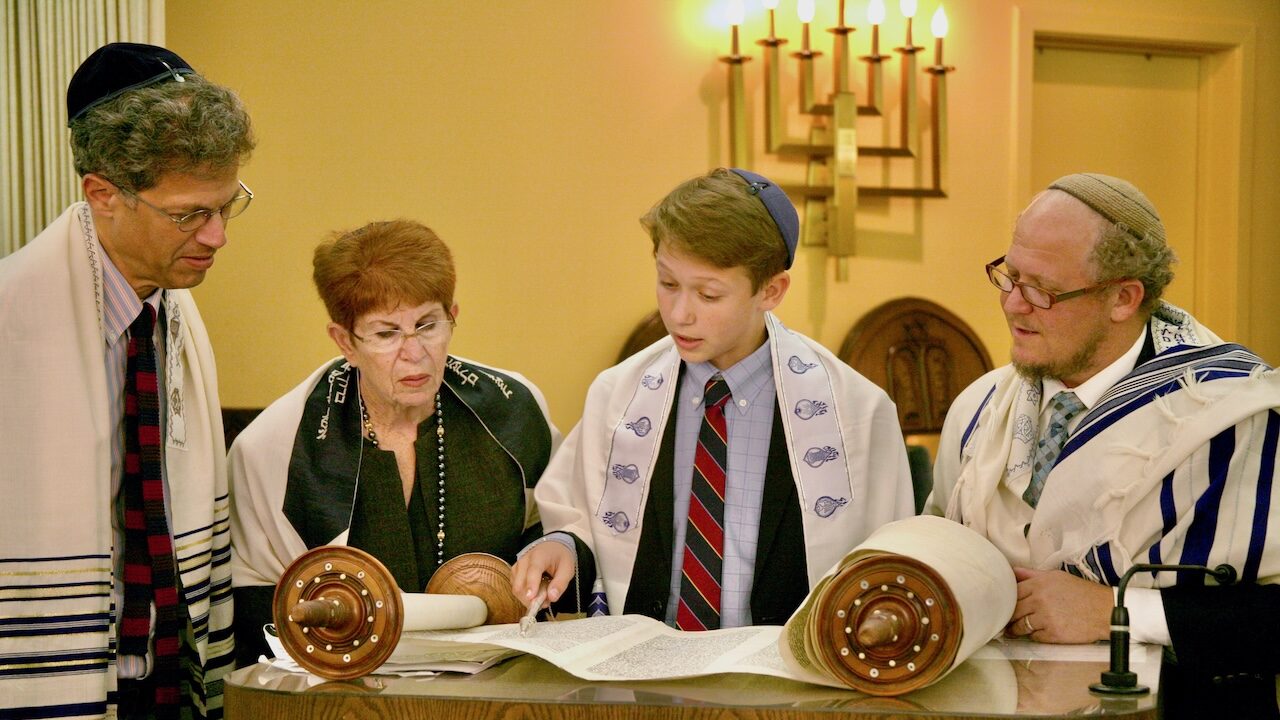
Linda Rosenbloom Semi was a gifted musician, cantor and anchor of her San Francisco congregation whose impact stretched across generations of Bay Area Jews, according to those who knew her well.
Semi, a longtime cantor at Congregation B’nai Emunah in San Francisco, died on Jan. 21 at the age of 78 in Knoxville, Tennessee. Semi served at B’nai Emunah for more than a quarter century, from 1991 until her retirement in 2017. She became a cantor emerita and served in that role at Congregation Am Tikvah, which was created when B’nai Emunah merged with nearby Congregation Beth Israel Judea.
Even after retiring, Semi regularly returned to lead services, officiate lifecycle events and tutor b’nai mitzvah students, remaining a constant presence in a community she helped hold together through decades of change.
“She just was the common thread that really tied the community together,” said longtime B’nai Emunah and Am Tikvah member and former B’nai Emunah president Sharon Bleviss.
B’nai Emunah, a Conservative congregation, was founded in 1949 by Holocaust refugees who came to San Francisco by way of Shanghai, China.
Semi was widely regarded as the unifying presence during some of the congregation’s most uncertain years. When Rabbi Ted Alexander retired in 2005, B’nai Emunah was without a rabbi for an extended period. Semi assumed full pastoral responsibility during that time, leading all services, providing counseling, officiating lifecycle events and ensuring that communal life continued uninterrupted.
“She did all services, brises and weddings, funerals and everything in that time. She did all pastoral work,” recalled Bleviss.

In 2008, the congregation welcomed Rabbi Mark Melamut, who served B’nai Emunah for a decade.
“He was straight out of seminary, so she really helped show him the ropes and together, they worked as a team to create the next chapter,” said Bleviss.
Semi’s presence was especially felt in moments of crisis. Congregants regularly requested that Semi continue to officiate funerals because of her deep personal relationships and the emotional power of her voice.
Semi’s musical and spiritual grounding began early.
She was born on Feb. 28, 1947, and grew up the youngest of three children in Olean, New York, where according to family recollections, Judaism was the center of daily life in her childhood home. Semi’s daughter, Jane Olman, spoke about Semi’s upbringing at her burial service in Modi’in, Israel, on Jan. 25, and relayed anecdotes from Semi’s brother, Oscar Rosenbloom, about their childhood.
“We had a musical family with an unusual knowledge of traditional Jewish liturgical music at home,” Olman relayed from Rosenbloom’s recollections. “The highlight of our year was the observance of Passover. We waited impatiently to get to the highlight of things, the singing of the many songs at the end. We knew them all and had blended our voices and what any guests found to be something superb.”
Music filled Semi’s childhood household, as relatives formed an all-family choir that sang major portions of the High Holiday liturgy in their synagogue. The choir was led by Semi’s uncle and together the family performed European cantorial music in the tradition developed in Odessa, where Italian operatic influence shaped a distinctive cantorial style. That blend of classical music and Jewish prayer would later define Semi’s own approach on the bimah.
Semi earned a degree in music education from Syracuse University and completed her cantorial training at the University of Judaism (now part of the American Jewish University in Los Angeles). She was inducted into the Conservative movement’s Cantors Assembly in 1997.
One of Semi’s most enduring musical legacies at B’nai Emunah was her teaching of the complex choral work known as the “Great Hallelujah,” a rendition of Psalm 150 by Louis Lewandowski. Semi patiently taught the many layered vocal parts to the choir, transforming the piece into a congregational tradition.
Bleviss recalled returning home after Rosh Hashanah one year to find her 3-year-old son marching down the block with a broom held like a Torah, chanting “Hallelujah” like Semi’s choir.
Semi’s liturgical standards were high and she was known as a “stickler for good nusach,” Olman said at the burial service, referring to the specific melodies for chanting prayers. Students preparing for b’nai mitzvah learned quickly that she expected precision, preparation and respect for the sacredness of the work. At the same time, she was deeply encouraging. One congregant who trained with her for an adult b’nai mitzvah recalled struggling to hit the proper notes and match Semi’s vocal range. On the day of the service, Semi congratulated her excitedly, saying “You got it all!” Words that remain, decades later, a treasured seal of approval.
“Her patience and willingness to teach gave me so much more confidence to sing and read Torah and even encouraged me to lead prayers and take a more active role in prayer services at my high school,” said Audrey Ingerman, a senior at Jewish Community High School of the Bay who was tutored by Semi for her bat mitzvah.
Elena Ingerman, Audrey’s mother, described Semi as “a source of immense Jewish knowledge, strength and musicality,” noting she had a “beautiful voice and sharp sense of humor” that was apparent when teaching and leading services.
Semi’s discipline was legendary, according to Bleviss. She fasted fully on Yom Kippur while leading hour after hour of services and the choir, never taking “even a sip” of water. When the fast ended, she reliably broke it with a shot of slivovitz in a ritual that became part of congregational lore.
“I don’t know how she did it,” Bleviss laughed.
Although she was fully immersed in congressional life, Semi worked by day as a supervisor at the Social Security Administration.
She had what her daughters described as a “zany” sense of humor, recalling how she loved corny jokes, gag gifts, costume parties, traveling and dancing late into the night. She was also a devoted sports fan, fiercely loyal to the Buffalo Bills, New York Yankees and Golden State Warriors. She was known for cheering loudly and texting friends during games with commentary as spirited as her singing.
In her final days, Semi was surrounded by love and music, her daughters said in the announcement of her death to Am Tikvah. They played selections from “Fiddler on the Roof,” family Passover melodies and her favorite classic songs at her bedside. In the announcement they also wrote, “We even managed to share a shot of slivovitz. Okay, Mom’s was more like a little taste, but she definitely knew what it was and she gave us a large grin as we toasted.”
Semi’s family said she had long dreamed of spending the final chapter of her life in Israel. Though her health prevented her from making aliyah, her family fulfilled that wish after her death and ensured she was buried in Israel. She is survived by her daughters, Margaret Toon and Jane Olman, and their spouses; her brother, Oscar Rosenbloom; and eight grandchildren. Contributions can be made to Reading Is Fundamental or the Helmet Fairy via brsonline.org/amyisraelchai. Semi will be honored at a Shabbat Shirah event at Am Tikvah on Saturday, Feb. 14. The community is invited to a remembrance ceremony at 1 p.m. Sunday, Feb. 22 at Am Tikvah.