

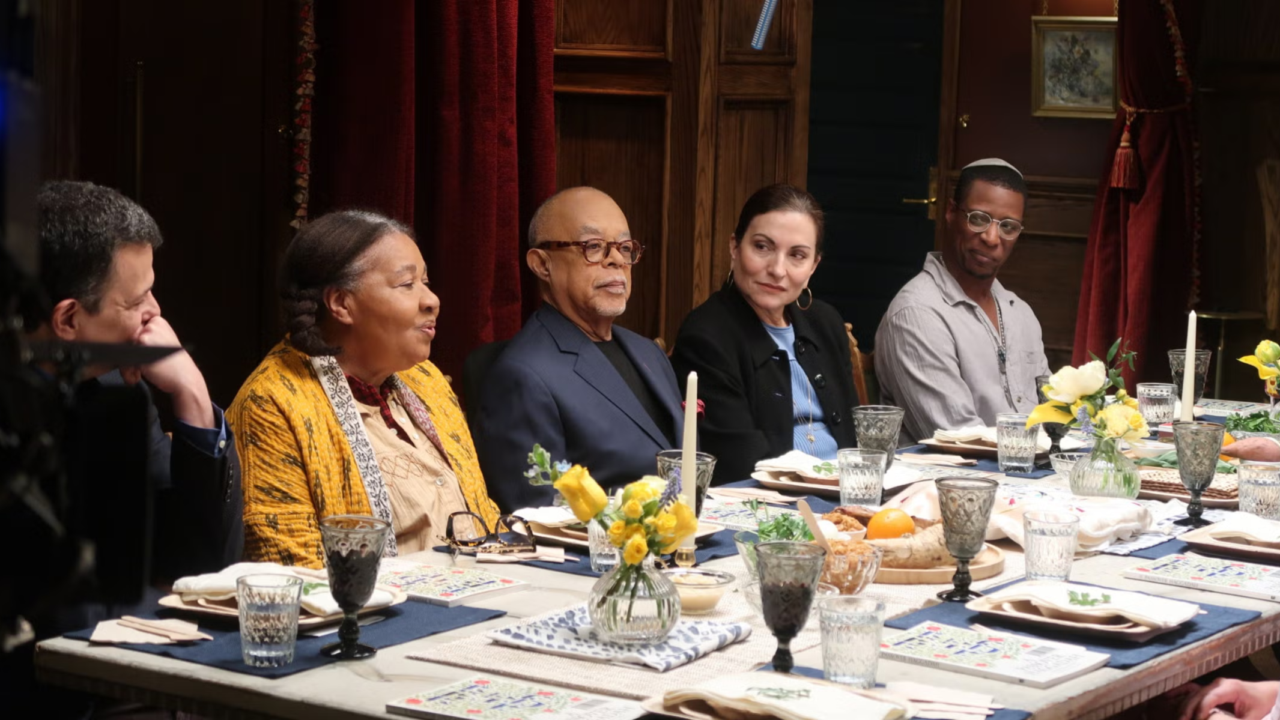
(JTA) — Passover may still be two months away, but PBS is seating a diverse set of Jews down for a seder this week — casting the communal storytelling meal as an ideal entry point for exploring the complicated history of Black-Jewish relations in the United States.
The meal can be seen in “Black and Jewish America: An Interwoven History,” which began airing on Tuesday evening, and it features a diverse set of Jews — including many who are Black — discussing the role that the Exodus story plays in both Black and Jewish traditions.
The conversation does not avoid difficult topics that challenge the conventional wisdom that having gained freedom from slavery represents a clear parallel for Jews and Black Americans.
“Something that I often think about during Passover is every year we commemorate our freedom as Jews,” says Nate Looney, director of community safety and belonging at the Jewish Federations of North America, in a clip shared exclusively with the Jewish Telegraphic Agency. “But as Black Americans, we’re often told to ‘get over slavery,’ and ‘forget about it.’”
The four-episode docuseries explores the historical rifts and alliances between Jewish and Black Americans and is hosted by Harvard University historian Henry Louis Gates Jr. It comes at the start of this year’s Black History Month — and as questions have simmered about whether the last several years have irreparably harmed the historic kinship between Jewish and Black Americans.
It argues that the relationship between Black and Jewish Americans wasn’t set in stone during the civil rights movement when Rabbi Abraham Joshua Heschel marched in Selma with Martin Luther King Jr., but was shaped by centuries of history, and continues to be shaped by oppression and white supremacy.
Among those at the table with Looney are Angela Buchdahl, senior rabbi of New York’s Central Synagogue; cookbook author and culinary historian Michael Twitty; writer Jamaica Kincaid; editor of The New Yorker David Remnick; and Rabbi Shais Rishon, also known as MaNishtana.
The series explores key moments in the histories of Black and Jewish Americans, and how those moments ran parallel and crossed paths over the past five centuries. It covers the transatlantic slave trade, the overlaps between the Great Migration and Jewish immigration from Europe, the lynching of Leo Frank, the Civil Rights Movement, the Crown Heights riots, the 2017 Unite the Right rally and post-Oct. 7 activism.
“A lot of previous conversations about [Black and Jewish relations] really just look at that golden era or just look at the divisions that have come in the last decades, but we’re trying to take a holistic view about how race and caste [were] established in America,” Sara Wolitzky, co-executive producer and director of the docuseries told eJewishPhilanthropy.
“Black and Jewish America” features a variety of academics, activists, writers, and celebrities, including Rev. Al Sharpton, Jewish studies professor Susannah Heschel (the rabbi’s daughter), actor Billy Crystal, activist and professor Cornel West and playwright Tony Kushner.