

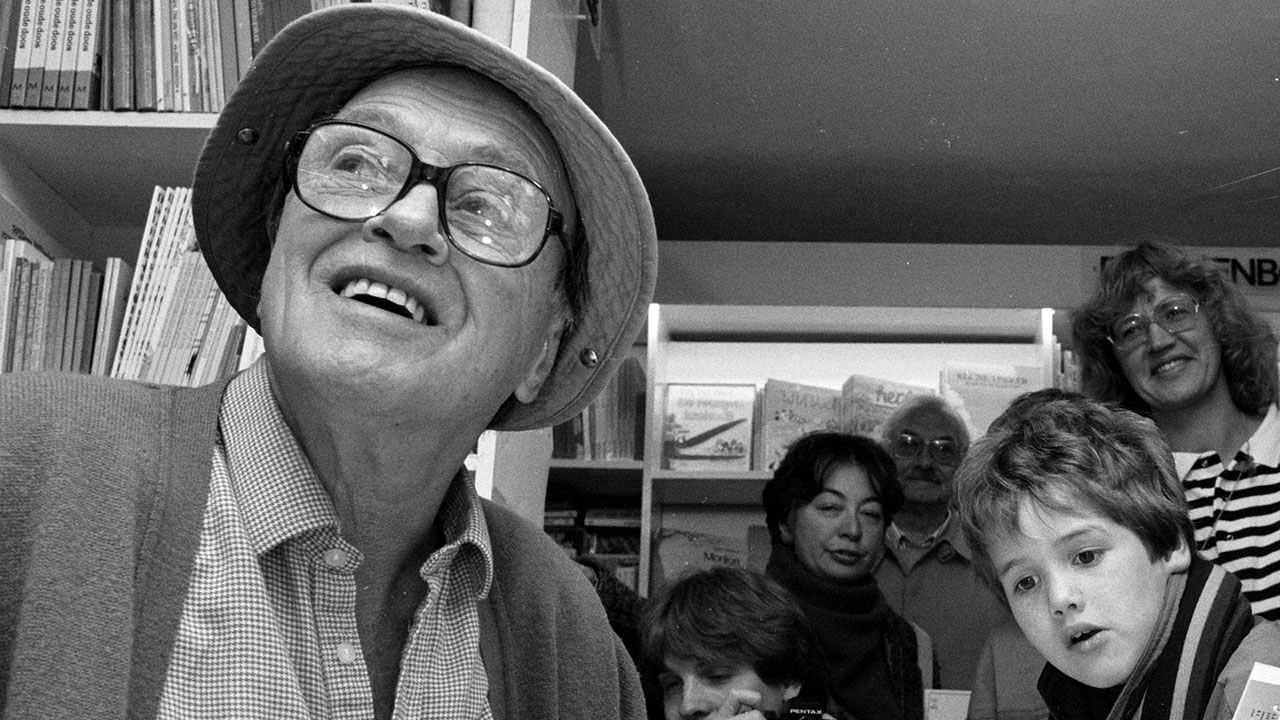
When a beloved children’s author unleashes a brutish antisemitic screed, his career is threatened. His publisher and wife scramble into damage control mode. Will the author back down? Will he apologize?
That is the subject of “Giant,” which is coming to Broadway in March.
The play is based on true events. In 1983, prolific writer Roald Dahl, who was a giant in the publishing world and towered at 6-feet, 6-inches, reviewed a book about the siege of western Beirut by the Israeli army during the 1982 Lebanon War. His review was widely regarded as antisemitic.
In the play, Dahl’s longtime British publisher descends on his home, along with a representative of his New York publisher, a Jewish American woman. They plead with him to issue a statement explaining, softening or retracting his remarks — anything to offset the damage to his career, the upcoming publication of his next book and his pending knighthood.
Written by Mark Rosenblatt, “Giant” premiered in 2024 at London’s Royal Court Theatre with John Lithgow starring as Dahl. It won three Laurence Olivier Awards, including best new play.
The show has a Bay Area Jewish connection: Aya Cash, who stars as the Jewish American visitor, was born and raised in San Francisco and graduated from the Ruth Asawa San Francisco School of the Arts.
Provocative at the best of times, “Giant” premiered during a terrible time: the Israel-Hamas war. When my husband and I saw the play in London last June, Israel and the U.S. had also just bombed the Iranian regime, including its nuclear facilities. So the issue of military action was more than timely, as was (and is) the problem of antisemitism.
For me, the most moving moments were the onstage debates about Jews loving Israel even if they disagree with specific actions taken by the government.
I won’t give away the play’s resolution, though it’s easy enough to find out on your own. Suffice it to say, Dahl was no angel.
The play is disturbing. Both my husband and I got little sleep that night. Few productions I’ve seen have so deeply affected me. To sit there and have hate spewed forth felt so personal, frightening and immediate.
“Giant” challenges viewers to think not only about antisemitism and the State of Israel, but also how we regard flawed cultural and political heroes. Can we admire their work while acknowledging their moral failings?
Great art, music and literature is sometimes created by people whose personal behavior is morally complex or problematic. Do we stop reading and watching Dahl’s classics — “Charlie and the Chocolate Factory,” “James and the Giant Peach,” “Matilda” or “The BFG” (Big Friendly Giant) — with our children or grandchildren? Likewise, should we dismiss Picasso’s paintings because of his mistreatment of women? Do we avoid works by authors like Virginia Woolf, whose writings contained antisemitic bias? And what about the artwork of Caravaggio, who committed murder?
I don’t know the answers, but “Giant” raises the right questions. I absolutely recommend you see the play when it opens in New York City in March, but be prepared to squirm and think.