

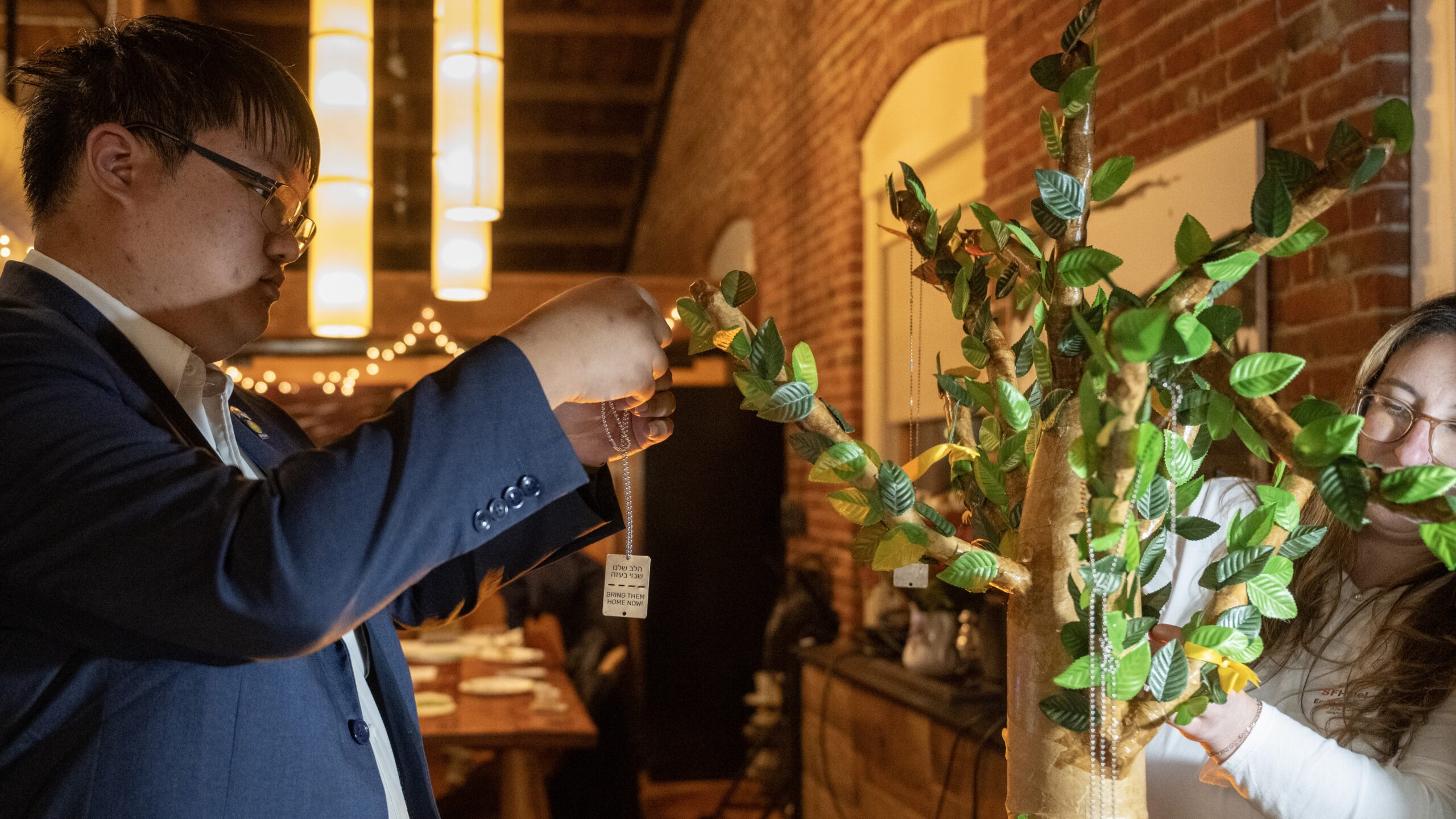
When University of San Francisco senior Jack Schell boarded a BART train in September wearing a yellow ribbon pin, a woman approached him and asked if it was connected to the hostages taken on Oct. 7, 2023.
He initially braced himself for an unpleasant encounter, but when he said “yes,” the woman told him that she, too, was Jewish, and asked for a hug. There were still 48 hostages, both living and dead, held by Hamas in Gaza at the time.
On Tuesday night, at an event hosted by the San Francisco Hillel at a private home in the Mission District, Schell joined around 40 people, mainly college students from across the Bay Area, to part with that pin. The ceremony was among many held worldwide marking the end of the campaign to return the hostages, after the Israeli military retrieved the body of the final hostage, Ran Gvili, on Jan. 26.
In all, 255 hostages were rescued, returned or recovered from Gaza, including the 251 taken on Oct. 7 and another four who had been there for more than a decade.
Participants were invited to part with their items and attach them to a paper-mache tree that stood about 3 feet tall. By the end of the night, its branches were covered in yellow ribbons and pins, as well as in chains with metal dog tags bearing the Hebrew words: “Halev shelanu shavui b’Aza” / “Our heart is captive in Gaza” and the familiar refrain in English: “Bring them home now!”
Beyond spreading awareness about the hostages who remained in captivity, Schell told the group, the pin was a sign that “we have an unbreakable bond as a people. We are indivisible. Over centuries, no one has ever been able to break us up as a community. Even under the most extreme pressure, even under terrorism, we haven’t folded.”

Rabbi Batshir Torchio, senior Jewish educator at the Jewish Community Center of San Francisco, led the group in “Mi Shebeirach,” the prayer for physical and spiritual healing.
“We lift our prayers for those who have returned, and for the families whose hearts have been stretched beyond what any human heart should feel,” Torchio said. “In this moment, we hold gratitude and relief for the return of all the hostages, for bodies brought home, for lives reclaimed, for the possibility of breathing more deeply than we have for so very long.”
Eshton Liu, a student at San Francisco State University and a campus ambassador for Jewish advocacy group StandWithUs, spoke to the complicated mix of emotions that the recovery of Gvili’s body brought to the surface: relief and sorrow simultaneously.
“While the waiting has ended, the loss remains,” Liu told the group. “This return does not close the chapter of Oct. 7, but marks a significant milestone, reminding us of the human lives at the center of everything we have been carrying.”

The idea for the event emerged from conversations among SF Hillel’s staff, its Israel education coordinator, Gabby Gabbay, told J. The event was co-sponsored by UC Berkeley and Stanford’s Hillel centers, StandWithUs, Moishe House, JCCSF, the Jewish Community Relations Council Bay Area and the Jewish Federation Bay Area.
“Art has been a really meaningful thing for a lot of the staff,” Gabbay said. “Bringing the art to life and allowing it to mesh into this event was our way of changing the vibe around Oct. 7.”
At the event, artwork by Israeli Druze artist Bothaina Halabi, on loan from the StandWithUs Holocaust Education Center, was on display.
One of the pieces — a pair of hands holding a sapling sprouting from a mound of soil, symbolizing new life and revival after the Holocaust — is inspiration for the post-Oct. 7 era, too, Gabbay said.
“Oct. 7 is another event that we can use to commemorate something where life can come out of something so tragic,” she said. “We can always create something positive out of tragedy.”
The paper-mache tree will be on permanent display at SF Hillel after the massive renovation of its building, located near San Francisco State University. On March 29, the community will gather to break ground and officially start the construction project. (The building is currently empty following an arson in December.)
The tree was created by Sarah Wechsler, a programming fellow at SF Hillel.
“It’s been hard to be Jewish on campus,” Wechsler said. “We’ve noticed that our students are feeling a sense of relief now that the war is kind of over. But also there’s this leftover feeling of ‘well, what did we just go through?’ So this is really an opportunity for them to get, not necessarily closure or any answers, but to take action, to mark that moment in their lives.”