

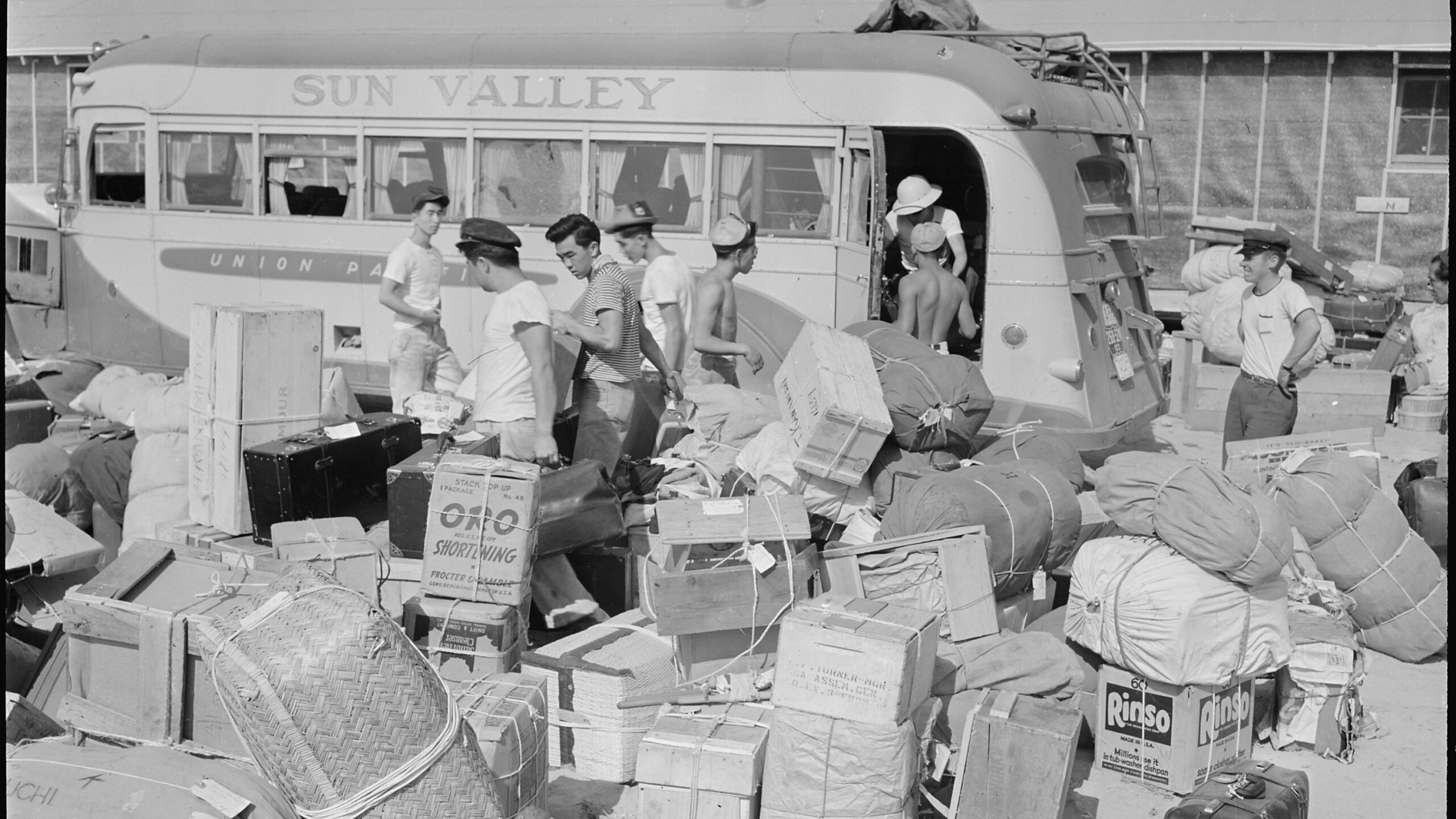
The year was 1942. People were being rounded up and sent to camps for no reason other than their ethnicity. They weren’t death camps — this was not Europe. They were internment camps for Japanese Americans during a racist panic in this country over the possibility of enemy agents hiding among those with Japanese ancestry.
Feb. 19 marks the federally recognized Day of Remembrance for the Japanese American internment. It was a shameful period in American history, and one that Bay Area Jews reacted to in mixed ways at the time.
On Feb. 19, 1942, President Franklin Roosevelt signed an order that placed at least 110,000 Japanese Americans, mostly living in California and the Pacific Northwest, into incarceration camps. About two-thirds of them were born in the U.S., and none was charged with a crime. The rationalization was that the U.S. faced danger from Japanese Americans who might sympathize with a wartime enemy following the Japanese attack on Pearl Harbor on Dec. 7, 1941, and the U.S. entrance into World War II the next day.
Our paper at the time was full of news of the war and the trickle of horrific reports from Europe’s Jews. We also reported on what was happening closer to home.
Looking back, our response to the internment of Japanese Americans was a mixed bag. The paper was definitely intensely patriotic, pro-war and pro-America. That fits in with the overall bent of our publication in those days, which sought to ensure that American Jews were thought of as truly American. It was also underpinned by a natural fear of the Nazis, with whom Japan was allied.
Yet Jews, too, were immigrants and a minority in America. And those circumstances colored how this paper discussed the internment. Jews here were sensitive to losses of rights and freedoms — but some were also either racist or afraid to speak up.
The ambivalence that greeted the internment order was apparent.
Clearly, there was anti-Japanese sentiment in our pages. In an “Editor’s Comment” from in 1942, we mentioned the “lust of the Japanese for conquest and their capacity for cruelty” in a piece that chastised San Franciscans for complaining about the loss of their Japanese servants to the camps.

Yet, in another “Editor’s Comments” that year, we surfaced a sense of unease: “Despite the general support of the movement, there is still a tremor among long-range supporters of a constitutional democracy who fear that such a step sets a precedent to deny other minorities their legal guarantees under a pretext of guarding the nation’s safety.”
Again, in 1942, we wrote about the American Civil Liberties Union’s argument that targeting Italians and Germans in the U.S. made no sense if they were known to be anti-fascist. As part of that, we wrote, “As for United States citizens of Japanese extraction, the Union argued that ‘to evacuate those who have been outspoken opponents of Japanese militarism, or who served in our armed forces during the last war, seems particularly unfair.’”
As early as 1932, after Japan had invaded China the previous year, Rabbi Rudolph Coffee of Oakland pondered what we’d now call “implicit bias” in the context of showing kindness to a gardener of Japanese descent who clearly doesn’t expect that.
“Can it be that the white man is letting his innermost feelings about Japanese atrocities in China react upon this innocent gardener?” asks Coffee. “Unfortunately, some mass-minded individuals will link all Japanese in one groove, quite unconscious of the startling fact that a poor Japanese gardener in the United States may be just as opposed to Japanese militarism as were the innocent Germans in our midst to the tactics of Deutschland’s Kaiser.”

The internment order was rescinded in January 1945, but returning Japanese Americans were greeted with discrimination. That year, we reported on a speech by Robert Sproul, then president of the University of California system, that explicitly called for an end to bias against Japanese American citizens:
“Generally, it is a warning that once any class of American citizens can be deprived of those constitutional rights, no other minority can feel safe. Mr. Sproul puts the proposition succinctly and eloquently: ‘The dream of America will be over when the color of men’s skins or other physical characteristics, determines the communities in which they live.’’’
In a 1945 article in our pages, Teiko Ishida of the Japanese American Citizens League posed a related question while noting the large number of Japanese Americans who volunteered to serve in the U.S. military during WWII: “Thirteen thousand Yanks with Japanese faces are proving themselves worthy Americans on all fronts of battle. Will the Japanese Americans who are returning to their homes in California, Oregon and Washington be given a fair chance to prove themselves?”
It was an appropriate and reasonable question in reaction to an inappropriate and painfully unreasonable period in American history — one we need to remember.