

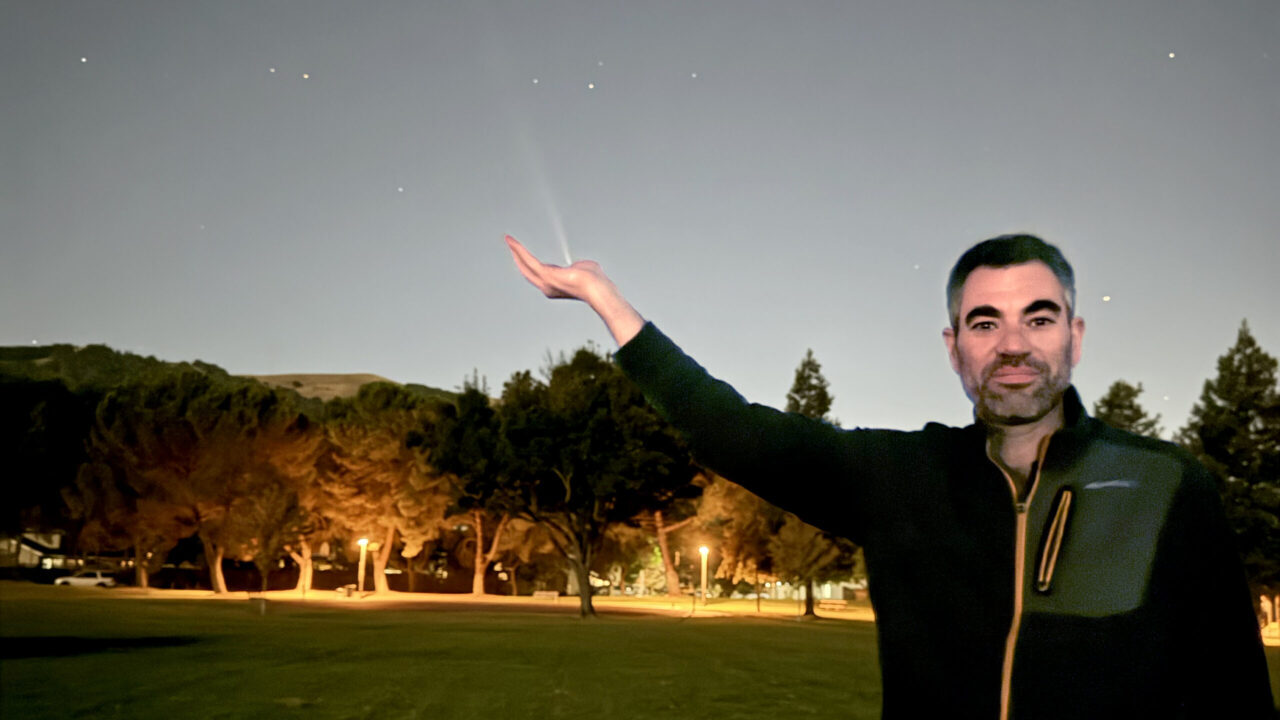
Daniel Jontof-Hutter is looking for planets. The astronomy professor, who was born in South Africa, raised in Australia and now lives in Pleasanton with his family, is at the forefront of a surge in research into exoplanets — planets outside of our own solar system.
Once the province of science fiction, the search for Earth-like planets around other stars is moving into the realm of reality, thanks to researchers like Jontof-Hutter and recent advancements in telescopes and data analysis.
Jontof-Hutter, who teaches at the University of the Pacific in Stockton, spoke with J. about Jewish life in Australia, a bar mitzvah trip to Israel that was interrupted by last year’s Iran-Israel war, and the search for Earth-like planets around farflung stars.
This interview has been edited for length and clarity.
What was Jewish life like for your family in South African and Australia?
My grandfather escaped Nazi Germany in 1936 and went to South Africa, and my grandmother survived in the underground in Holland. After the war, she left and went to South Africa and met my grandfather there.
Things were not going too well in South Africa in the ’80s. We were pretty safe there as Jews, but the whole country was heading toward civil war. So we moved to Australia, and Australia was an amazing place for Jewish families. There are a lot of South African Jews like us who moved to the same suburbs in Melbourne. It is a pretty close-knit community, fairly strong community.
Did you know anyone who was affected by the Bondi shooting?
Not directly. I have family who had friends who were in Sydney. And my rabbi here in Pleasanton [Chabad Rabbi Raleigh Resnick] actually knew the rabbi who was killed in Bondi.
You were actually in Israel with Resnick for your son’s bar mitzvah during the brief war with Iran last June.
We were there when the 12-day war with Iran started, which was an unbelievable experience. [Resnick] organized getting us onto a humanitarian evacuation that was organized for religious Jews who were trying to get out of Israel, because all the flights were canceled.
The war started just a few hours after my son’s bar mitzvah. My kids were disappointed that our plans to go to the Dead Sea and Masada were canceled, but I felt incredibly grateful that Israel was able to keep everyone safe. Most of the rockets were intercepted in space by the Israeli missile defense shield.

Well, how’s this for a segue? You mentioned that the rockets are intercepted in space — so I want to ask if you have an early memory of your interest in space.
Astronomy was always my hobby. When I was in elementary school, I borrowed all the books on astronomy I could find from the library, and I had a small telescope, and I could look at the planets and the moon and so on through my telescope. I went to the University of Maryland for my Ph.D. and haven’t looked back. It’s been an amazing journey. When you’re part of a study that you’re the first in the world to understand something or to discover something, it’s just a thrill. I really love being a scientist.
When you’re looking at one of those new discoveries, these planets orbiting other stars, how much do you know about them at this point?
Great question. We never see the planets directly. We look at the star and we see the stars dim a little [as the planet passes in front of the star]. So what that tells you is how often the planet goes around the star, what its year is. And it also tells you how big the planet is. So you can see, if it’s a small planet, it could be Earth-like.
So far, are you finding that our solar system is pretty average? Or is it an outlier?
Actually, it’s very unusual, and we don’t understand why. Before we found all these planets around other stars, we had a good theory for the solar system: that planets that are closer than the asteroid belt are small and rocky. Then you have these massive planets like Jupiter and Saturn, which have collected loads of water, hydrogen and helium gas.
But that’s not what exoplanet systems are like at all. We’re finding that there are these systems of planets — three, four, five, six, seven planets — that are closer to their star than Mercury is to the sun. It kind of turned the textbook upside down. We have to understand why the solar system seems to be the exception. And we’re motivated by trying to find life out there, how common Earth-like planets are.
That’s very exciting. I’m a big sci-fi fan, and so I love the idea that the search for extraterrestrial life is moving into an observational phase, not just speculative.
We are very lucky now that we can turn questions like that — like, how common are Earth-like planets, which until recently was more of a philosophical question — into a practical question. Like, “Well, let’s design the telescope that can answer that question and learn how to analyze that data.” It seems like we can really find twins of the Earth around other stars in the next few decades.