

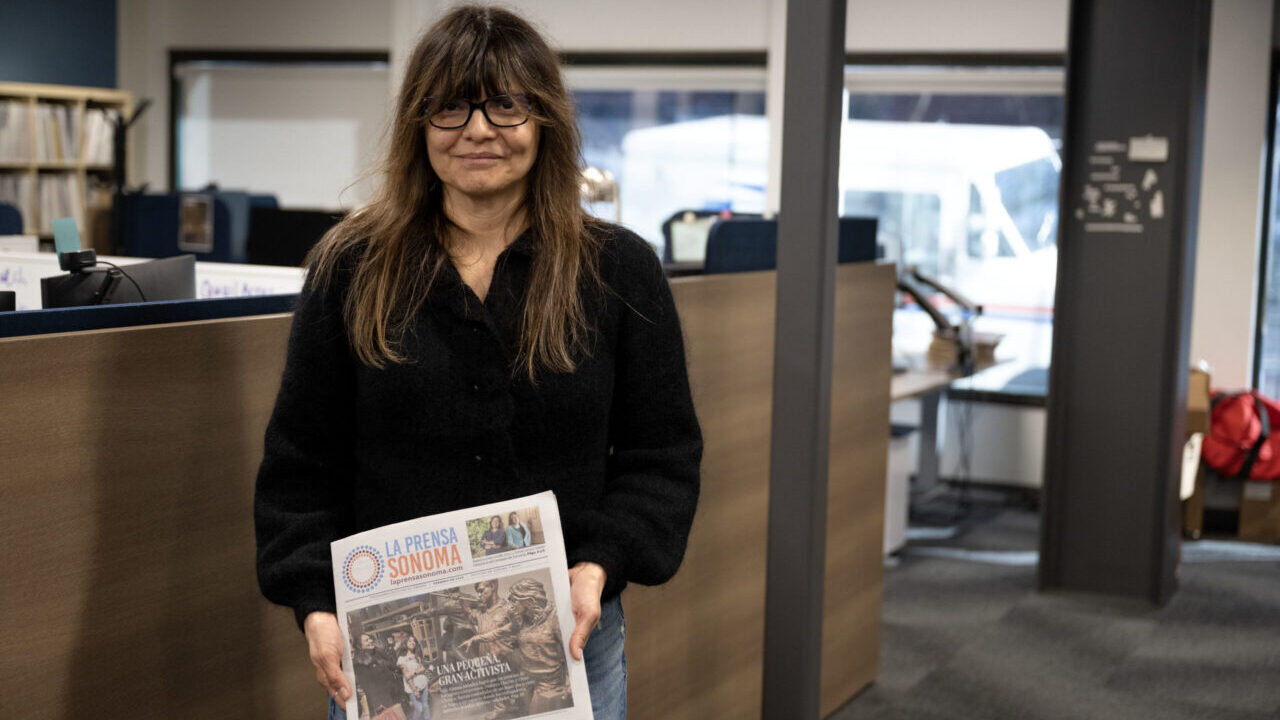
Raquel Issenberg’s life traces a path shaped by migration, reinvention and a commitment to storytelling.
In just over a year as editor-in-chief, Issenberg has expanded La Prensa Sonoma, the Spanish-language publication of the Press Democrat News Group, into a vibrant media presence that delivers culturally attuned coverage and critical information to Spanish-speaking residents across the North Bay.
She also frequently contributes to the Press Democrat. In 2025, her writing and editing on issues affecting local Latino communities was honored at the California Journalism Awards.
Issenberg was born in Mérida, Mexico. Her family later moved north to Monterrey, where she earned a degree in communications sciences from the Monterrey Institute of Technology and Higher Education.
Her first day as a reporter at El Norte, a large national newspaper, was Sept. 11, 2001. It was a sobering introduction to the gravity and unpredictability of news. Over the next 14 years, she worked at major Mexican publications, including Reforma and El Horizonte, building a career as a writer, editor and managing editor.
In 2016, she immigrated to the U.S. on a fiancé visa and began a new chapter. She lived with her husband in Pennsylvania and then Georgia, working as a teacher, interpreter and yoga instructor, eventually founding her own yoga studio.
Still, journalism remained her calling. When a rare bilingual editor position opened in Sonoma County, she seized it.
Issenberg, 50, who is a member of Congregation Shomrei Torah in Santa Rosa, spoke with J. about journalism, her conversion to Judaism and the delicate balance between neutrality and compassion in covering her own community.
This interview has been edited for length and clarity.
When did you first realize journalism might be your calling?
My grandfather was also a journalist. He would tell a lot of stories about his work and that kept my attention, but it was not my intention to become a journalist. When I finished college, I had so many options. This was around 2000 and a lot of things were happening in Mexico at that time. There was a lot of frustration with the government because the same party had been in power — we would call it a regime, because it lasted 70 years — because of election fraud. A candidate from the opposing party won the election, and with that came a big shift in Mexico. I decided that I just wanted to be part of it and to write about it.
After nearly 15 years in Mexican journalism, what was it like making a career pivot in the U.S.?
When I moved here, I thought I was never going to work in journalism again. I couldn’t see myself working as a writer or editor, especially with a language barrier. At some point, I gave up on it. I became a yoga teacher, did translation work, taught Spanish, anything I could do to work in the U.S.
When I moved to California, the Press Democrat was looking for a bilingual writer and editor with strong Spanish and news skills. I never thought I’d see a job like that. I remember calling a friend and felt like … goosebumps and butterflies. It was so exhilarating and exciting. I was just so happy to see that they were looking for someone basically describing me.
What was your vision for La Prensa Sonoma when you became its editor?
I was surprised that most agencies in both Sonoma and Napa counties don’t have a Spanish version of their PSAs when there are emergencies like wildfires or atmospheric rivers. So I started translating the work of my peers. In real time, the traffic would get super high for La Prensa Sonoma on social media. That shaped my initial vision, because people need basic emergency information in these communities that only read in Spanish.
All the immigration issues over the last two years have also changed my focus. Now we’re covering more around immigration enforcement, legal resources and the nonprofits helping out, and how the Latino community is trying to figure out what’s next and what’s right for them and their families.

How do you personally navigate the line between being a journalist and being an immigrant affected by the stories you cover?
Being neutral as a journalist, to me, is actually more like being truthful. Look for the truth, and whatever the truth is, just write it. And yeah, sometimes it’s hard. It’s heart-wrenching. The truth is not always easy to write about, not easy to tell.
What did your role as a yoga instructor teach you that you now bring into journalism?
Yoga philosophy has informed me to be more aware of my surroundings and my connection with others. I’ve talked about this with peers and colleagues: How are we reporting? How are we treating our sources? What compassion and awareness do we bring? Are we looking for the truth? By doing so, am I being aware if my source is feeling too vulnerable to speak to me, or maybe the way I direct my questions? Is there a better way? Can I offer some support to my source? Yoga gave me an awareness of others and how I can adjust within the role of a journalist to not only protect my sources but also to not retraumatize them, or not to make them feel more vulnerable than they already are.
What role do you think La Prensa Sonoma plays in today’s media landscape?
Access for our community and to our community. The Press Democrat has a paywall, but La Prensa Sonoma is free. That’s about access. The print version of La Prensa Sonoma is only in Spanish but online it is both Spanish and English. Our news in Spanish directly serves the Latino community, and the English version allows other readers to be informed about what’s happening in the Latino community.
Tell me about your Judaism. What led you to convert?
David and I got married by a Reform rabbi, so I didn’t have to convert at the time. But as journalists, we always want to know more about everything. I wanted to know more about every Jewish festival, every type of observance, everything there is to know. I took so many classes. One day my father-in-law said, “Hey, you’ve studied so much, have you thought about converting?” I decided then that I wanted to because I already felt so connected spiritually through the Jewish community there in Pittsburgh. I started converting in late 2016, and I finished in February 2018. It was beautiful. Saying my first Jewish prayer, my first Shema — I get emotional talking about it because it was very important for me.
In Pittsburgh, you were part of the Squirrel Hill community. Were you connected to the Tree of Life synagogue in 2018 when 11 worshippers were massacred?
Tree of Life synagogue is where I converted. Tree of Life has a huge building, and my synagogue at the time, New Light, rented space there. Three of the deceased were from New Light and were our shul friends. It was devastating. We were outside the building when it was all unfolding. After that, the Squirrel Hill community came together beautifully but very painfully because we were all mourning. My husband and I like to remember them every year in our own personal way at home.
So much of Latin American culture, especially Mexican culture, is influenced by Catholicism. How do you reconcile those parts of your identity?
With no judgment! In Mexico, there are Catholic holidays that feel more like social festivities than religious ones. In December I wrote about the first Posada at the Windsor town holiday celebration. Posada is a Mexican celebration during Christmastime representing the part of the nativity story when Mary and Joseph are looking for a place to stay so Jesus can be born. It took me back to when I was a kid, and I really enjoyed that. I feel the same joy going to a Purim party or Tu Bishvat. But now that I’m Jewish and very connected to the Jewish community, the meaning is different.