

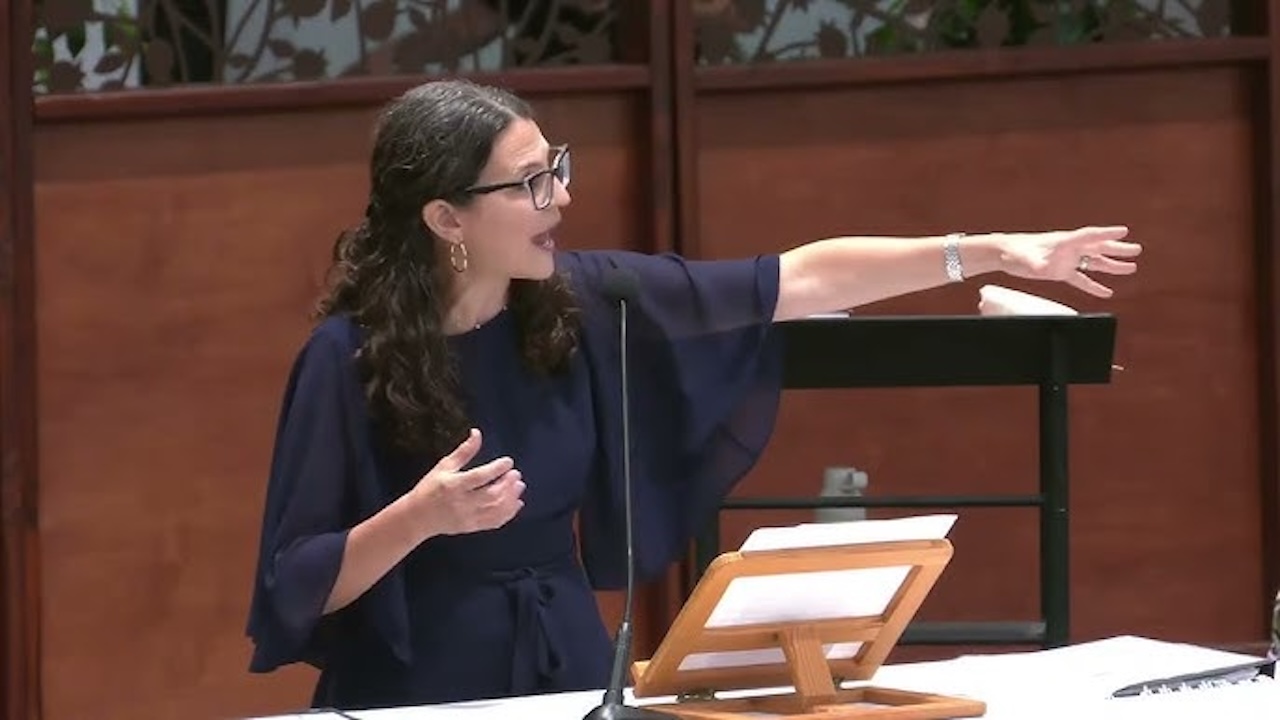
Rabbi Sharon Brous has spent much of her career asking a deceptively simple question: How do we keep our humanity in a world that often pushes us toward isolation, fear and division?
As the founding and senior rabbi of Ikar, a nondenominational congregation in L.A., Brous has become an influential voice for Jewish progressive values. Her 2024 book, “The Amen Effect: Ancient Wisdom to Mend Our Broken Hearts and World,” explores how spiritual traditions can help individuals and communities confront modern crises. She will discuss her work on April 23 at a City Arts & Lectures event in San Francisco.
“My work for the last several years has been rooted in how we heal as individuals, as communities and as a society in a time of so much anguish and so much moral confusion and uncertainty,” she told J.
Ordained as a Conservative rabbi, Brous co-founded Ikar in 2004, seeking to infuse traditional, egalitarian worship with more music, emotion and social action. Next year, the congregation is scheduled to begin redeveloping a property that will serve as its first permanent home and will include 60 to 70 housing units for formerly homeless seniors.
Her book draws on Jewish texts and traditions to explore how ancient wisdom, such as that found in the Mishnah, might help people “reclaim our humanity in profoundly inhumane times.” Brous believes faith communities can play a crucial role in countering political polarization and deep social fragmentation that she says threaten people both individually and collectively.
“Loneliness, social alienation and isolation pose such a profound threat, not only to our spirits, but also to our democracy,” she said. “How we turn to each other, with compassion and curiosity, is an act of hopeful defiance in an environment that is increasingly hostile and callous and really polarized.”
People are grappling with a future threatened by climate change, political extremism, rapid technological advances, violence and war, she said. While these forces can leave individuals feeling powerless, Brous asserts that people need to “learn how to respond with love, courage, compassion and curiosity” instead of retreating into fear or ideological entrenchment.
Anger, she added, is not necessarily the enemy. Throughout history, righteous indignation has fueled social change.
“We should be angry about what’s happening in our country and around the world,” Brous said. “But the question is, what does that anger awaken in us?”
Rather than allowing rage to harden into resentment, she encourages people to transform it into constructive action through acts of solidarity rooted in love.
“Part of what we have to do is recognize that so much is broken right now, but every one of us has the power to respond to these really difficult times by showing up in private and in public with love,” she said.
During the U.S. Immigration and Customs Enforcement escalation in Minneapolis this winter, for example, community members responded not only by protesting but also by delivering food, protecting vulnerable residents and offering support and other forms of mutual aid, she said.
“We saw what happened when there were literally armed militia men on the street who were pulling neighbors out of their homes,” she said, “and the people of that city responded with love.”
Everyday gestures of love and kindness are part of what Brous calls “quiet care,” a concept she describes as rooted in Jewish ritual and communal tradition.
“In moments of grief and illness and loneliness and heartache, the tradition reminds us that while our instinct is to self-isolate, we’re actually called into community,” she said. “Extrapolating from these ancient rituals, what we learn is that sometimes it’s an act of courage to even leave your house and go to dinner with friends, to go out and meet your neighbors on your street.”
In a country where many people do not know the names of their neighbors, Brous said that rebuilding local relationships can be a radical act. One simple spiritual practice she recommends is intentionally connecting with the people who live nearby through a weekly walk around the block or small conversations that build familiarity and trust.
“We need each other,” she said. “And in order to support each other, we have to actually know each other.”
Brous speaks from experience. While researching her book, she realized she barely knew many of the people in her own neighborhood. She began greeting neighbors during morning runs, gradually building relationships. Over time, those connections formed the basis of a neighborhood support network, allowing residents to check in on one another and respond quickly when community members needed help.
“When there were ICE raids in our neighborhood, we had a neighborhood group chat and people checking in on each other,” she said. “We heard that people were sick, and we could go and bring them food.”
For Brous, that kind of community building is not merely social, but spiritual and civic. Human connection, she argues, strengthens both personal resilience and democratic life.
The rabbi will explore some of these themes at her April 23 event with john a. powell (who lowercases his name), the director of UC Berkeley’s Othering & Belonging Institute and a professor of law, African American studies and ethnic studies.
“The running thread through all of this is rehumanizing ourselves and each other by actually showing up for one another,” Brous said. “The harder it gets to do that, the more important it is.”