

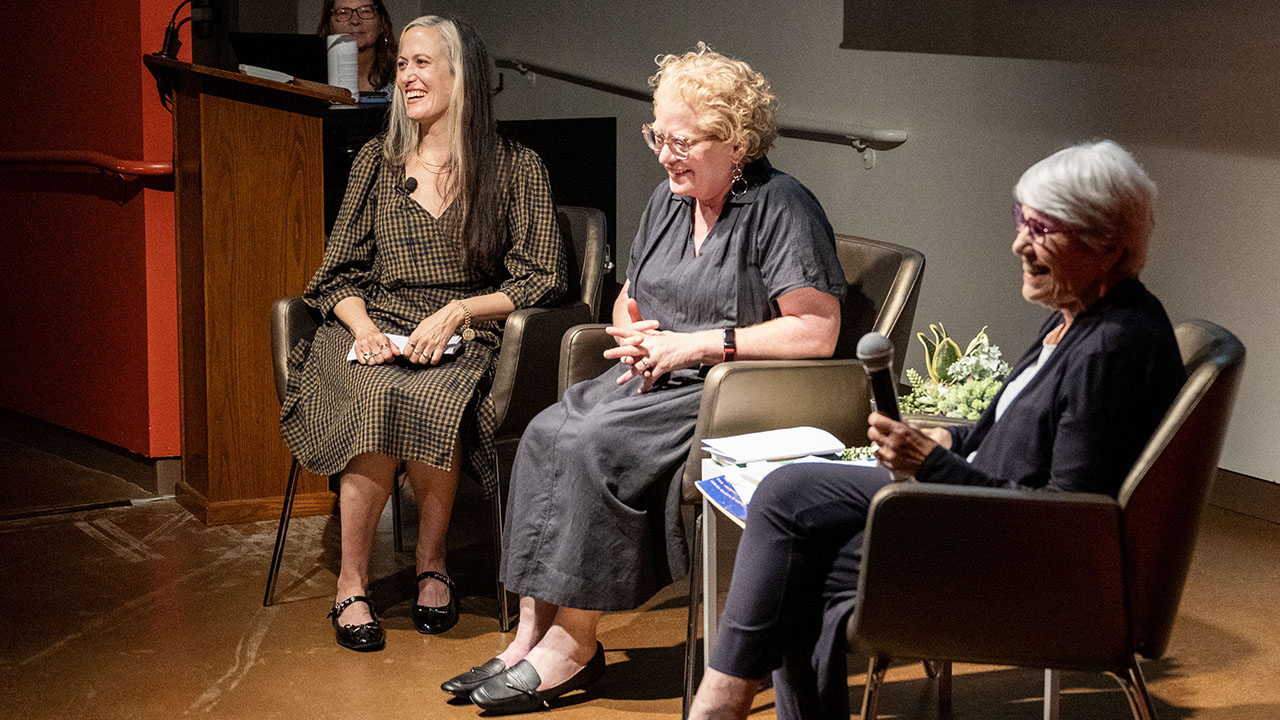
I sat down with two wonderful historians and archivists, Lara Michels and Susan Morris, on March 22 to discuss the importance of preserving California Jewish history. We met up at the Magnes Collection of Jewish Art and Life in Berkeley as part of a celebration of 130 years of J., which was founded in late 1895.
Michels is head of archival processing at UC Berkeley’s Bancroft Library, where she oversees collections that include the records of the Western Jewish History Center. Morris is a former curator and executive director at the Judah L. Magnes Museum, the precursor to the Magnes Collection, and the author of “A Traveler’s Guide to Pioneer Jewish Cemeteries of the California Gold Rush.”
This interview has been edited and condensed for clarity.
Why even bother saving all of these bits and pieces of history? What’s the point of keeping all these records?
Michels: This is what I think about 24 hours a day. Archives are primary sources — the photographs, the documents, the letters, all the things that people create in their day-to-day lives. They are the primary sources upon which historical research is based. They’re part of keeping a society, organization or institution accountable.
The Jewish community in the Bay Area has kept its archives, at least some of them! They’re spread around a little bit.
These are not easy things to create or maintain. They are somewhat expensive. You need certain kinds of materials and climate and staff, so they take a huge amount of commitment. At the Bancroft, we have 100,000 linear feet of paper, and we have to maintain that … kind of forever.
Morris: I’m going to point out a particular object that we almost didn’t acquire when I was at Magnes. It’s a portrait of Max Lilienthal. [Lilienthal was an influential rabbi in the antislavery movement in Cincinnati and a key figure in early American Reform Judaism. The portrait was defaced in 1861 by Jacob A. Cohn, a Confederate captain who died a year later at Manassas.]
What is scrawled on the portrait, what is boldly written, I quote: “Sir, since you have discarded the Lord and taken up the sword in defense of the Negro government, your picture, which has occupied a place in our southern homes, we here return to you, and may you present them to your beloved black friends. I shall be engaged actively in the field, and should be happy to rid Israel of the disgrace of your life.”
I was working at Magnes when [founder] Seymour Fromer learned this was going to be auctioned. He went to many prospective donors to say this is an important part of the holdings of the Magnes. In the end, members of the Lilienthal family helped to supply the funds needed to bid at that auction. This is such an important original piece of history.
How is it decided what will be preserved? How do you prioritize, when funds and space are not endless?
Michels: You have to remain connected to the community. We are short on space, short on paper, short on everything. But we have to make decisions. Sometimes our decisions do come down to: Do we have enough space?
They would have debates [at the Magnes] about what parts of the community they were capturing and which parts they weren’t. And they were sensitive to the fact that they were capturing more from the German Jewish community, from the Eastern European Jewish community, and they talked about that, and they were attempting to remedy that at various times.
In your work, are there collections or items that just stay with you?
Michels: I have collections that stay with me and that I think about all of the time. The Congregation Sherith Israel records — it’s a big collection, an amazing collection, going back into the 1850s. It is the only real significant organization whose records survived the 1906 earthquake in San Francisco.
Its records document the history of the city in really interesting ways. I was committed to retaining almost everything. This collection is truly spectacular. I’m very happy that I got to work on it.
Morris: This is a rough translation of a letter written from Downieville, California, Mother Lode country, in November of 1856. The writer is Johanna Mayer Hirschfelder. She writes to her mother and brothers in Germany, describing her trip from New York to San Francisco a month earlier.
Let me read you just a couple of passages: “Our trip was, with God’s help, one of the best and most beautiful that has been made in a long time.”
There are pages and pages about what she ate and how she spent her time. She says, “On October 2 in the morning, at nine o’clock, we left on the Panama Railroad via the isthmus from the Gulf of Darién, where it was awfully hot, and my arm, which held the umbrella, was blistered.”
The point is — these are human beings, like we are.
J.’s archives are online at jweekly.com. How can people access other records?
Michels: The Bancroft Library is open to the public. You have to request [the records] ahead of time. It’s a little more logistically challenging, but everybody is welcome to use the Bancroft Library and any of the collections. We do have reference librarians who can help you figure out how to access things.
What should people do when they have materials that might be worth preserving?
Michels: Our curators will engage with you. They do an appraisal, where they’re trying to figure out whether this is the right fit for the Bancroft Library.
It could be a lengthy process, deciding whether we should add it to the collection. But we are collecting Jewish Americana to this day. We’re still bringing materials in from various families and organizations.
Morris: This has to do with your curiosity and alertness and awareness of the importance of documenting and preserving the diversity and complexity of the Jewish community you live in, of your family. Recognize that each of your stories is important. We are the holders of the future archives. We are the collectors of the breadth and the depth of the knowledge of the Jewish experience.