

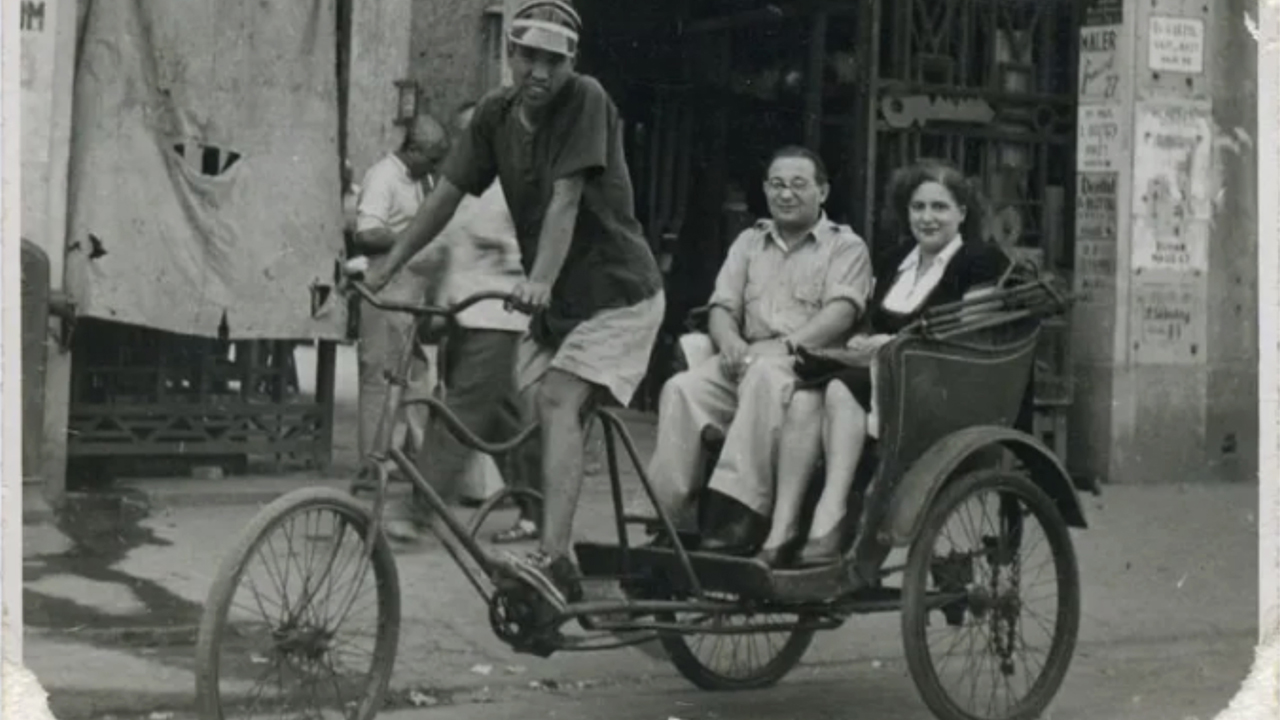
For many American Jews, the connection to Chinese culture begins and ends with a familiar Christmas Day ritual: eating at Chinese restaurants. But that modern tradition obscures the deep history of Asian Jewish communities, including one of the oldest in Kaifeng, China.
“We are the OG,” said Josh Zuo, a board member of the Sino-Judaic Institute whose father grew up in the Kaifeng Jewish community. Zuo lived in Taiwan before relocating to Los Angeles six years ago. “We are the most native Chinese Jews around the world.”
The Sino-Judaic Institute, an academic institution with strong connections with the Bay Area, strives to commemorate this Chinese-Jewish connection with its programs, grants and scholarly journal. The institute also highlights Jewish communities that have sprung up along China’s coasts, most notably in Harbin and Shanghai.
Andrea Lingenfelter, the Kensington-based president of the institute and an adjunct professor at the University of San Francisco, sees her academic work as vital to preserving the story of Chinese Jewry.
“There’s a generational shift,” she said. “One of our goals is to bring younger people into the community, because so much of the work is important historically.”
For Lingenfelter, a scholar and translator of Chinese literature, studying the history of China’s Jews offers lessons about living alongside those who are different, the tenacity of tradition and the human capacity to take care of each other.
“Repressive societies and governments are the enemies of historical memory,” she said. “This is true everywhere.”
In Kaifeng, the story began with a group of merchants who migrated from Iran and Iraq around 1,000 years ago during the Song Dynasty.
“At that time, it was maybe the largest city in the world,” said Rabbi Anson Laytner, the previous president of the institute. “It was also the capital of the Chinese Empire, so it was the place to be.”

The small group of merchants eventually acclimated, intermarried and became acculturated to Chinese society, Laytner said. The Jews of Kaifeng were accepted into the Chinese community in ways they weren’t in Europe — they were allowed to take Chinese surnames, enter the civil service and build a synagogue.
“They had financial support from the government to rebuild the synagogue when it was destroyed by floods, which happened numerous times,” Laytner said.
There were other key differences, too, according to Zuo.
“Unlike in Europe, the Chinese Jews were allowed to own land,” he said, giving them agricultural rather than business experience. Zuo also said there was not the same level of antisemitism there was in Europe.
Fortunes changed for the Jewish community in Kaifeng during the Ming Dynasty, which closed the country’s doors to Western trade. That was followed by a major rebellion in the Qing Dynasty, culminating in the siege of Kaifeng.
“The community was pretty impoverished and just existing on memories,” Laytner said. “The last rabbi had died in the beginning of the 19th century, and they didn’t know how to read Hebrew anymore.”
At some point, the Kaifeng Jews adopted the Chinese method of lineage, tracing their heritage patrilineally instead of matrilineally as required by Jewish law. “So they were not halakhically Jewish, but they still considered themselves Jewish,” Laytner said.
Today, the community numbers between 500 and 1,000 people and must practice largely in secret because of restrictions imposed by the Chinese government. Judaism is not one of China’s officially recognized religions. After a government crackdown on unauthorized religions began in 2015, the Sino-Judaic Institute was forced to close the school it had helped establish.
“Even museum exhibits dealing with the Kaifeng Jews were closed,” Laytner said. “We’re in survival mode, because we’re waiting for Chinese attitudes to change.”
Still, the story is far from over, and there are signs it may soon reach an even broader and younger audience despite governmental restrictions — echoing one of Lingenfelter’s key goals.
About six months ago, Zuo was interviewed by Netflix producers in Los Angeles for a documentary on Asian Jews, which they want to start with the story of Kaifeng.
“It’s a serious documentary,” he said. “It’s something like a $20 million production.”
Zuo understands why the story of the Kaifeng Jews is so compelling, especially in today’s world where we are looking feverishly for stories that have not yet been told.
“I’m an Asian Jew. I’m like a unicorn,” he said. “I’m so special, but that’s both a blessing and a curse.”