

San Francisco’s Jewish community held its first Yom HaShoah ceremony on May 3, 1978, just one short and painful year after the opening of a Nazi bookstore across from a Sunset District synagogue led to violent confrontations. It was the spark that led the city to establish the annual event — but it also came nearly 30 years after the Israeli government had declared Holocaust Remembrance Day to be held on the 27th of the Hebrew month of Nisan.
Why did it take that long for San Francisco’s Jewish community to start its own commemorative tradition? That rhetorical question, posed by JFCS Holocaust Center director Morgan Blum Schneider, hung in the air on Monday night for the 47th annual Yom HaShoah ceremony at the JCCSF.
The theme, “The Courage to Act: How to Be an Upstander,” was illustrated through the stories of Holocaust survivors and their descendants and was punctuated by calls to action from educators and public officials. It was one of several such events held around the Bay Area.
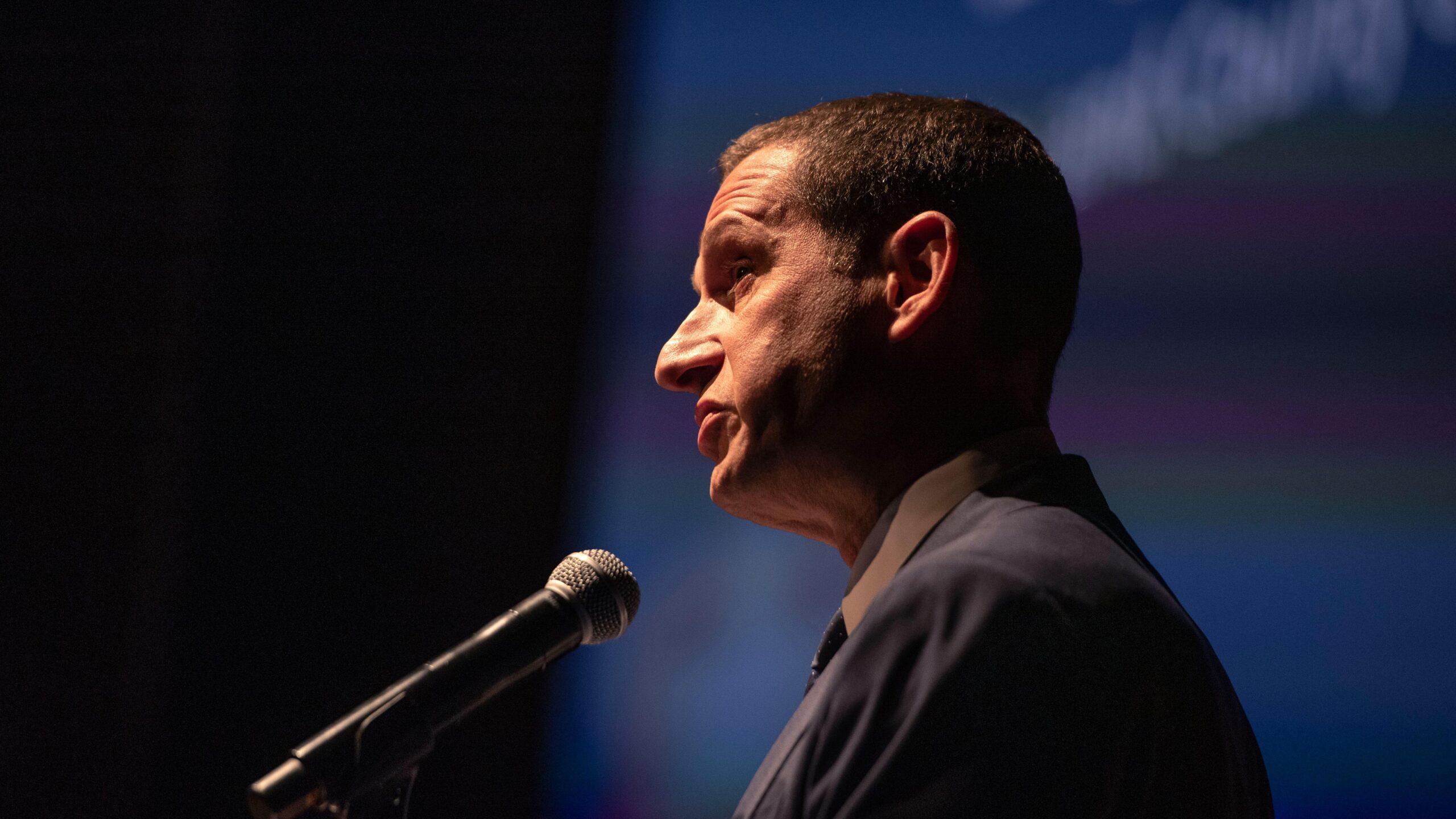
San Francisco Mayor Daniel Lurie delivered the keynote speech.
“As we remember those who died and honor those who survived the Holocaust, we also look forward. Because even in our darkest moments, we have seen the light of courage and community,” Lurie said to some 400 attendees. “We see it in the survivors who rebuilt their lives. We see it in the families who carry their stories forward, and we see it right here in our Jewish community, and as a city that continues to choose hope and optimism.”
But for these very survivors, San Francisco wasn’t always such a beacon of hope. In April 1977, it was the site of real anguish, when the Rudolf Hess Bookstore opened on Taraval Street in the Outer Sunset and brought the trauma of the city’s Holocaust survivors to the surface.
Disturbing confrontations between survivors and those operating the bookstore led demonstrators to attack the store with crowbars, sledgehammers, tire irons and axes, J. and the New York Times reported at the time. The stained-glass windows of Congregation B’nai Emunah across from the bookstore were shattered in retaliation.
During Monday’s ceremony at the JCCSF, organizers screened part of “Pioneers and Founders of Holocaust Remembrance,” a short film from 2013 about how the bookstore incident led to city-wide efforts to confront the legacy of the Holocaust.
The film referenced a meeting at the time with local survivors, where leaders of the Jewish Community Relations Council finally understood how the survivors’ trauma had been overlooked for years.
“They really started yelling at us,” then-JCRC educational director Naomi Lauter recalls in the film. “‘Where have you been? We have been here 30 years, and no one has come near us. We’ve done pretty well.’ And they really have done pretty well, amazingly so.”
Among the Holocaust survivors who managed to thrive after finding their new homes in the Bay Area was the grandmother of Rafael Mandelman, president of the San Francisco Board of Supervisors. In conversation Monday night with local philanthropist Susan Lowenberg, whose father, William, was also a survivor, Mandelman shared his grandmother’s story and the lessons he continues to draw from it in his work as an public official. (He represents District 8, spanning the Castro and Noe Valley neighborhoods.)

By the time the Nazis invaded her native Poland, Esther Kozlowski had a 3-month-old baby, Rafael’s father. She spent the war in hiding going from attic to basement, somehow managing to elude capture. After the war, she fled Poland with her son for a displaced persons camp in Germany, eventually making her way to the U.S. in the early 1950s.
“These people who survived, who came to this country and built lives here, were the toughest human beings,” Mandelman said at the event. “As bad as it gets, we’re not even in the same universe as what these people had to go through. And I think that is actually a gift.”
That perspective has helped him weather tense confrontations that surged following the attack on Israel on Oct. 7, 2023, when fierce debates over a resolution calling for a ceasefire in Israel’s war with Hamas embroiled San Francisco’s City Hall.
Mandelman, along with supervisors Matt Dorsey and Catherine Stefani, were the only three who voted against a revised resolution that added a call for the release of hostages — but still demanded a ceasefire. That period reminded Mandelman of the crucial importance of allyship with those outside the Jewish community.
“It was very helpful to me to have Dorsey and Stefani on that body, who … instinctively understood that this is a complicated issue that the San Francisco Board of Supervisors did not need to weigh in on. And if we were going to weigh in on it, we needed to do it with care,” he said. “Having them there to make those arguments was a relief for me.”
The JFCS Holocaust Center’s California Teachers Collaborative also seeks to find such allies in the classroom. The Bay Area has seen a resurgence of antisemitic incidents at K-12 schools, including neo-Nazi displays, swastika graffiti and glorifications of Hitler.

To highlight the work of the collaborative’s participants, every year at its annual Yom HaShoah commemoration the JFCS presents the Tauba & Morris Weiss Award, which recognizes innovative education around the Holocaust and other genocides in history. The Weisses were survivors and among those who confronted the operators of the Nazi bookstore.
This year’s winner, Rohnert Park teacher Kate McGerity, dedicated part of her speech to her decade of collaboration with Holocaust survivor Peter Krohn on a series of talks with survivors and their children at schools throughout Sonoma County.
“I strive to create a space for students to reflect and ask questions and connect these lessons to their own lives. Over my 30 years in the classroom, my teaching has evolved to focus not only on historical understanding, but on helping students develop empathy and ethical awareness,” said McGerity, who teaches U.S. and world history at Rancho Cotate High School. “In my classroom, students begin to understand their universe of obligation, that even people they have never met deserve dignity, protection and care.”