
Books coverage is supported by a generous grant from The Milton and Sophie Meyer Fund.
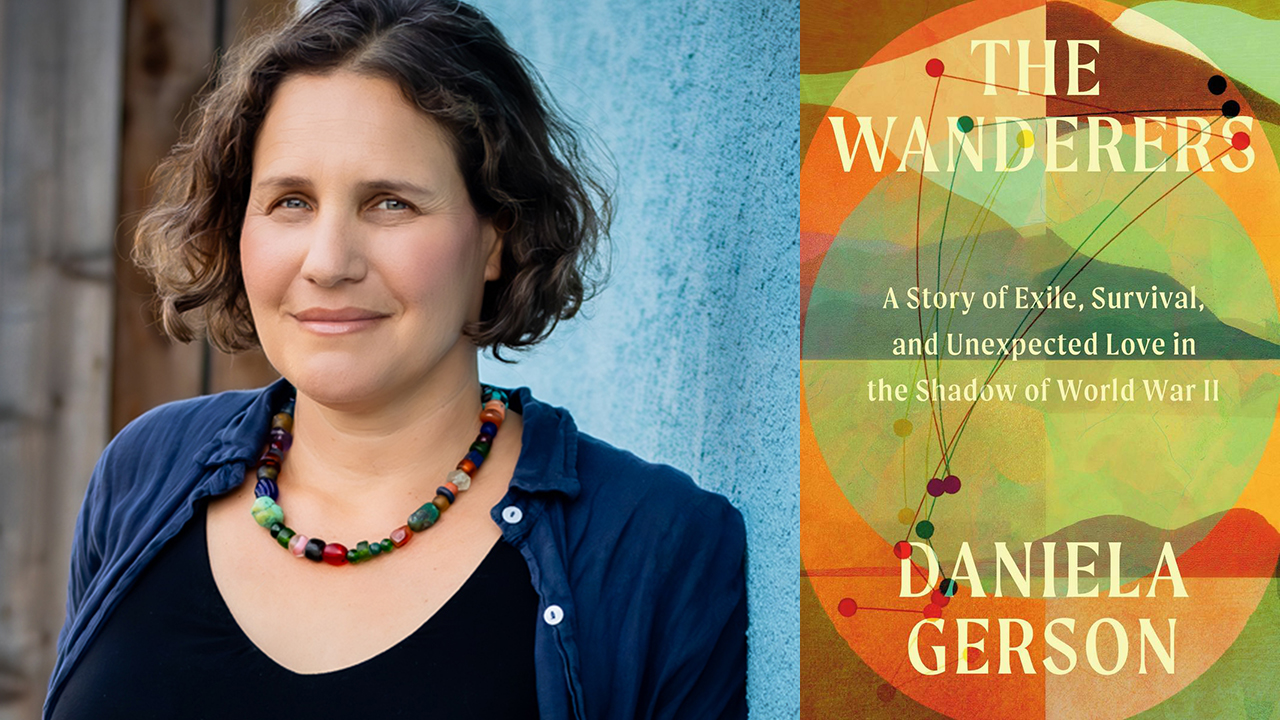
When Daniela Gerson met her future wife, Talia Inlender, in Los Angeles, neither knew their families had come from the same town in Poland. They later learned that their grandparents had even been neighbors.
In “The Wanderers,” Gerson, who teaches journalism at California State University, Northridge, combines reporting and extensive travel to reconstruct the parallel paths the two families took after their lives were upended in the late 1930s. Deeply personal, the book is among the most compelling family histories I’ve read in recent years.
Today a UNESCO World Heritage site, Zamość is a picturesque town that for centuries was home to a substantial Jewish population, both Sephardi and Ashkenazi. Germany captured the city after invading Poland in 1939 but, following the Molotov-Ribbentrop Pact that divided Poland between Germany and the Soviet Union, soon ceded it to Soviet control. However, in a mind-boggling case of geopolitical whiplash, Germany again assumed control upon a redrawing of borders a mere week later.
The departing Red Army offered the Jews of Zamość a choice: remain under Nazi rule or travel east with them to the USSR, leaving behind any possessions. Most chose the latter option, including many of the Gersons and Inlenders, who soon found themselves in Lviv.
The refugees then faced another painful decision: accept Soviet citizenship or register to return to Nazi-occupied Poland. Having experienced Soviet repression firsthand, most of the Jews from Zamość opted to register for repatriation to Poland.
But the offer was a ruse. The Nazis did not yet have a formal policy of complete annihilation of European Jewry, and did not want Jews back in their territory. The Soviets had no interest in retaining people who were not loyal to the USSR. Using names and addresses entered in the registry, the secret police forced vast numbers of refugees onto trains headed east of the Urals.
Members of both families were sent to gulags, where conditions, particularly in the winter, were brutal.
When Britain and the USSR forged a military alliance in 1941, Britain pressed for the release of Polish political prisoners, and Joseph Stalin obliged. Liberated from the gulag, the Gersons and Inlenders joined an exodus to Soviet Central Asia, where Gerson’s father was born in Uzbekistan.
After the war, many Jewish families attempted to rebuild their lives in Poland, but violence and hostility made clear they were not welcome. The 1946 pogrom in Kielce that claimed 42 lives underscored the danger. Thousands of families moved to displaced persons camps while awaiting resettlement. Inlender’s family would eventually go to Israel, while Gerson’s, using false papers, immigrated to the United States, ending more than a decade of displacement.
Striking in reading about the families’ odysseys is how little recognition the experience of Polish Jews deported to the eastern Soviet Union has received. Before reading “The Wanderers,” I did not know that the vast majority of Polish Jews who survived the war did so in part because of deportation to Siberia.
At the time, they could not have known they were the lucky ones. Nearly all the Jews who remained in Zamość were either shot there or died in the Belzec and Sobibor extermination camps.
Gerson notes her surprise in learning that most Polish deportees to Siberia were non-Jews, with their experience memorialized to a greater extent. At a museum in Bialystok dedicated to the Siberian deportation, she was told: “when Polish people are talking about deportations, they are talking about suffering, about death, about all these tragedies. When Jews, Polish Jews, are talking about these deportations, they are talking about that they survived because of these deportations.” She reflects that “for our families, the legacy of exile and forced labor in Siberia would always be a most brutal salvation.”
“The Wanderers” reads like a love letter to Gerson’s inherited and chosen families, reflected in the enormous amount of work behind the book. In the case of Inlender’s family, who rarely spoke of their travails, it was a herculean task to reconstruct these narratives of survival after most of those who experienced them were gone. Gerson went to great lengths to interview those who could be interviewed, and to uncover primary source material — some of it now easy to access digitally, and some, such as the records kept by the Soviets, extremely difficult to obtain — which yielded some extraordinary revelations.
Given that Gerson’s journalism career has focused on immigration, while Inlender works as an immigration attorney, it may feel as if they came to their work through a sort of predeterminism. But we know from our nation’s current political climate that not all descendants of immigrants feel empathy for newer immigrants. These values need to be cultivated.
“As Talia and I pass on the Jewish tradition to our children, with its legacy of displacement and survival, we are now the ones charged with sharing our ancestors’ stories and the lessons we draw from them,” she writes.
In reading those words after Passover, I was struck by how those ancestors could be from centuries or millennia ago, or our most immediate families — a wandering Aramean or a wandering Polish Jewish refugee. Absorbing these histories and integrating their lessons — that all of us are vulnerable, and that all of us are valuable — feels as essential as ever.
“The Wanderers: A Story of Exile, Survival, and Unexpected Love in the Shadow of World War II” by Daniela Gerson (Grand Central, 336 pages)
IF YOU’RE GOING
JCCSF talk. 7 to 8:30 p.m. Thursday, April 30. At the JCCSF, 3200 California Street, S.F. $25-$45.
“The Missing Piece: Hidden Soviet Jewish Histories.” 12 p.m. Sunday, May 3. At the Magnes Jewish Arts & Bookfest, 2121 Allston Way, Berkeley. $5-$40.
Jewish Community Library talk. 6:30-7:30 p.m. Tuesday, June 2. Virtual Free