

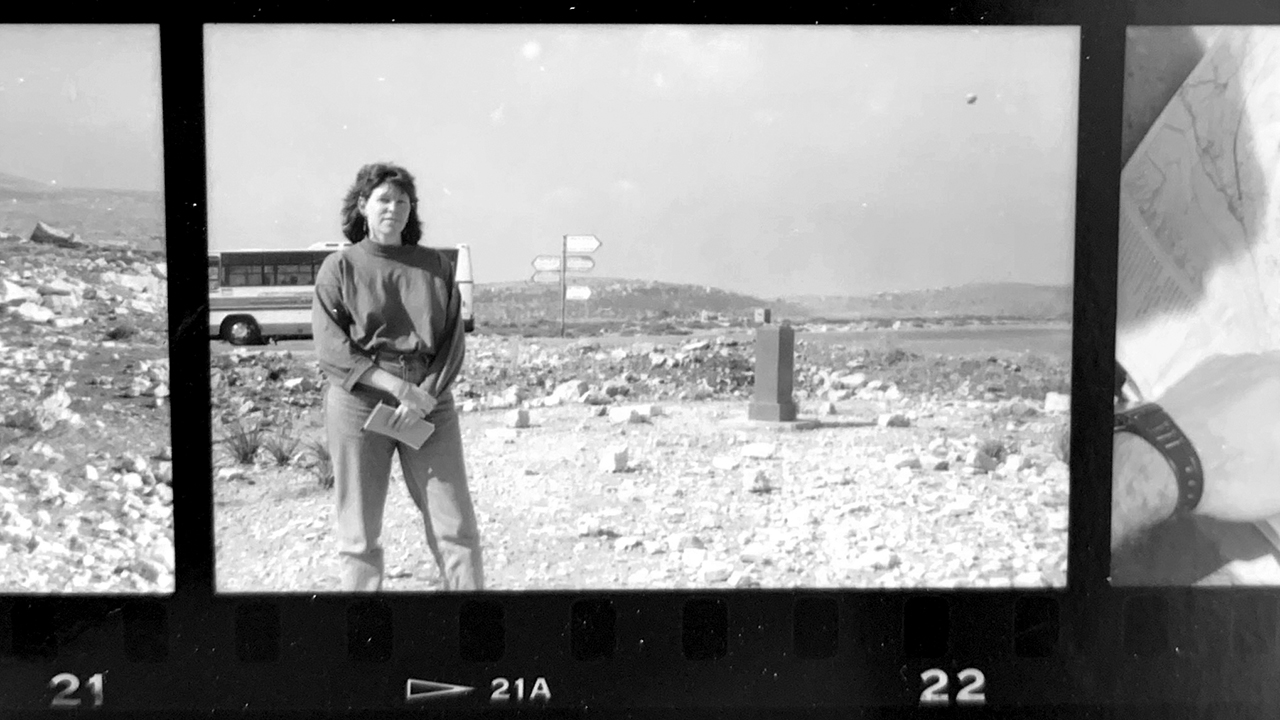
After running a quick search in our digital archives, Sue Barnett’s impact on this publication is confirmed: Her name has appeared 712 times in J. and its predecessor, the Jewish Bulletin.
“Sue Barnett” first appears in this publication in a modest 1975 announcement about the officers for a San Francisco youth group. She became the historian of the local B’nai B’rith Girls chapter. But that was far from the last time the San Francisco native would show up in our pages, including during two separate stints on our staff.
Our managing editor, SueB, as she is known around the office, retired on May 1. So in this installment of “From the Archives,” we’re taking a look back at her long imprint on our publication, with a focus on that first stint and the gap years before her return.
She is mentioned twice more in BBG announcements in 1977 and 1978, but her first appearances as a writer came in our Aug. 2, 1987, issue. Sue was 26 when her first two bylines came up in the Jewish Bulletin, each shared with another reporter. The first, with Steve Smith, was “Homes for aged learn to cope with older, frailer clients,” a story about local Jewish senior homes dealing with increasingly elderly residents. The second, with L.K. Friedman, “Anti-circumcision drive may be perilous, doctor asserts,” was an interview with a local urologist.
Sue insists she has no memory of either story. But she does recall her next byline: an interview with Abba Eban, the legendary Israeli diplomat and politician.
“I still remember how nervous I was for the interview,” she said. So nervous, in fact, that she neglected to put her tape recorder close enough to pick up his voice clearly, making the actual writing of the story a little more difficult than she anticipated.
Over the next few years, she covered all kinds of stories for J.
Against her will, as the resident “young person,” she was repeatedly sent to cover stories about singles: “Comedians yuk it up at Emanu-El’s singles network dinner,” “Singles groups create family of friends to break fast,” “Traditional matchmakers find niche in contemporary ’80s,” “Jewish singles unravel mystery behind fruitful flirting.”
Soviet Jewry and the refusenik crisis were frequent topics in the Bulletin in the late ’80s, and Sue had a few bylines on the subject, including “BBYO teenagers rally for refuseniks at Soviet Consulate” and “Soviets open door to Jews for 2nd time at S.F. rally.”
She actually had a personal stake in the refusenik issue. After the Soviet Union collapsed and Jews began streaming out of the former USSR into the U.S. and Israel, Sue placed this classified ad in the Bulletin in 1993: “Comfortable, reasonably priced 2 bedroom apartment wanted in Richmond District for Jewish Bulletin staffer’s Russian family, emigrating to San Francisco on August 26. $800 or under; garage would be nice.”
That family, second and third cousins she’d never met before, was the subject of a touching and funny article: “My cousins, the emigres: Writer tells insider’s story.” In it, Sue saw America anew, through the eyes of her newly arrived relatives:
“Imagine walking into a used car lot and saying in halting English, ‘I’ve got $4,000 cash in my pocket. What will it buy me?’ You’d be a sleazy salesman’s dream. That’s essentially what happened to my cousin Arkady, in this country from Moscow just 10 months and eager to buy his family their first American car. He walked in with the cash, and drove out in a 1984 black Lincoln Continental with a sweet 100,000 miles on it. It wasn’t what he had planned to buy, he admits, but when he went for a test-drive, ‘it was so smooth.’”
“Back in Russia, he drove a ’79 Lada, the Soviet car so crudely made that he carried spare parts including a carburetor in the trunk. No wonder that Lincoln looked so good. The next day, naturally, it wouldn’t start. Arkady ended up back at the lot, where he traded the Lincoln in for something more sensible and a hard-learned lesson.”

That same year, Sue joined a trip for Jewish journalists to Tunisia, then the headquarters of the Palestine Liberation Organization, and participated in a group interview of Yasser Arafat, whom she termed in a headline “The artful dodger,” for his facility at evading their questions.
That was 1993, near the end of her first stint at the Bulletin. Sue next appeared in our pages as a reader. Both of her children’s birth announcements were printed in the paper. And in 1996 she wrote a critical letter to the editor. It’s a glimpse at how her moral spine bristles at hypocrisy and unfairness — typical attributes in a journalist.
“It was obvious that your March 30 frontpage story on gay couples awkwardly avoided the words marriage and wedding. Choosing to call a gay marriage a ‘union’ doesn’t change the couple’s love or commitment, it only serves to exclude homosexuals as different, and less deserving of the same rights as heterosexuals. Jews should be sensitive to the intrinsic danger of singling out minorities as unworthy of inclusion: Weren’t we in a similar position when the Nazis decided our differentness was a threat, excluded and separated us, and labeled us with yellow stars?” she wrote.
“You justify your editorial position by saying the state of California does not ‘condone’ gay marriage. Should we act only when the government approves? When African-Americans were denied the right to vote, did we as Jews say, ‘The government doesn’t condone it so we can’t either,’ or did we fight for equal rights?”
“The Bulletin must do the right thing, not the easy thing. Call it a gay wedding. Will the wrath of God come down upon us? I doubt it. Will gay Jews who want to affirm their love under the chuppah feel the embrace of the community, rather than its condemnation and judgment? Undoubtedly so.”
In 2011, Sue returned to us, shortly before the arrival of Sue Fishkoff as editor-in-chief, necessitating her transformation into SueB, the editor whom the current denizens of this newsroom know and love.
In her second round here, she continued to write occasionally, including about drag performers, the band Lawrence and Morocco, where she explored the vestiges of the country’s Jewish past while avoiding platitudes. Mostly she has been the backbone of the editing process during her second stint: overseeing and shaping younger reporters, meticulously editing all of our work, undertaking all the behind-the-scenes effort required for our print edition and always standing up for us when we need it.
Sue Barnett has left her mark on J. in countless ways. This publication wouldn’t be what it is without her. We will carry on, as J. has for 130 years, but it won’t be the same.