

It’s harder than you think to write a “From the Archives” column on Shavuot, because as a search term in our archives, this holiday is tricky. In the past 130 years we’ve spelled it many different ways: Shavuoth, Shavuos, Shevous, Shabuoth … and some I probably don’t even know to look for.
I never celebrated Shavuot as a kid, and apparently I’m not the only one.
In a 1940 article titled “Shavuoth: American Jewry Should Revive Important Biblical Holiday,” the author, Rabbi David Stolper, lamented the lack of Shavuot fervor.

Stolper was a famous teacher who in 1926 became principal of San Francisco’s Central Hebrew School. Founded in the previous century, the school became a major institution under Stolper’s direction.
According to a 2006 article in this paper by Joe Eskenazi, Stolper ran “six Hebrew schools up until his death in 1947. He also oversaw Kol Yakov, a synagogue entirely operated by children. As a result, dozens and dozens of young San Franciscans drafted into World War II ably led Jewish services in every corner of the globe.”
In his 1940 article, Stolper wrote that he had “recently made a survey among a large number of Jewish boys and girls to determine their attitude toward our different holidays, and found that, while one hundred per cent of the children contacted celebrate Passover, Rosh Hashona, Yom Kippur and Chanukah, only sixty per cent know about Succoth and not all of them celebrate it. Shavuoth was found to be known only to twenty per cent.”
I’m a later vintage, myself, but it maps on well to my experience. Even today, Hillel International’s website has a page called: “What Even Is Shavuot?” But is that ignorance of Shavuot a problem? Stolper said it was.
“It is most regrettable that such a holiday as Shavuoth, which commemorates the greatest event not only in Jewish history, but also in the history of humanity, should be neglected,” he wrote.

“The greatest event in the history of humanity” is a big claim. Shavuot is an agrarian holiday, tied to the first harvest, but it also commemorates the giving of the Torah on Mount Sinai, which is what Stolper was referencing.
In “Particulars Concerning the Observance of Shabuoth, the Feast of Weeks,” from 1926, we wrote that the holiday “takes us back to those early days when this religious festival, like most others, was a farmer’s festival. Later, as again happens with most festivals originally connected with the soil, a historical significance was given to the feast. The Giving of the Law on Mount Sinai was ascribed to that date, the 6th day of Sivan.”
So how did our publication, and the readers it serves, handle the holiday for the greatest event in human history?
With blintzes and learning.
The tradition has a long history. In 1941, we wrote that “blintzes are the order of day during Shavuoth because they symbolize the joy of the Jewish people in the Torah, which an ancient phase described as ‘sweet as milk and honey.’ In the Middle Ages it was the custom to bring little boys to Hebrew schools for the first time on Shavuoth, when they began their Hebrew education.”
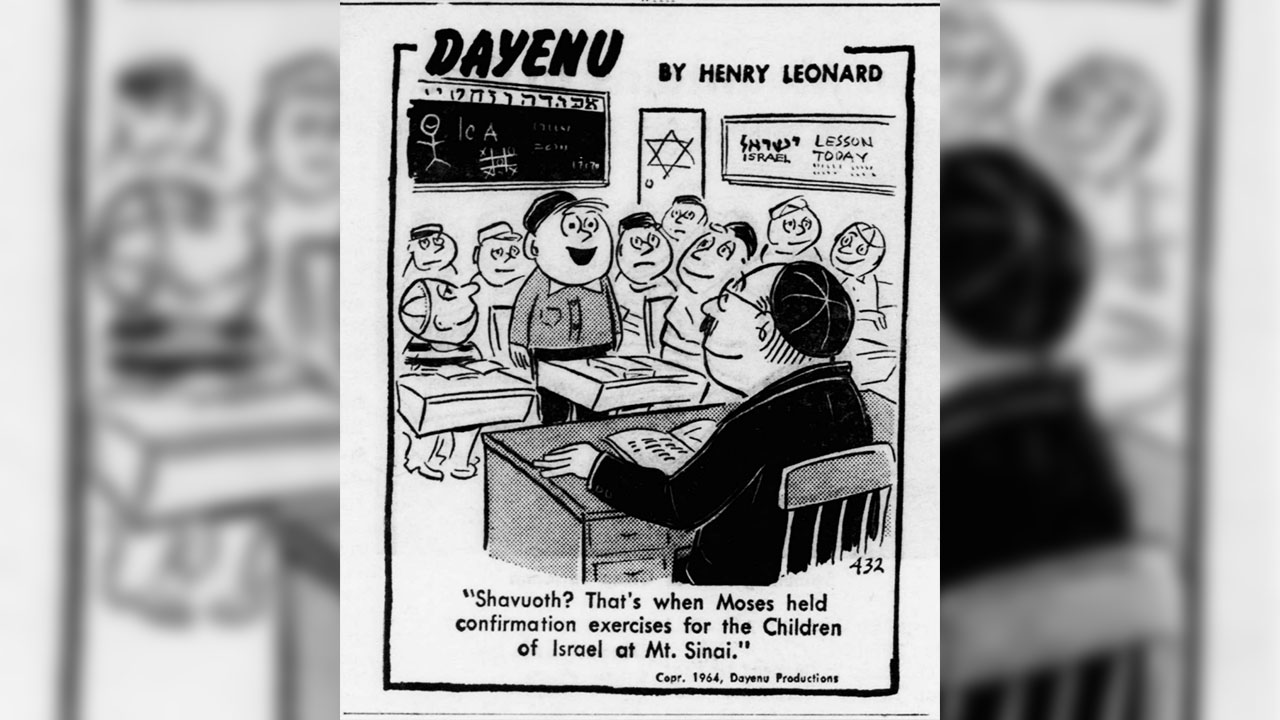
The tie-in with education was significant in the Reform world in the United States, including in California. Confirmation on Shavuot became a Reform custom in the States in the mid-19th century, linking the receiving of Jewish laws on Mount Sinai with learning them by young people. By the 20th century, it was well-established.
“Sixty-four boys and girls will be confirmed into the ancient faith of Israel next week when San Francisco synagogues celebrate the traditional festival of Shavuoth, the Feast of Weeks, which commemorates the confirmation of the Jewish people into their faith under the leadership of Moses,” we announced in 1940.
It’s easy to make light of Stolper’s fervor about not forgetting Shavuot, a holiday now often associated with cheesecake, but the context in which he wrote his treatise on Shavuot is sobering. It was 1940, and word of what was happening in Europe was trickling out in confusing, but horrifying, ways. Stolper was from Lithuania.
“Even now in the darkest days of our life let us hope that our distressed and tortured brethren in Europe will soon find a safe haven in our old historical land, and there they will again celebrate Shavuoth as the ‘Feast of the Harvest,’ Stolper wrote. “As for us, who are fortunate enough to live in this glorious land of freedom, let us continue to celebrate Shavuoth as a day of ‘Kalbolath Hatorah,’ the receiving of the Torah — as from the Torah the Jew draws life, contentment, and real happiness.”