

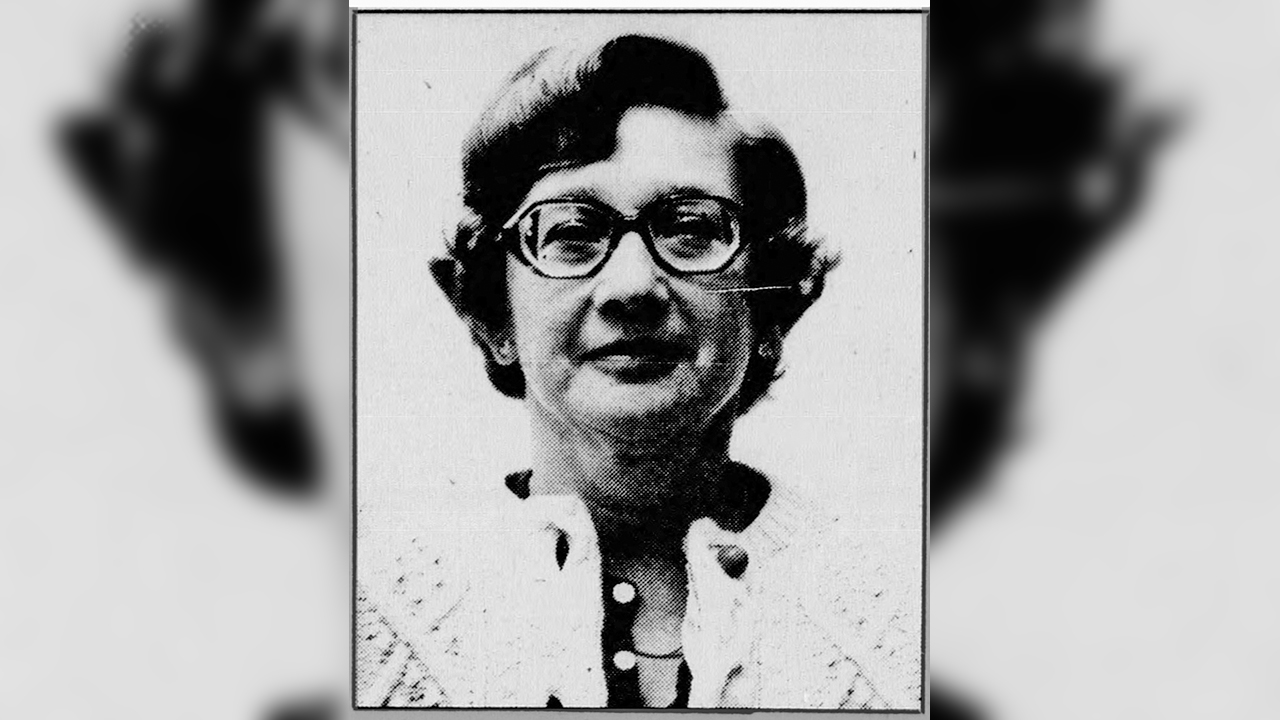
Rita Semel, who died May 13 at 104, was known throughout the Bay Area as an activist. But first, she was a newspaperwoman — at this paper.
Before all the committees and speaking engagements she was known for, and alongside some of the bread-and-butter work of a journalist, her own words written for this paper reveal a deep belief in unity and justice as a lodestar for Jews.
Semel was lauded for her tireless work supporting Jewish American life through many decades, which is how most people knew her. As a 1973 profile of Semel in this paper noted: “When someone calls her San Francisco home, her husband Max, a labor relations expert, tells the caller, ‘She’s not here, she’s at a meeting.’”
If you look at the list of roles she held, it’s not surprising: member of the board of the Northern California division of the American Jewish Congress; director of the San Francisco Conference on Religion and Race; director of the American-Israel Public Affairs Committee; Middle East specialist and later associate director at the Jewish Community Relations Council; coordinator with the Conference on Religion, Race and Social Concerns; member of the Jewish Welfare Speakers Bureau; and chair of the Interfaith Communications Commission.
She sat on the boards of San Francisco’s Congregation Emanu-El and Grace Cathedral. She also served on the San Francisco Human Services Commission, the New Israel Fund’s regional board and the Graduate Theological Seminary’s board. That’s not even the whole list.
“I’m very good at these unpaid jobs,” Semel told J. in 2011, at a mere 90 years old.
Her passion for connecting Judaism with other faiths was apparent early on. In 1945, she wrote her first story for this paper about a camp for children. She would later become associate editor. She left the paper in 1948 to start a family but continued to contribute articles throughout the rest of her career.
“Living examples of inter-faith harmony, these children are of all religions — Jewish, Protestant and Catholic — working and playing together,” she wrote. “A child’s mind, beautifully free from adult prejudices, remains that way in the democratic atmosphere of Camp Tiyatah. Interfaith understanding becomes a reality, there, to these, tomorrow’s men and women, rather than the theoretical hope of today’s adults.”
That early piece was followed by another that same year about a Stanford program for teachers, reflecting her interest in education and cultural understanding.
“In intercultural education, now spreading fast throughout the country, many outstanding educators and sociologists see one of the most effective remedies for anti-Semitism and other un-American bigotries which have threatened the unity of this nation since the Nazis first began sowing their seeds of hate,” she wrote. “All agree that no child is born a bigot.”
She was also deeply concerned about Israel.
In 1958, on the occasion of ten years of statehood, she wrote that “one amazing fact emerges from the welter of statistics on economics, population, trade, music, art, immigration and development— Israel has survived!
“After ten years Israel remains true to the three objectives established in 1948: 1. The open-door policy for all Jews needing and wishing to find haven in that country. 2. The development of the country for the common good of all its inhabitants. 3. Establishment of peaceful relations with Arab neighbors and the rest of the world.”
While she loved Israel, she was not blind to its challenges. Nearly 20 years after that first glowing report, in 1976 she wrote “An Eyewitness View” about a trip she took there with JCRC.
They went, she wrote, “from early morning to late at night, to talk with Israeli Jews. Israeli Arabs. West Bank residents. prime ministers and foreign affairs ministers, social workers, editors and just plain folks. We explored the social gap in Israel, the question of borders, the status of the Arabs in Israel, the problems of urban living, the place of religion in the Jewish state and the nature of the Israeli political process.”
“Did we find the answers? Or did the problems give birth to new problems? The answer to the first question is ‘No, but …’ the Answer to the second is ‘Yes, but…’”
Semel, as she did with every cause that she cared about, refused to let the difficult questions become barriers. Even if there were bumps along the road, doing the work was the only way forward.
“It will take all our ingenuity, our know-how. and commitment to do the job,” she wrote. “But do it we must, not for Israel alone, but for ourselves, as part of a vital American Jewish community, proud of its American roots and inextricably linked by heritage with Israel and Jews all over the world.”