

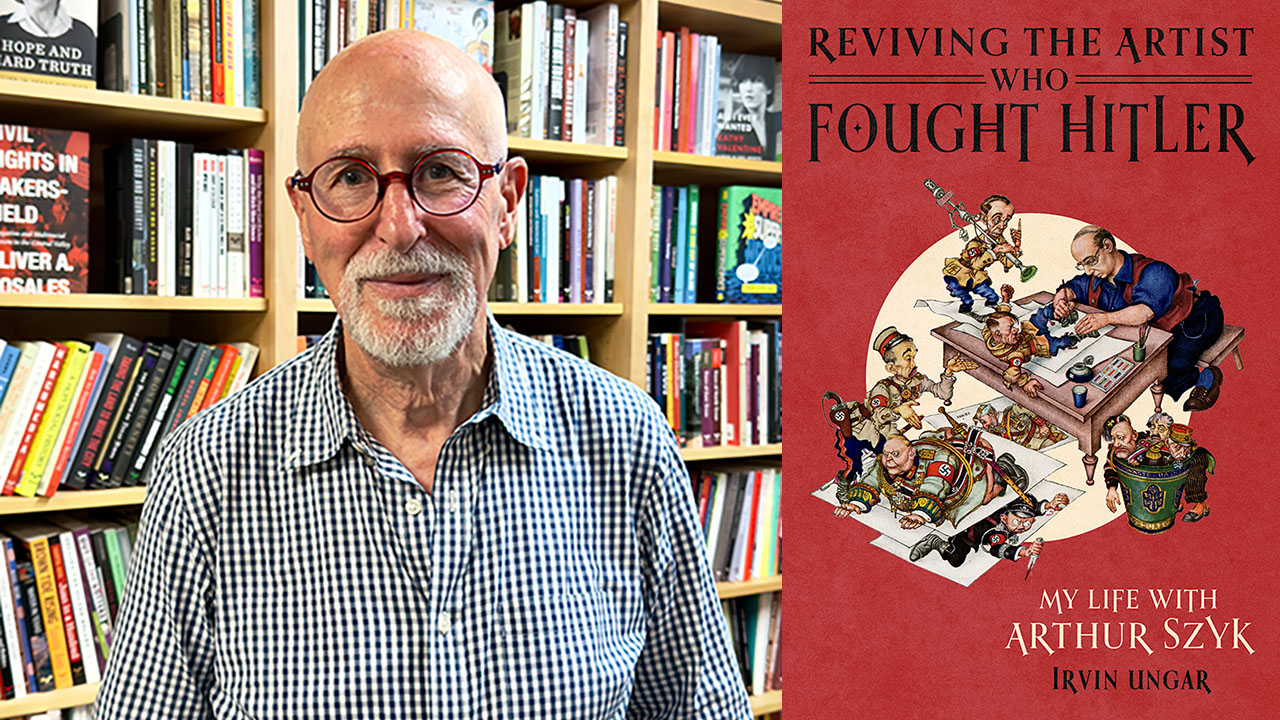
For the past three decades, Irvin Ungar, a pulpit rabbi turned antiquarian, has been on a singular mission to bring anti-Nazi illustrator Arthur Szyk out of obscurity and secure his place in the canon of narrative art.
“Szyk is going to be the Jewish artist of the millennium,” Ungar told J. in 2000, early in his quest. “He’s going to blow everyone else right off the map. I’ve committed my life to making this guy famous again.”
Now 77 and living in Burlingame, Ungar is confident he pulled it off. His new book, “Reviving the Artist Who Fought Hitler: My Life with Arthur Szyk,” published June 2 by University of Texas Press, chronicles how it happened.

The memoir is the culmination of records that Ungar began to keep around 10 years ago to preserve the process he took to build a network of art collectors, museum curators and scholars to fulfill his goal. Szyk’s art, which combines the intricate detail of illuminated manuscripts with the bite of political caricature, has become widely recognized, with the most significant collection of his work housed at the Magnes Collection of Jewish Art and Life in Berkeley.
Ungar sees his relationship with Szyk as something more than scholarly devotion.
“His art is in service to the Jewish people,” Ungar said in an interview. “And I feel like by doing this, I am too. That’s where we were both married, in a way — getting married to someone who’s not alive, but making them alive so that you can enjoy the relationship for the rest of your life.”

Michael Berenbaum, a Holocaust historian and professor of Jewish studies at American Jewish University, describes Ungar as the “John the Baptist” for Szyk.
“Their souls are linked: proud Jews, proud Americans and, above all, creative and defiant in the fight for freedom,” he said.
Because of Ungar, he added, Szyk’s work will have an impact far beyond the artist’s own generation and “have its respected place in 20th century art.”
Born in Poland in 1891, Szyk (pronounced “shick”) became a master of narrative painting and calligraphy best known for rendering biblical stories, classic literature and political cartoons in detailed imagery.

After living in multiple countries in Europe, he made it to the United States in 1940, where his work against Hitler went into overdrive. After Szyk’s death in 1951 at age 57, though, his popularity and renown faded.
While living in New York in 1975, Ungar, then a newlywed, walked into a bookstore in search of gifts for his wedding party. There, he found “The Szyk Haggadah,” filled with nearly 50 intricate and vibrant “illuminations,” or medieval-style illustrations interwoven with text, on the Exodus story.
“I quickly saw that he was creating political art, anti-Nazi art,” Ungar said. “I love the idea that here was a Jewish artist who was steeped in the Bible, who was also combining religious art with politics.”
After serving as a pulpit rabbi for 13 years, seven of which he spent at Peninsula Temple Sholom in Burlingame, Ungar embarked on what he called a “totally unexpected” career of collecting and selling rare historic Jewish books.

“The dual part of being both a collector and businessman, and also being a scholar at the same time, it was very important,” Ungar said. “I was always wearing two hats.”
Ungar spread the gospel of Szyk in the form of books, films and exhibits throughout Europe, Israel and the U.S., including the Bay Area.
His devotion ultimately paid off in multiple ways. He amassed more than 450 of Szyk’s paintings, drawings and sketches over decades. In 2017, Taube Philanthropies made a $10.1 million gift to the Magnes to purchase Szyk’s works from Ungar. His art became the center of a dedicated exhibit at Magnes, and the whole collection can be viewed online.
“I would be dishonest if I didn’t say that as a result of doing good, I also did well,” Ungar said, paraphrasing Ben Franklin.