

The Torah column is supported by a generous donation from Eve Gordon-Ramek in memory of Kenneth Gordon.
Pinchas
Numbers 25:10−30:1
Our Torah portion this week contains one of those passages that is hard to stomach.
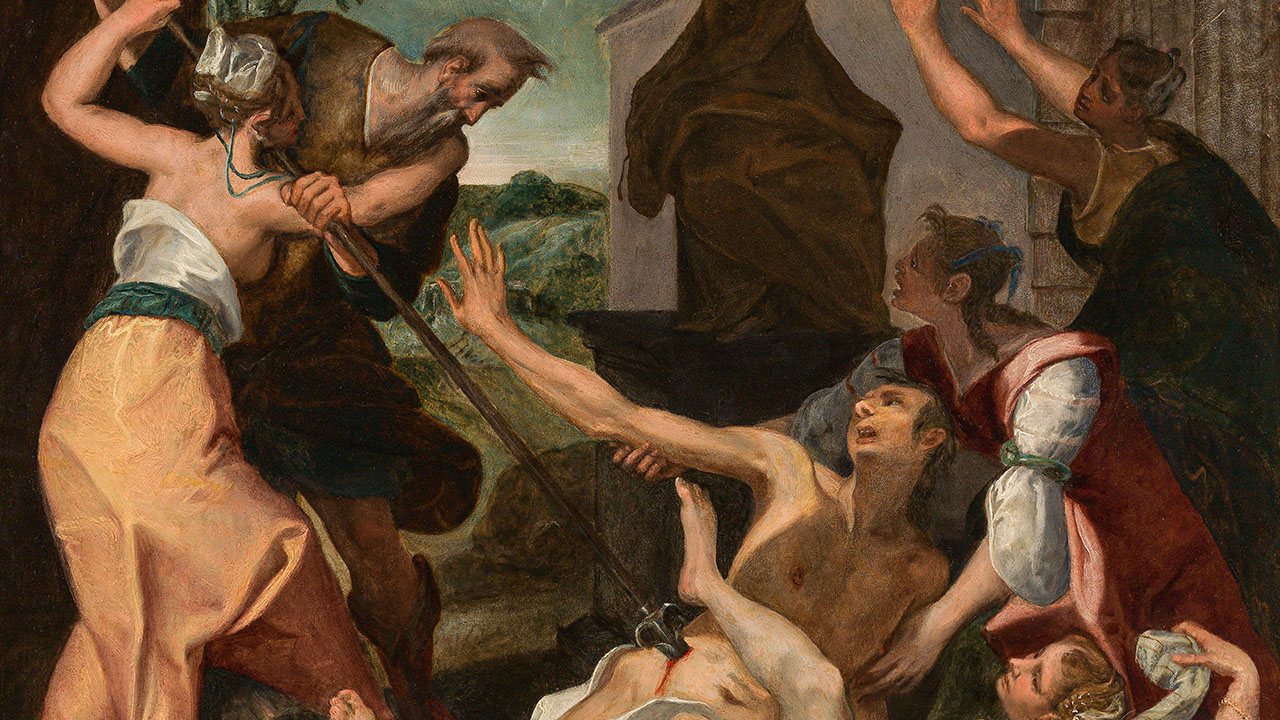
At the end of last week’s parashah, we read about Israelite men having relations with Moabite women, who convinced them to worship the false god Baal-Peor. God becomes incensed with the Israelite men and orders them all to be impaled. But an Israelite man named Pinchas decides himself to take up a spear and kill an Israelite man and a Moabite woman. At the beginning of this week’s parashah, God praises Pinchas for taking matters into his own hands and thus decides that more Israelite men do not need to die.
Some in our tradition offer the interpretation that Pinchas acted virtuously because if it hadn’t been for him, God would have killed far more people. The late scholar Tikva Frymer-Kensky writes in “The Torah: A Women’s Commentary” that Pinchas “acts with violence to stop violence, like setting a backfire to stop a wildfire.”
This interpretation is valid; the plain meaning of the text seems to suggest that Pinchas did something virtuous.
But if we take a step back, the whole story is troublesome. Non-Jewish women are being blamed for leading Jewish men into idolatry? God sees this as being punishable by death?
I wonder what might happen if we let the disturbing nature of this story linger in our minds. What does it mean that we’re part of a tradition that includes passages like this? What does it mean to be part of a tradition that sometimes has gotten things so wrong?
Certainly, the Jewish tradition is not unique in its capacity to make mistakes. A few years ago, I had the occasion to grapple with how our Euro-American civilization has also gotten things very wrong.
I was in a graduate course doing research on the Enlightenment. I spent hours scrolling through the digital archives of the Affiches Américaines, a newspaper in Saint Domingue, the French colony that would become Haiti after a revolution. The newspaper was at once fascinating and horrifying. A classified ad for horses appeared next to a seemingly routine announcement of an escaped mother and her 5-year-old child.
The writing of a doctor named Charles Arthaud stood out. He caught my eye because he was an intellectual. He cited Rousseau, insisted on using the scientific method and played a pivotal role in creating the island’s learned society. His writing was juicy and very 18th century. Topics include the nasty tropical disease yaws, religion and the mystery of the skeletal remains of a group of Indigenous people who all had flattened skulls.
Arthaud also owned a plantation with enslaved people near the town of Limbé. And yet, he wrote beautifully about natural religion and how all people have a relationship with the Divine. In explaining why the native peoples built their large monuments, Arthaud’s prose came alive with enthusiasm for natural, and seemingly universal, religion. Here’s my translation of one of his reflections:
“A higher power guides man to the apprehension of a supreme being; man is guided by the seduction of everything that strikes him and astonishes him when he opens his eyes in nature, and all his senses are overwhelmed by the marvelous things that nature produces.”
Arthaud wrote these beautiful words that suggest everyone has an ability to connect to God, and yet he presumably treated the people he enslaved horribly. How could he have been so right about some things and so wrong about others?
At its heart, Arthaud’s thought embraced logic. He sought to demonstrate that native people with flattened skulls belonged to a different human species. It didn’t occur to him that they were strapping their babies to boards that flattened their heads. He painstakingly applied what he thought was an empirical approach and came to an incorrect conclusion.
During a stint back in France, he was one of the doctors who conducted a “scientific” examination of an albino person from Africa. Arthaud took part in the beginning of the hardened, scientific racism that became pervasive in the 19th century.
As I immersed myself in Arthaud’s writing, I came to the conclusion that his racism and his intellectual greatness came from a similar part of himself, and more importantly, a similar part of his era. Arthaud, this Enlightenment thinker, believed above all else in his power to reason and to know the truth. He believed in his logic, and tragically, his logic became, among other things, the logic of racism and white supremacy.
It’s humbling to consider how wrong both our Euro-American tradition and our Jewish tradition can be.
As we read Parashat Pinchas this week, we can recall that as Jews we have inherited a tradition of thinking critically about things like the story of the Moabite women and Pinchas. Some interpretations, like Frymer-Kensky’s, harmonize potentially disturbing strands of our tradition with our morality. At other times, we must teach against the text. We have inherited both the content of Judaism and a tradition of calling parts of it into question. When we are at our best, we debate and question both the values of our own tradition and of mainstream society.
I think back to the image of Arthaud scrupulously examining the skulls of the skeletons he encountered. In what ways are we similar to Arthaud? In what ways are we leading ourselves astray? In what ways are we, like Arthaud, carefully measuring flattened skulls and coming to the wrong conclusion?