


(JTA) — JERUSALEM — Just days before the start of the Maccabiah Games, the Jewish sports competition held every four years in Israel, Australia was officially out of the competition.
Australia had canceled its official delegation — typically one of the largest — during Israel’s war with Iran. In early June, its organizing group said it could not flout the Australian government’s designation of Israel as a danger zone.
But on Sunday, with the war on hold amid peace deals announced by the United States, Maccabi Australia reversed course. On Wednesday, 14 Australian athletes marched behind the Australian flag into Teddy Stadium in Jerusalem, where they are competing in six sports across two weeks of play.
Australia’s about-face reflects the uncertainty that has plagued the quadrennial “Jewish Olympics” for more than a year, diminishing the number of athletes and countries participating and making it unusually challenging for their supporters to attend from abroad. Organizers say about 5,000 athletes are competing from 55 countries, compared to 10,000 in 2022, when U.S. President Joe Biden joined the opening festivities.
The 2022 Games marked a triumphal return after a year’s delay due to the pandemic. This year’s competition, too, followed a delay: Three weeks before play was set to start in 2025, organizers understood there was no way to bring thousands of Jewish athletes to Israel. Israel was at war with Iran, the government had declared an emergency, and airlines had stopped flying. They postponed — never expecting that conditions would be similar in the months ahead of the Games.
“We were sure that things would be much better by now,” said Roy Hessing, Maccabiah’s chief executive. “The only really good thing that has happened since then is that all the hostages are back.”
Signs of the postponement, and the wrenching years since the last Maccabiah, were omnipresent at Wednesday night’s opening event, starting with the logo for the Games, which features a “25.”
Former hostages took part in the ceremony, including IDF spotter Daniella Gilboa and the American-Israeli soldier Edan Alexander, who both performed with Israeli singer-songwriter Idan Raichel.
The ceremony also included wounded soldiers and representatives of Irgun Nechei Zahal, Israel’s official organization for disabled veterans, as well as recognition of several athletes, including swimmer Eden Zimri, who were killed on Oct. 7.
Members of the French delegation carried shirts featuring Dan Elkayam, their football teammate who was killed in December’s shooting attack on a Hanukkah celebration in Sydney.
“Welcome to your home away from home,” Israeli President Isaac Herzog told attendees. “Your gathering together in Jerusalem, in this beautiful event, fills us with pride and charges this stadium with magnificent energy. … Each of you here is a winner, and I know you will have a great Maccabiah together, in unity and in love of Israel.”
In a sign of Israel’s internal tensions, Prime Minister Benjamin Netanyahu drew both applause and audible boos as he took the podium. The ceremony took place on the eve of the 1000th day since Oct. 7, with an election looming and the vast majority of Israelis critical of Netanyahu’s refusal to open a state commission of inquiry into the failures that led to the historic attack.
Netanyahu said he had “only one message” for attendees: “In the face of antisemitism, stand tall, stand proud, do not bend, do not bow, stand strong, stand together, and together we shall win. You are all winners here, we shall be winners in the world.”
Hessing said the decision to postpone rather than cancel the Games was essential as the event has only grown more important for Jewish communities abroad, where he said “antisemitism is raging,” and for Israelis still living with the fallout of Oct. 7 and the wars that followed.
“We must have some events that will give us some joy and hope,” he said.
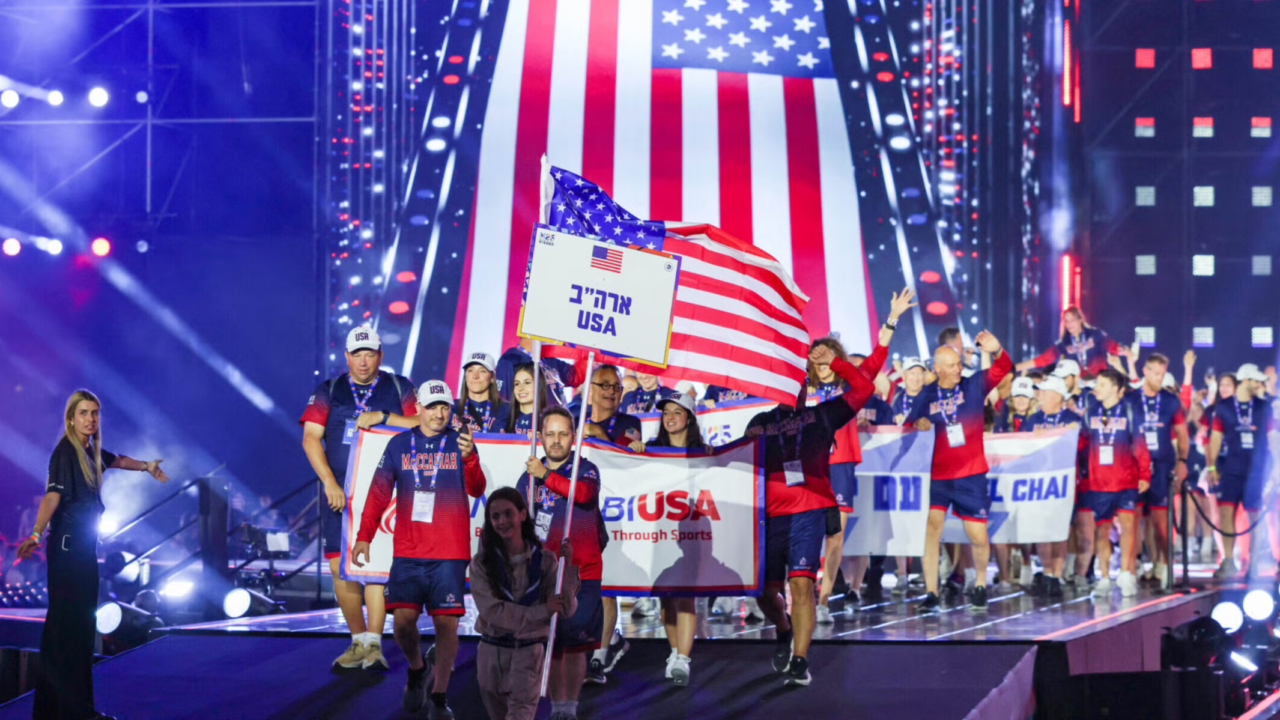
About 3,000 athletes arrived from the Diaspora, joined by about 2,000 Israelis. Taiwan and the Philippines sent athletes for the first time, while the largest overseas delegation came from the United States, with more than 900 athletes, ranging in age from 14 to 87.
The U.S. cheering section is smaller than it might have been, as scarce and historically costly flights have made it hard for supporters to make the trip. Einav Rabinovitch Fox told the Jewish Telegraphic Agency from her home in Ohio that she and her family had hoped to accompany her son Adam, who is on the U15 football team, to the competition. But she was not eager to bring her family into a war zone, and then she could not secure plane tickets once hostilities ended.
“It was a) really expensive and b) a transportation nightmare,” she said. “It just became impossible.”
At the opening ceremony, a mother who came from Los Angeles to support her son, also on a soccer team, told JTA that she had lucked out by purchasing El Al tickets in 2025, well before prices shot up. But when her husband went to book his own tickets last month, the only options available cost more than $10,000. He stayed home.
In total, organizers expect the Games to bring roughly 9,000 visitors from overseas, many fewer than in 2022.
But Hessing said he was looking on the bright side: “We’re still talking about thousands of tourists that will come to Israel, will support the state of Israel, will be part of amazing ceremonies, amazing trips, volunteering, and the competitions, of course,” he said.
Over the past year, there were many moments when Hessing questioned whether the Games could or should go ahead.
“We had very tough times,” he said, pointing to March’s second round of fighting with Iran and ongoing hostilities on the northern border. “I said to myself, oh my gosh, are we doing the right thing?”
The postponement made the budget harder to close. Propelled in part by war, the dollar fell from about 3.7 shekels last summer to about 2.9 today, reducing the value of money raised abroad, while flight prices climbed sharply amid widespread cancellations and rising oil prices.
The combination raised costs for both the organization and the delegations, forcing the Maccabiah to secure additional funding from the Israeli government, philanthropists and the private sector companies to close the gap.
Meanwhile, it took months of reassurance to persuade some delegation leaders to come to Israel amid security concerns. Then, hundreds of athletes from around the world backed out in March, and some countries were unable to send official delegations because of travel warnings and insurance restrictions tied to Israel’s status as a war zone.
Some athletes from those countries decided to come anyway, Hessing said, competing as individuals rather than as part of a national delegation. But Great Britain canceled its youth delegation, sending only adult athat least a dozen countries that competed last time are not represented this year, including Canada, whose 700 athletes were the fourth-largest delegation in 2022.
“While we are saddened that our more than 300 delegates were unable to take part this year, our Maccabi spirit remains as strong as ever,” Maccabi Canada posted in an Instagram story on Wednesday promoting a livestream of the opening event. “Join us in watching the opening ceremony and cheering on all those competing.”
The only recent precedent for a much smaller Maccabiah, Hessing said, was in 2001, during the Second Intifada, when about 2,000 athletes came as suicide bombings were hitting Israeli buses and cities.
The Maccabiah began in 1932 with 390 Jewish athletes from 18 countries competing. More than nine decades later, Hessing said, the Games are still judged not only by the competitions but by what participants take back with them.
This year, he said, success will mean turning those who chose to come in wartime into “great ambassadors to the state of Israel,” sending them back to their communities “as leaders, as members, with pride, and most important, with a much stronger connection to Israel.”
For many participants, it will be their first time in the country, he said, with first-time visitors typically making up 65% to 70% of the Maccabiah and about 5% later immigrating to Israel.
For Hessing, the first test has already been met. The message he hears most often from athletes and their families is that they are grateful the Maccabiah was happening.
“The first thing people are saying when they land is thank you for not canceling the Games,” he said. “It’s going to be two weeks they will never forget.”