

This story was originally published in the Forward. Click here to get the Forward’s free email newsletters delivered to your inbox.
Hypothetically, if someone you had every reason to like and trust told you that if you went up one flight of stairs, you would “probably see things you never expected to see, ever,” how would you react? A sane individual might feel curiosity or skepticism, tempered with a dose of fear.
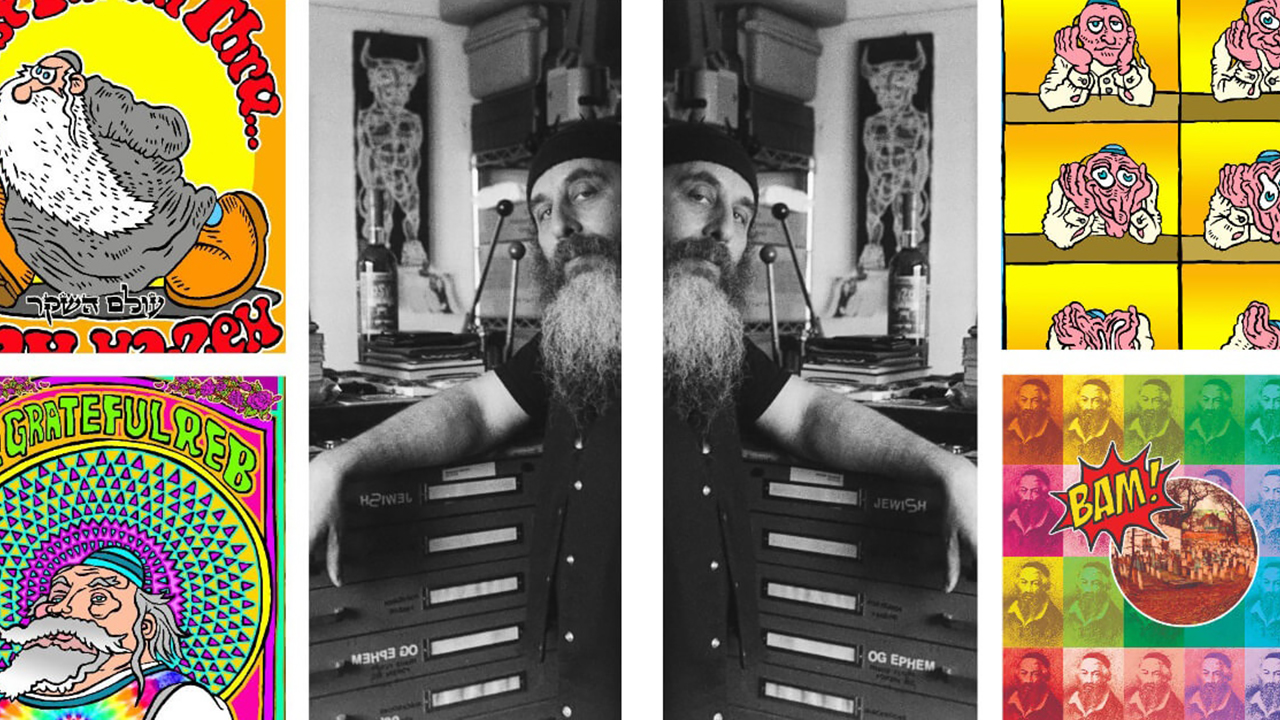
However, if you are anything like the crowd that gathered at YIVO for the opening of kosher-pop-art-visionary Steve Marcus’ new exhibit, “Psychedelicatessen: A Powerful Dose of Art,” the answer is simple: you’d get your tuchus upstairs, and fast.
In the gallery, the dose of art was as powerful as the exhibit title (and exhibit director Eddy Portnoy) had warned. The walls had gone groovy with technicolor mashups of Judaica and LSD, Flower Power and Maimonides. Strange shidduchim were being made in that room: There was a yad, a ritual Torah pointer, flashing a peace-sign instead of a pointer finger; a drawing of the “Power to the People” fist wrapped in tefillin; a wall of famous-rabbi-themed blotter art; a poster for “The Grateful Reb” in which a skeptical-looking Hasid in a tye-dye shirt (presumably the Grateful Reb himself) stood in front of a colorful mandala. It was like walking through a Hasidic hippie’s hallucinations.

As it turns out, Steve Marcus is neither entirely a hippie nor entirely a Hasid, though he has had brushes with both worlds. Marcus was born in the Summer of Love, 1969, just a year after the original Psychedelicatessen, an East Village headshop, got busted by narcs. Marcus spent his childhood — maybe even his life — surfing the afterwaves of the 1960s. He read MAD Magazine and Cracked. He gorged himself on Looney Tunes. As a teenager, he dug into Comix, the underground world of illustration concerned with hippie preoccupations like sex and drugs. As for Judaism?
“About a year after my bar mitzvah, I took a long sabbatical,” Marcus told me. It was the day after the opening, and we were sitting on a bench in the empty gallery. Marcus was jittering his knees up and down like he’d had too many Astro Pops.
He grew up Masorti, attending shul with his parents on Saturday morning and then booking it to the Yankee game that same afternoon to eat non-kosher hot dogs with his dad. But when Marcus was in his late thirties, his father died of a heart attack on Rosh Hashanah at the age of 66. “He was blown out like a candle,” Marcus said. “It kind of rang my bell.” He decided to say kaddish for his father three times a day for almost 11 months. It was during this period that he started grooving with the ultra-Orthodox.
“The only people showing up to shul three times a day are hardcore,” he said. He had noticed some of his Haredi compatriates studying Torah. When he asked how much it would cost to study there for a semester, “they were like, ‘You want to learn? You just come!’” For the past 17 years, at least three hours a day, Marcus has done exactly that.

Since turning to Talmud, Marcus has kept his art kosher. He obeys halachic stipulations such as not drawing the moon or the sun (or naked ladies, for that matter). He says halacha does not limit his work, but makes its reach more expansive, allowing Jews of every religious stripe to enjoy his art. But other halachic rules rankled him at first, most of all the Hasidic man uniform. Marcus looks like a countercultural Tevye. He is grizzled and bearded, and wears a baseball cap as religiously as other Jewish men wear yarmulkes. On the night of the gallery opening, he was wearing a camo jacket.
Earlier in his religious journey, he consulted a famous rabbi about his fashion troubles: “I said, ‘This white shirt, black suit, black hat thing? I don’t think it’s gonna happen … Is this a problem?’” The Rabbi in question replied with an interesting analogy. “‘You need to think of the halacha like a box,’” he said. Just because some people were crowding in one corner of the box didn’t mean that that was the only place in the box to stand.
“Sometimes, unfortunately the world, especially the Jewish world, wants to put everybody in a box,” Marcus said. “I think it’s hard to put people in a box.”
Marcus plants his eye-popping, mindbending art in familiar cultural boxes — pop art, Judaica, Flower Power counterculture — and then, before you get too comfortable, he explodes them with something unexpected. He showed me a piece called “Daf Yomi Agin!”, a yeshiva-bokher take on Robert Crumb’s famous ’70s poster “Stoned Agin!”, a six-panel depiction of a guy melting into blitzed-out goop. Except in Marcus’ version, the man is a Hasid turning aqueous at the thought of restarting the Daf Yomi, a seven-and-a-half-year cycle in which you read one of the 2,771 pages of the Talmud each day.

“They have an expression in yeshiva called ‘breaking your teeth,’ right? Which is when you’re trying so hard to understand something that they break their teeth over it,” Marcus said. “To me, it’s more like melting my brain than breaking my teeth, so that’s why it’s like this slow progression to a complete meltdown.” He has done the Daf twice already. One time, he said, he even went to the yeshiva in Lublin where the Daf Yomi began. He said his presence shattered the minds of the Hasidim. “I showed up, and it’s like I look like the hair in the matzo ball soup or something. They were like, ‘How do you know about such a place?!’”
A lot of Marcus’ stories start like this: Two dudes of different walks of life collide. First they are baffled; then they are bros. The phrase “Hey, man” makes frequent appearances. Marcus told me stories about his Zuni friends out in New Mexico who invited him to a secretive winter solstice holiday called Shalako in which the Zuni build a new house and feast on a dish that’s “almost like a cholent made of mutton.” He talked about meeting author Ken Kesey (whose grandson, Caleb Kesey, printed the rabbinic blotter art), and painting his Jeep with a phoenix rising against a psychedelic background. He told a story about a World War II vet named “Buzzy Katz” he used to hang out with who taught him how to cut onions. Marcus seems down to hang with the whole world.
“I’m one of those people that feels at home wherever I am,” he said. “I put on a backpack. I get into a truck or whatever and I fly over to another place.”
“Psychedelicatessen: A Powerful Dose of Art” is presented by the YIVO Institute for Jewish Research and the Center for Jewish History and is open to the public at the Center through December 2026.