

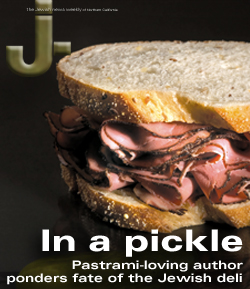
See bottom of this story for David Sax’s views on Bay Area deli.
Chicago and Cleveland have the best corned beef. Detroit is tops for rye bread. The best smoked meat is in Montreal, and for pastrami, you can’t touch New York and Los Angeles.
When it comes to Jewish delicatessen, 30-year-old David Sax is the go-to guy. A longtime deli aficionado, the surprisingly trim Sax spent three years eating his way through more than 150 Jewish delis to research “Save the Deli: In Search of Perfect Pastrami, Crusty Rye and the Heart of Jewish Delicatessen,” a wistful, riotously funny paean to this quintessential slice of American Jewish history.
The book, published Oct. 19, is a delicious romp through a fast-disappearing world. The chapters are divided by regions and cities — from New York to San Francisco to the Southwest — each stuffed with tidbits of about a locale’s deli history and its current deli scene.
The first 70 pages are devoted to deli nirvana, New York City. In 1931, Sax reports, there were 2,000 delis in New York City, three-quarters of them kosher. Today, Sax says, his research turns up 25 Jewish delis in the city, two-thirds of which are kosher.
 A similar pattern has followed across North America, with city after city sounding the death knell for its last traditional deli. Sax guesses there are just a few hundred left worldwide, most of them in the United States.
“The Jewish deli is dying,” Sax, a native of Toronto, said in an interview. “Each time I hear a deli closes, something inside me dies.”
German immigrants brought the deli to New York in the 1820s, Sax reports. By the 1870s and ’80s, German Jews had made their own kosher modifications to the traditional treif recipes: schmaltz, or rendered chicken fat, instead of lard; ptcha, or jellied calves’ feet, instead of pig trotters.
The origin of the first pastrami sandwich is shrouded in mystery, although writer Patricia Volk told Sax her great-grandfather was the first to slap pastrami between two slices of rye bread at his kosher butcher shop in New York in the late 1880s.
Sax chronicles the rise and decline of the “kosher-style” deli, an American innovation that originally differed from its kosher counterpart mainly in hours of operation (they did not close on the Sabbath) and lack of rabbinical supervision.
Reaching its heyday in the 1950s and ’60s, the kosher-style deli eventually succumbed to economic pressure and popular tastes and began putting cheese on turkey sandwiches, offering milk with coffee and using non-kosher meats.
 From there, it was an easy hop to serving bacon with French toast. Today few such delis use the term “kosher-style,” preferring to call themselves Jewish or New York delis.
Sax also bemoans the rise of glatt kosher, a stricter standard for kosher meat that demands round-the-clock oversight by a mashgiach, or kosher supervisor.
He says it puts financial demands on deli owners that most cannot meet.
That’s why most new delis are not kosher, he claims — it’s just too expensive.
“There’s a lot of money in hechsher,” he said, using the Hebrew for kosher certification. “It’s a turf war that uses religion as leverage.”
But most of this book is about food — the gloriously fatty, heart-stopping Ashkenazi cuisine that is the signature of the Jewish deli: braised brisket in wine sauce; pickled tongue; cabbage rolls in sweet-and-sour tomato sauce; matjes herring; and, of course, the litany of k’s: knishes, kreplach, kugel and kvetching.
He saves his highest praise for the deli meats: corned beef pickled and boiled in vats of brine; pastrami, lovingly rubbed with secret spice mixtures, then smoked and steamed to perfection.
The way to suss out a good deli, he says, is to order the matzah ball soup and whatever deli meat the city specializes in, be it corned beef, tongue, pastrami or smoked beef (a softer, gentler Canadian variant).
A big part of Sax’s mission is to encourage young Jews to take over delis at risk of closing or to open new ones, a goal that might seem counterintuitive in today’s economic climate. But he insists the market for deli food is there, as a new generation looks back nostalgically to a cuisine that represents an earlier, simpler, more comforting era.
“People aren’t really looking for innovation in deli,” he insists. “The best things I see in the new delis are a return to tradition.”

His favorite new Jewish delis — such as Miller’s East Coast Deli in San Francisco and Saul’s Restaurant and Deli in Berkeley — are taking advantage of the organic, do-it-yourself movement that is influencing the country’s restaurant scene. “It’s ‘innovative’ today to pickle your own meat or make your own kishke,” he said.
In his effort to give props to these newcomers, Sax glosses over the sad but very real possibility that the Jewish deli may not survive outside a few key cities. New York’s deli scene has imploded, he says, and new delis in Portland, Ore., and Boulder, Colo., may be just flashes in the matzah brie pan.
Sax said his book was not meant to be an encyclopedia of delis, and it isn’t. While he has a chapter on Las Vegas, titled “Luck Be a Brisket Tonight,” he doesn’t have a chapter for Baltimore, Boston, Cleveland or Philadelphia.
“I didn’t want it to just be this huge guidebook,” he said. “I wanted each chapter to be a comprehensive story. Cleveland, Boston, Baltimore — they all have their own stories, but you can’t tell them all.”
One story he does tell is the Southern California story, in an 18-page chapter titled “Hooray for Hollywood.” The chapter begins: “Brace yourself, New York, because what I am about to write is definitely going to piss a lot of you off, but it needs to be said: Los Angeles has become America’s premier deli city.”
He writes about Factor’s Deli in the Pico-Robertson neighborhood, Nate ’n Al in Beverly Hills, Langer’s near downtown L.A., Greenblatt’s on Sunset Boulevard, Junior’s Deli in West Hollywood, Brent’s in the San Fernando Valley — and, of course, Canter’s on Fairfax Avenue.
But some stories he doesn’t tell. For example, he includes Scottsdale, Ariz., in a chapter titled “Schmaltz by Southwest,” yet somehow he didn’t write about or even visit the immensely popular Chompie’s, which has three locations crowded with Eastern and Midwest transplants and retirees.
Sax said he was limited by several factors: a finite supply of money for his deli travels, a strict deadline and the editing process. “The book had to be a certain length,” he said. “And you should have seen my first draft — they made me cut it back completely.”
The seeds for “Save the Deli” were planted when Sax was an undergraduate at Montreal’s McGill University, where he took a course called “The Sociology of Jews in North America.” Researching a term paper on Jewish delicatessens in North America, he discovered that there wasn’t a lot of written material to be found.
In the ensuing years, after living abroad in Israel and Argentina and cranking up his career as a freelance writer, he launched a blog called Savethedeli.com, helping establish him as a go-to source on Jewish delis. He has been quoted in numerous publications, including the New York Times and the Washington Post.
In promoting the book, Sax said the obvious question he gets is: Are you sick of deli food?
“No, I’m not sick of deli,” he said. “In New York, I’ve been doing all of my interviews at delis, and you’d think it’d be, ‘Oh no, not another day of eating deli.’ But yesterday I was eating everything in sight, really going to town, and the journalist who was interviewing me was taking little bites.
“Deli is nothing I can get sick of, because it’s part of who I am.”
J. staff writer Andy Altman-Ohr contributed to this report
See how the book’s author rates Bay Area delis: Good deli in the Bay Area? You bet your kishkes