

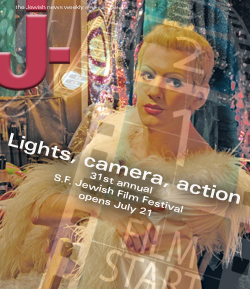
See below for links to film reviews

The 31st annual San Francisco Jewish Film Festival is ready for its close-up.
This year’s festival runs from Thursday, July 21, through Aug. 8, at multiple locations across the region: the Castro Theatre and JCCSF in San Francisco, the Roda Theatre in Berkeley, the Rafael Film Center in San Rafael and, for the first time, the Oshman Family JCC in Palo Alto.
This year’s line-up of 58 films from 16 countries should please film fanatics of all stripes. (A full list of films can be found in j.’s calendar section for the next few weeks, as well as online at www.sfjff.org.) It includes big themes (the Jews and Poland), big events (a cantors’ concert before screening the film “100 Voices”) and one of the biggest Hollywood stars of all time: Kirk Douglas.
Douglas — a nice Jewish boy born Issur Danielovitch — will be on hand July 24 to accept this year’s Freedom of Expression Award, honoring his resistance to the Hollywood blacklist during the 1950s.
The festival’s opening night features the North American premiere of “Mabul (The Flood)” from Israeli director Guy Nattiv (“Strangers”). This tale of a dysfunctional family won best Israeli feature at the Haifa International Film Festival. It’s one of 21 Israeli films included in the JFF this year.
Another festival theme this year is humor, a no-brainer given the close connection between Jews and comedy.
“Jews in Toons” is a July 25 screening of three episodes of “The Simpsons, “Family Guy” and “South Park,” arguably the Bach, Brahms and Beethoven of American animated comedies.
The episodes boast Jewish storylines: Krusty the Clown’s estrangement from his father, Rabbi Hyman Krustovsky; Peter Griffin (“Family Guy”) wanting to turn his son Jewish so he’ll be smarter; and Cartman (“South Park”) leading a campaign against the Jews after seeing Mel Gibson’s “The Passion of the Christ.”
“The Simpsons”
Former “Simpsons” staff writer Mike Reiss will be on hand afterward to talk about his Bart years.
As for the theme of Poland’s long, troubled relationship with the Jews, the festival includes dramas such as the centerpiece film, “Little Rose” (set during the anti-Semitic purges after the Six-Day War), and the Israeli documentary “Torn,” about a Polish priest who discovers late in life he is actually Jewish and later moves to Israel.
And if you’re looking for signs that Israeli culture keeps pace with the Western world, the festival presents “Rabies,” Israel’s first horror film: Good-looking youths make a wrong turn in the forest. Mayhem ensues.
For the July 28 closing night offering at the Castro Theatre, the festival pulls out all the stops. Literally.
Prior to the screening of “100 Voices: A Journey Home” (which captures a 2009 concert at the Warsaw Opera House featuring 100 cantors) several local cantors will perform a concert, backed by the Castro’s Mighty Wurlitzer organ.
And throughout it all, there will be nonstop movie watching, popcorn munching, debating, laughing and shmoozing as only the S.F. Jewish Film Festival can elicit. Movie buffs, time to fade in.
cover
photo collage | cathleen maclearie
A scene from “Mary Lou,” which will be screened during the San Francisco Jewish Film Festival.
Berkeley filmmakers take on Jewish identity, controversial issues in new documentary
‘Little Rose’ places femme fatale in thorny predicament
Jewish cemetery in Germany comes to life in ‘Heaven’