

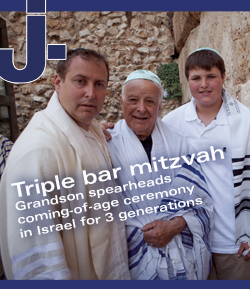
One fine summer day a few months ago, a boy became a man in Jerusalem’s Old City, chanting Torah by the ancient wall. He was not the only one.
Standing shoulder to shoulder with him were his father and his grandfather, also wrapped in tallits, also chanting Torah.
Three generations of the Solomon family had come from their homes in Contra Costa County to Robinson’s Arch, a few dozen yards from the Western Wall, to become b’nai mitzvah together on June 27. As is the custom, onlookers threw candies at the bar-mitzvah “boys” after the ceremony, but the moment could not have been any sweeter for the family.
“It was my idea,” 13-year-old Alex Solomon said of the triple bar mitzvah in Israel. “My father and grandfather didn’t ever get the chance to do it, and I wanted to make it special for all three of us.”
And special it was.

Alex’s grandfather, Edward Solomon, was finally able to become a bar mitzvah — some 68 years after his 13th birthday. The 1944 Nazi invasion of his native Hungary, and the subsequent murder of his family in the fires of Auschwitz, left any opportunity for a bar mitzvah at that time in ruins.
Alex’s father, Andre Solomon, had never had a bar mitzvah, either, due to his Holocaust survivor parents’ resistance to organized religion after immigrating to the Bay Area.
Somehow, the flame of Judaism flickered on through the years, until the three decided on a triple bar mitzvah.
“I thought ‘What a great opportunity for us,’ ” recalled Andre, a 46-year-old real estate agent who lives in San Ramon. His father lives in nearby Alamo.
“I found a Hebrew tutor and the three of us went together. Wednesday was our time together.”
That tutor was Benicia resident Bella Bogart, who also serves as spiritual leader of Congregation Shir Shalom in Sonoma. “I never had three generations before,” Bogart said. “I thought it was a beautiful idea.”
Though Alex had studied some Hebrew with the Chabad chapter in Walnut Creek, his grandfather had not looked at the alef-bet since his boyhood days in Bokony, his Hungarian home village (“A shtinkene place,” Edward called it with Yiddish-inflected derision).

Meanwhile, Andre came into the bar mitzvah project knowing not a single Hebrew letter. Still, he quickly impressed Bogart. “Within six weeks he learned how to read Hebrew really well,” she recalled.
Alex had double duty, having to grow comfortable reading Hebrew while at the same time gain insight into his Torah portion, Chukat. “It was hard to learn Hebrew,” Alex said, “until I started to get it.”
Bringing grandpa into the picture added to the fun and poignancy of the project.
“It’s real common in families of Holocaust survivors that there’s a turning away from Judaism,” Bogart said. “We’re taught God loves the people of Israel and will protect us. Then they experience something like the Holocaust. That’s a pretty huge betrayal.”
Though Edward, 81, had not re-connected to Judaism in the decades since the Holocaust, Bogart thought he was “the most wonderful man” when she met him at the outset of the Hebrew lessons.
“The relationship between Ed and Alex is incredible,” she said. “They adore each other. I’m not sure Alex fully grasps what his grandfather lived through, but he honors and respects it.”
The trio got a late start in more ways than one. Alex’s actual 13th birthday came last December, but once the family decided on a triple bar mitzvah in Jerusalem, they knew they needed time to plan.
It turned out to be worth the effort.
The Solomon clan, including Edward’s wife (Lidia) and Andre’s wife and daughter (Melinda and Sophie), flew to Israel for a pre-bar mitzvah family reunion. The Solomons stayed with cousins in Beersheva, and on the big day, all 50 extended family members piled into a rented bus for the 65-mile drive, singing Israeli songs all the way.
Once at Robinson’s Arch, the three Solomon men took their positions at the wall, with Rabbi Yoshi Zweiback presiding. Each one chanted his Torah portion like a champ.
The parshah (Numbers 19-25) included stories of poisonous snakes and red heifers. It created for Alex a fearful mood, so he addressed that in his speech.
“Even if we sometime feel as if whatever is happening is God punishing us, it is not something that is being done to us by God out of anger,” the 13-year-old said in the shadow of the arch. “Whatever we experience can be used as something from which we can grow, or to teach us a lesson in some way.”

Alex also took a moment to acknowledge his grandfather standing beside him, because “He is always there when I need him, and he is the best grandpa you could ever ask for; any grandchild would be lucky to have one just like him.”
The feeling was mutual as the family rejoiced.
For Andre, though he strived to make Alex the center of attention, the experience was a personal point of pride. “I was always aware of my identity, but not religious,” he said. “The older you get, you get a newfound appreciation for identity and background.”
To that end, the family didn’t come home immediately after the bar mitzvah. Instead, after a week in Israel, the Solomons spent 1 1/2 weeks searching out their “identity and background” in Hungary and Poland — and Auschwitz.
“It was my wish to take the family to where I was born,” Edward said. “I wanted them to know what price we paid for being Jewish.”
The first stop was Budapest, where the family strolled along the banks of the Danube and saw the memorial there: a long line of shoes, now bronzed, once worn by Holocaust victims. They also traveled to that “shtinkene village” of Bokony, to visit the land of Edward’s youth. It was the site of his worst horrors.
Though Hungary forestalled the Nazi whirlwind until 1944, once Germany invaded, things went badly. Proportionally, the Hungarian Jewish community was one of the most decimated.
“After 11, I was on my own,” Edward recalled. “I had a sister in Budapest. She wrote to me, and said maybe you come. By the time I got there, it was getting worse and worse. I was hiding here and there, never knew where to sleep.”
While he hid, his siblings and parents were rounded up and transported to the death camps. He was the sole survivor. Fifteen other close family members perished, as well.
“I never saw my sister again,” he said in a breathless whisper. “I never saw my five brothers again. I had two brothers in labor camp. I found out one of my brothers died on a train to Auschwitz.”
Edward managed to survive in hiding. After the war, he lived in a displaced persons camp near Vienna, until he learned of an aunt who lived in New Jersey. He made his way to the United States in 1949.
A friend from the D.P. camp wanted to move to Oakland, where he had relatives, and he invited Edward along. The two opened a flower shop in Oakland, next to a mortuary on Telegraph Avenue. “I made $40 a week,” Edward remembered. “I was the happiest.”
He soon met Lidia, his wife to be, and also a Jewish Hungarian survivor. The couple married in 1958.
His happiness and fulfillment in the new world contrasted with the suffering in the old.
After the visit to Hungary this summer, the Solomon family traveled to Poland. Though that country has made strides in reconciling with its anti-Semitic past, there is more work to be done. While riding on the train to Auschwitz, the Solomons saw anti-Jewish graffiti scrawled on the walls racing by.
Then they toured the infamous factory of death.
“Auschwitz was the hardest.,” Alex said, “because seeing it on TV is different from seeing it in real life. It was sad.”
Added Andre: “It’s almost surreal. It’s hard to imagine being in a place where such atrocities happened. King David, the Romans, that’s a long time ago. This was not so long ago.”
They also toured Oskar Schindler’s factory, made famous in the Academy Award–winning 1993 film. “The reason we did this whole journey was educational,” Andre noted. “The kids need to see this and know this.”
The family had some fun, too. They found themselves enchanted with Krakow in Poland and Prague in the Czech Republic.
But the joys of Israel and the sober lessons of Poland are the likely enduring memories.
“It stays with you forever,” Edward said of his personal history. “You never forget what you go through. That’s why I wanted to see my family together.”
cover
photo | dov yarden
Three generations of a Bay Area family (from left, Andre, Edward and Alex Solomon) celebrate a memorable triple bar mizvah in Israel.