

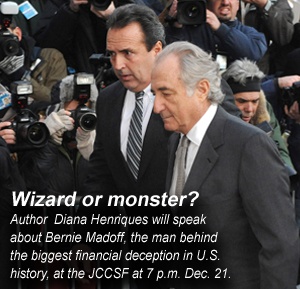
Diana Henriques, author of “The Wizard of Lies: Bernie Madoff and the Death of Trust,” spent almost three years doing research for the book, including two prison interviews with Madoff. The Jewish financier led a Ponzi scheme considered to be the biggest financial deception in U.S. history; in 2009 he was sentenced to 150 years in prison.
A senior financial writer at the New York Times and the author of three other books, Henriques will talk about the Madoff scandal 7 p.m. Wednesday, Dec. 21 at the JCC of San Francisco.
Henriques continues to cover the unfolding of the bankruptcy process and the criminal cases involved in the Madoff scandal. In an interview, she talks about Madoff’s motivations, his Jewish ties, his family and the extent to which he feels remorse.

Q: You presented the facts about Madoff and the Ponzi scheme objectively. Was that difficult? Did you have a preconceived judgment about him?
A: It was a difficult line to walk — to humanize him without either demonizing him or glamorizing him. But I did not approach him with a preconceived image. Instead, I saw him as a mystery to be solved, a knot to be untangled to whatever extent possible.
Q: The book reads like a novel. We learn about Bernie’s roots: He and Ruth were high-school sweethearts; Bernie’s mother kept a kosher home; Ruth’s family was not particularly observant. Was Bernie Madoff a religious man?
A: He did not strike me or the people I interviewed about him as a religious, or even a particularly spiritual man. There is certainly a thread of sentimentality woven into his makeup. His wife, Ruth, recalled that he had such happy memories of raising their sons in their Roslyn, N.Y. home that when he would show prospective buyers through the house, he would break down in tears. But that is very different from religious conviction, of course.
Q: You quote Madoff as saying that early in his career some of the biggest names on Wall Street liked to send him orders because “they thought I was a nice Jewish boy.” Did you get a sense of how he reconciled his image with his actions?
A: I don’t think he actually can reconcile his image with his actions. He clings to his image of himself as a seminal figure in the evolution of the Nasdaq market, which he was, and as the founder of a successful OTC trading firm, which he was. That he also defrauded his investors is something he seems to keep in a different compartment of his psyche — it’s almost like the story of Dr. Jekyll and Mr. Hyde. The only exception is his deep sense of guilt over the suicide of his son Mark. That seemed to pierce the extraordinary armor that seems to protect him from a deep sense of shame over his fraud.

Q: Many of Madoff’s biggest clients were important Jewish charities and major philanthropists. Was he ever concerned about putting them at risk?
A: He expressed no such concern. He did note in one interview that some charities had made a great deal of legitimate money by investing with him before the fraud began. And he notes that many of his longtime investors were able to be such generous philanthropists because they, too, reaped legitimate profits before the Ponzi scheme started. In some cases the charities that suffered were investing through a feeder fund or other intermediary, and Madoff himself might not even have been aware they were investors.
Q: Throughout his career, Madoff used his Jewish relationships to spread the word about his brokerage firm. You quote one of his victims as saying, “Nobody has done more to reinforce the ugly stereotype that all Jews care about is money.” Was he ever concerned that his actions could stir up anti-Semitism?
A: Again, he has not expressed that concern — but he and his lawyer were clearly aware of the harsh anti-Semitic reaction to his arrest and confession.
Q: You write that Bernie’s father, Ralph, started a sporting goods manufacturing company in the 1940s but by 1951 the business went bankrupt and the family faced serious financial anxieties. Was the need not to worry about money and to prove himself to be more successful than his father what kept him from admitting failure and continuing to run the Ponzi scheme?
A: That is my theory, and some of the psychologists and psychiatrists I’ve talked with agree that it is at least plausible. Madoff himself described a point in his march toward disaster when, if he had only been able to own up to his losses and face the music, the fraud would never have grown and multiplied as it did. He says he had too much pride to make that admission. One psychiatrist observed, by the way, that in Madoff’s twisted viewpoint, he may actually feel that he has been a success — he has made history, he ran the biggest Ponzi scheme ever.
Q: You recount what the former CFO of Hadassah, Sheryl Weinstein, who claims to have had an affair with Madoff, said about him in court. “Under the façade, there is truly a beast.” From all of your research and interviews with him, is that how you view him?

A: No. I am impatient with descriptions of Madoff that demonize him or dismiss him as some sort of sub-human monster. It lets Madoff off the hook in a way I am not willing to do. Applying a shorthand label like “monster” or “beast” is, ultimately, a cop-out. It spares us from confronting an uncomfortable reality: that human beings can and do commit acts of vast and devastating betrayal. Until we realize that Ponzi schemers are fundamentally human beings — deeply flawed, weak and selfish human beings, but still human — we cannot begin to defend ourselves from the con artists who will forever live among us.
Q: In the book, you say there is no evidence that Ruth and her two sons, Mark and Andrew, knew about the scheme. Did you interview Ruth?
A: I conducted a lengthy on-the-record interview with Ruth Madoff [in October] and, apart from revealing the failed suicide attempt of 2008, her recollections matched closely what I had been able to learn in my extensive confidential interviews during my research for “The Wizard of Lies.” She seems to still be in shock — she told me she couldn’t bring herself to follow all the very hostile coverage of the scandal as it was unfolding, so it wasn’t until she read my book last spring that she fully took in the scale and scope of Madoff’s crime. That knowledge has filled her with shame for what her husband did to so many people, many of them their closest friends and relatives.
Q: How does Ruth feel about him now?
A: Ruth cut off all contact with Madoff in the fall of last year, a month or more before her son Mark’s suicide. She will not see him or reply to any emails, and changed her telephone number so he could no longer call her from the prison.
Q: What are your thoughts now about Madoff?
A: This was such an enormous waste of life. He was a bright, energetic man. He had two sons he was immensely proud of and a loving relationship with Ruth and he destroyed it all. It was a question of whether he was able to live with himself as a liar or to live with himself as a failure, and for him, it was easier to live as a liar.
Diana Henriques will speak at 7 p.m. Wednesday, Dec. 21 at the JCC of San Francisco, 3200 California St. $10-$25. (415) 292-1200 or www.jccsf.org/arts.
This article appeared in the Jewish Advocate of Boston.