
The demise of the Soviet Union and the introduction of capitalism meant the end of government financing of movies. Filmmakers were presented with artistic freedom and, in the same moment, deprived of the resources to express it.
The film industries in the bloc countries have yet to recover, but Rustem Abdrashov’s “The Gift to Stalin” (from Kazakhstan) and Jiri Chlumsky’s “Broken Promise” (from Slovakia) provide unassailable evidence that talented directors are finding ways to work. Better yet, they are making first-rate films that shed light on the lives of Jews during and after World War II.
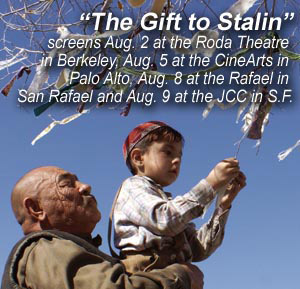
“The Gift to Stalin,” loosely based on a true story (or so one presumes), is a beautifully scripted, masterfully structured story of a young Jewish boy from Moscow who unexpectedly finds himself in rural Kazakhstan in 1949. Smuggled off a train full of Jews and other “traitors” headed to Stalin’s gulag, Sasha is too young to realize he has been granted a second chance at life. Nevertheless, he takes full advantage.
A rare passion for living also drives the real-life protagonist of “Broken Promise.” Martin’s a carefree, soccer-playing student in his early teens when Hitler claims Czechoslovakia for the Third Reich. By the end of the war, after a cascade of incredible experiences, he’s been molded into a fierce lone wolf.

These terrific films play several times in the S.F. Jewish Film Festival. “Broken Promise” is co-presented by the Jewish Partisan Educational Foundation and the Holocaust Center of Northern California. “The Gift to Stalin” is co-presented by Kritzer/Ross Émigré Program of the JCCSF, the 79ers (a program of S.F.-based Jewish Family and Children’s Services) and the Peninsula Jewish Community Center.
“The Gift to Stalin” is (sparingly) narrated by the grown-up Sasha, a device that saves us from worrying whether he’ll survive the steppes, the power-abusing local policeman and the anti-Semitic army officer who rules the region. That allows us to savor the relationships that surround and inform Sasha’s life, and the resourcefulness that separates him from the other kids.
The sunlit film plays at times like a country fairy tale, with heartwarming episodes steeped in sun-tinted nostalgia alternating with painful examples of callous brutality. This richness gives the film an epic feel, even though it doesn’t span a great deal of time.
Sasha’s guardian is an old railroad worker who isn’t Jewish, yet who takes the boy home at some personal risk. At its core, “The Gift to Stalin” pays tribute to a basic humanity that transcends ethnic, religious or geographical differences. The movie is deeply moving without cheating into sentimentality, and clever without feeling contrived. Abdrashov, plainly, is a director to watch.
Jiri Chlumsky’s “Broken Promise” is more explicitly epic in scope, segueing from the comforting routine of Martin’s large family through the disorientation of work camps and the various bursts of fate, quick thinking and icy nerve that allowed the lad to make it through a living nightmare.
The film is shot in the desaturated colors of faded war movies, setting us firmly in the past without glamorizing it. The movie is gritty and appropriately chilly, but stops well short of documentary-style realism.

There are moments, and sequences, in “Broken Promise” that will remind viewers of other true-life stories of Holocaust survivors, namely “The Pianist,” “Defiance” and “Europa, Europa.” They don’t detract from the film so much as make us ponder how every case of survival has some points in common, yet manages to be completely unique.
Chlumsky’s contribution to the literature of the Holocaust is a view of Czechoslovakia that we haven’t seen in quite a while, where the reactions of ordinary people to Nazism, anti-Semitism and war-stoked fear run the gamut from venal to heroic.
Presented with these two films 60 years after the events depicted, from regions that haven’t been particularly willing to discuss their treatment of Jews in the 1930s, ’40s and ’50s, a cynic might scoff, “Better late than never.” But both movies are so forthright and so rewarding that they deserve to be accepted, and savored, on their own terms.
“The Gift to Stalin” screens at 7:15 p.m. Sunday, Aug. 2 at the Roda Theatre in Berkeley, 6:15 p.m. Wednesday, Aug. 5 at the CineArts in Palo Alto, 4 p.m. Aug. 8 at the Rafael in San Rafael and 5:30 p.m. Aug. 9 at the JCC in San Francisco.
“Broken Promise” screens at 6:30 p.m. Thursday, Aug. 6 at the CineArts and 6:45 p.m. Aug. 8 at the JCCSF.