

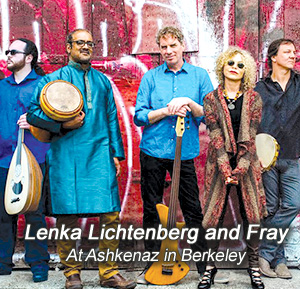
Toronto-based singer Lenka Lichtenberg and her band Fray add a new combination of international ingredients to the Jewish musical melting pot.
They infuse Yiddish songs and Israeli folk tunes with a world music vibe driven by South Asian and Middle Eastern hand drums, oud, violin and fretless electric bass.
Their two CDs — “Embrace” (2013) and “Fray” (2010) — have received nominations for top Canadian and international music awards. They’ll bring their unique Jewish music amalgam to the Ashkenaz in Berkeley on Sunday, Nov. 8 as part of a nine-city cross-country tour.
“The music may have Yiddish, or it may have Jewish elements from liturgy or other things,” Lichtenberg said in a phone interview. “The music has a Jewish brick that built it, but it has more of a global sound.”

That’s not surprising, given Lichtenberg’s background. The singer, whose mother and grandmother survived Terezin, performed in musical theater as a girl in Prague before leaving Czechoslovakia at age 18 to perform in various lands and, eventually, attend college in Vancouver, British Columbia. She sings in six languages, including Yiddish for several decades.
Fray (Yiddish for “free”) features Alan Hetherington, Lichtenberg’s musical co-director, on drums and percussion; Ravi Naimpally on tabla and darbuka; Chris Gartner on fretless electric bass; and Demetri Petsalakis on oud.
In “Peace Is the Only Way,” for instance, Lichtenberg and Fray turn the Israeli work song “Zum Gali Gali” into a multicultural plea for peaceful coexistence, with lush vocals in Hebrew, English and Yiddish floating above a propulsive Middle Eastern rhythm.
Lichtenberg learned the song as a little girl from her godmother, who was born on a pre-state Israeli kibbutz. “She sang it differently than ‘Zum Gali Gali’ normally is sung. She taught me a sort of lilt,” Lichtenberg said.
“I kind of forgot it, I didn’t really think of it. When I was looking at bringing together materials for ‘Embrace,’ this one jumped at me. I thought maybe it’s too common, too predictable, so I changed the rhythm to 7/8. I kept the part that my godmother taught me. And I added some other parts.”
One of Lichtenberg’s musical collaborators, Israeli oud and violin player and singer Yair Dalal, includes the phrase “Peace is the only way” in his email signature. “Since I share those beliefs, I love that line always,” Lichtenberg said. “I decided I’m gonna infuse the song with that message.”
The group’s take on the Yiddish-theater-song-turned-lullaby “Tum Balalaika” is flute-driven Brazilian jazz accented with tabla, a drum from India. Lichtenberg said “Tum” is the selection from “Embrace” that she asked her band to write in a style reflecting the music that several of them play in the band Tasa.
“Pigeons in Paris,” also from “Embrace,” combines sprightly Yiddish singing with accordion and tabla. The lyrics are by poet Khayke Beruriah Wiegand, whom Lichtenberg met at a Yiddish poetry festival in Tel Aviv.
“The story kind of captures the mood in the morning,” Lichtenberg said. “Something happened at night, but she isn’t saying. Now, in the morning, she’s looking out the window, it’s gray outside, she hears pigeons, and she’s trying to write something.” Lichtenberg even supplies pigeon sounds.
Her approach to Yiddish music is rooted both in her own sense of musical adventure and the music scene in Toronto, where she lives with her family.
“Five or six years ago, I started getting a different feeling about Yiddish music,” Lichtenberg explained. “Until then, I was pretty settled in the traditional music and instrumentation. I had a spark to expand the sound. It was not only a philosophical thing. I wanted to open the music.
“I also was influenced by being in Toronto, which is the most multicultural city in the world. I like music that’s mysterious, esoteric, that speaks to me, takes me away.” And when she heard Hetherington and Tasa, Lichtenberg said, “I thought, I want them playing my music.”
Lichtenberg has performed in the Bay Area as a member of Sisters of Sheynville, a female quartet that sang Yiddish songs in an Andrews Sisters style. Married to an Iraqi Jew and the mother of three 20-somethings, Lichtenberg is a cantorial soloist at a Toronto Reconstructionist congregation, adding Yiddish tunes to the liturgy when she co-leads worship.
She released the CD “Songs for the Breathing Walls,” featuring live renditions of Jewish liturgical songs recorded in Czech and Moravian synagogues, in 2012. The singer was backed by Hetherington and Israeli and European musicians.
That CD grew out of Lichtenberg’s performances in her native land. “The people there really want more Jewish music. They actually remembered me from when I was a child, which was kind of shocking,” she said.
When she sang in the old synagogues, each one “had its own ambience. More than the acoustics of the place, there were individuals breathing in the walls almost. There was something worthwhile commemorating, capturing, communicating with. So I’m connecting to the past through the texts, and bringing to it something new — the music.”
Lenka Lichtenberg and Fray, 8 p.m. Sunday, Nov. 8 at Ashkenaz, 1317 San Pablo Ave., Berkeley. $15 advance, $20 day of show. www.ashkenaz.com