

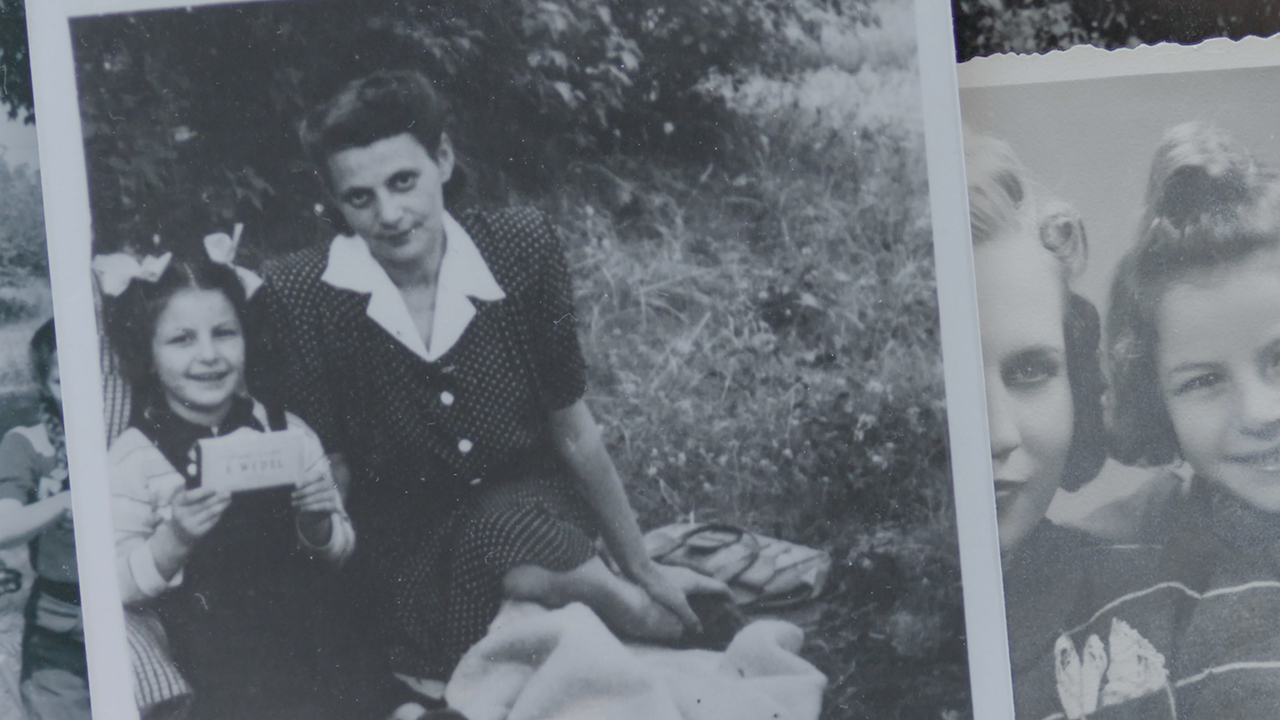
A Jewish child was born in Lithuania in 1939. Two years later, her father was dead and her mother smuggled the girl out of the Vilna Ghetto to be raised as a “hidden child” by her Catholic nanny. In 1943, Jewish poet and partisan Shmerke Kaczerginski wrote a Yiddish lullaby for the little girl about a mother and daughter ripped apart by war.
He called it “Dos Elnte Kind,” or “The Lonely Child.”
Nearly 80 years later, that little girl’s daughter — Oakland journalist and longtime J. writer Alix Wall — has co-written, co-produced and starred in a powerful, lyrical documentary about her mother’s and grandmother’s experiences during the Holocaust. She tells their story through the journey of this song, which has been preserved and performed in many venues, by many people.
“It’s not just about a mother and child. It’s about any mother and child,” Wall says in the film, which is also titled “The Lonely Child. “War is terrible in any circumstance. It tears people apart. This song is a way to keep that story going, long after those it is about are gone.”
“The Lonely Child” will have its world premiere July 18 at the Castro Theatre in S.F. as part of the 2026 San Francisco Jewish Film Festival.
Like many children of Holocaust survivors, Wall grew up surrounded by secrets. Her mother, Sarah Wall, was too young to remember the war. Alix’s grandmother, Rachela Melezin, told her some things, but not everything — above all, not about her romantic relationship with Kaczerginski after her husband’s death. Rachela ended up marrying another man, also a survivor.
Alix Wall did know that her grandmother was part of the “Paper Brigade,” a group of highly educated Jews in the Vilna Ghetto ordered by the Nazis to select Jewish documents collected by the Vilna-based YIVO Institute for Jewish Research, which they planned to use for a future “museum of an extinct race.” The Nazis didn’t realize that the workers were secretly smuggling key documents back into the ghetto for safe-keeping until after the war.
In one moving interview in the film, the current executive director of the YIVO Institute, which relocated to New York in 1940, tells Wall that 1.5 million of the institute’s 24 million documents came from the Paper Brigade’s heroic work.
Wall knew “a bit” about the song growing up, and her mother knew a bit more. But it wasn’t part of their family lore until her mother, who died in 2002, asked for it to be sung at her funeral. That piqued Wall’s interest. Yet she put it on the backburner as she advanced her career as a reporter.

If she was going to do anything with her family’s Holocaust history, she felt she owed it to her grandfather, whose first wife and child died during the war, to make sure his unpublished memoirs made it into print. That “felt like a huge burden” to her.
“As a child of survivors, the weight is handed to you whether you want it or not, and I didn’t want it,” she says in the film.
Then in 2015, the woman who sang the lullaby at her mother’s funeral, Felicia Sloin, sent Wall a video of Sloin’s sixth-grade Jewish day school students in Massachusetts singing the same song.
“It was out of the blue,” Wall said. “I was sitting at my computer, and I just started bawling. It was like a lightbulb went off and I thought, ‘Wow, this song has a life of its own and it’s out there.’”
If Wall couldn’t find her way into her grandfather’s memoir, which she called “dark and challenging,” perhaps she could focus on this lullaby.
“It was like, OK, maybe I’m not going to write a book, I’m going to do a film,” she said. “Of course I’ve never made a film. But if I choose the song as the angle, then it has to be a film because you have to see performances of it.”
Wall added she knew that “music has this power to make people feel things in a different way than reading about them.”

The song is about separation, about longing for lost parents — Sarah’s father was murdered in a mass killing of Jews before she was given to the nanny.
Its lyrics are also about memory and end with an exhortation to the child for whom it was written. The translation reads: “If it happens some day a mother you’ll be, you must make your children aware of our pain, how your father and mother suffered under the enemy. Forget not the past, not for one single day.”
Those words especially resonate with Wall.
“As my mother’s child, and as a woman without children, this is my effort not just to keep the song alive, but to keep the story alive,” Wall said.
In the 10 years Wall has been working on the film, a number of coincidences she can only describe as bashert, Yiddish for “destiny,” propelled the project forward.
Even before Sloin’s video arrived, Wall was contacted by a woman in South Africa who learned the song as a child in Tel Aviv, singing it at a Holocaust memorial when she was 10. Four decades later the woman was still singing the lullaby — it had become part of her life.
Then Wall met up again with filmmaker Marc Smolowitz, whom she knew from college at UC Santa Cruz. Like her, he was the child of Holocaust survivors whose mother was a hidden child. He also lived in the Bay Area. He already had a strong career as a director and producer, including producing “Trembling Before G-d,” the 2001 documentary about gay and lesbian Orthodox Jews. He agreed to direct Wall’s film, another bashert moment.
They kept coming in different ways. A woman in New York wrote a play about the Paper Brigade, with Wall’s grandmother figuring as a main character. There was a woman in Vancouver, Canada, who had been singing the lullaby for years at Yom HaShoah ceremonies. Other similar “coincidences” turned into people whom Wall interviewed on screen; several of them spoke about how something in the song connects them to their own families and to the victims of the Holocaust.
It was a slog getting the film to completion, Wall acknowledged. She gives Smolowitz huge props for keeping the project going when she despaired of ever raising enough money to continue or even to pay him. They still need $20,000 to finish covering their costs.
Still, if they had finished sooner, they wouldn’t have been able to include an amazing moment. In January 2023, Wall was invited to introduce a performance of the lullaby at a Holocaust memorial event at New York’s Carnegie Hall. It was, she said, an unbelievable honor.
It’s also an honor, Wall said, to have the film’s world premiere in the Bay Area, where she and Smolowitz have lived for so many years, and as part of the San Francisco Jewish Film Festival. Smolowitz’s first job out of college was with the festival, and he worked on “The Lonely Child” as a filmmaker in residence at the Jewish Film Institute, the festival’s parent organization.
Wall is especially grateful for the film festival.
“It’s not an exaggeration to say that ’The Lonely Child’ might never have existed without the inspiration I found in the many deeply personal Jewish documentaries I encountered there over the years,” she said. “Watching filmmakers investigate their own family histories helped me imagine that I might someday do the same.”
Most of those who donated to the film are also local, she said, “so to be able to share it with this audience seems bashert, too.”