

Ronald C. Wornick was a pillar of the Bay Area Jewish community, serving on numerous boards and giving millions of dollars to Jewish organizations, including the day school in Foster City that bears his name.
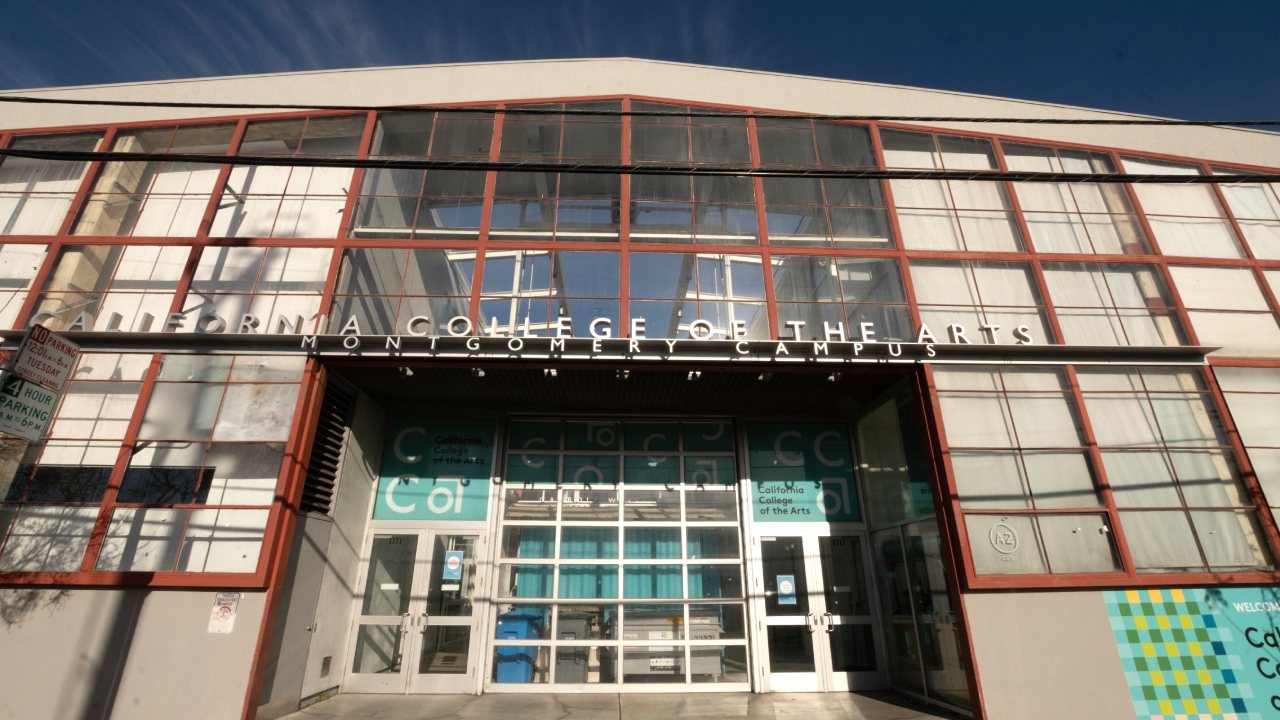
He also donated generously to the California College of the Arts, a private arts school in San Francisco where he served on the board of trustees for 29 years. He and his wife, Anita, endowed an annual furniture design prize and a residency for a visiting professor in the furniture program. Before Ronald’s death in 2021, they set up a large bequest to CCA’s endowment, to be disbursed after both have passed away.
Now the Wornick family’s long relationship with CCA faces a serious test.
Jonathan Wornick, the youngest son of Ronald and Anita, has publicly threatened to revoke the bequest, which he said is in the seven figures, unless the college issues an apology for an inflammatory social media post about the Israel-Hamas war and meets other demands.
“This is a battle that I didn’t expect, and certainly my father, who was the one who was active at the school, would be really outraged and heartsick about what’s happened there,” Wornick told J. in an interview earlier this week. He said he was speaking out with the full support of his mother, who is 87 and lives in San Francisco.
On Oct. 11, four days after the Hamas assault on Israel sparked the ongoing war, the Instagram account of CCA’s Critical Ethnic Studies department posted a photograph of a sign at a pro-Palestinian protest that read “Decolonization Is Not a Dinner Party.” The phrase seems to be a riff on a saying coined by Communist leader Mao Zedong: “A revolution is not a dinner party, or writing an essay, or painting a picture, or doing embroidery.”
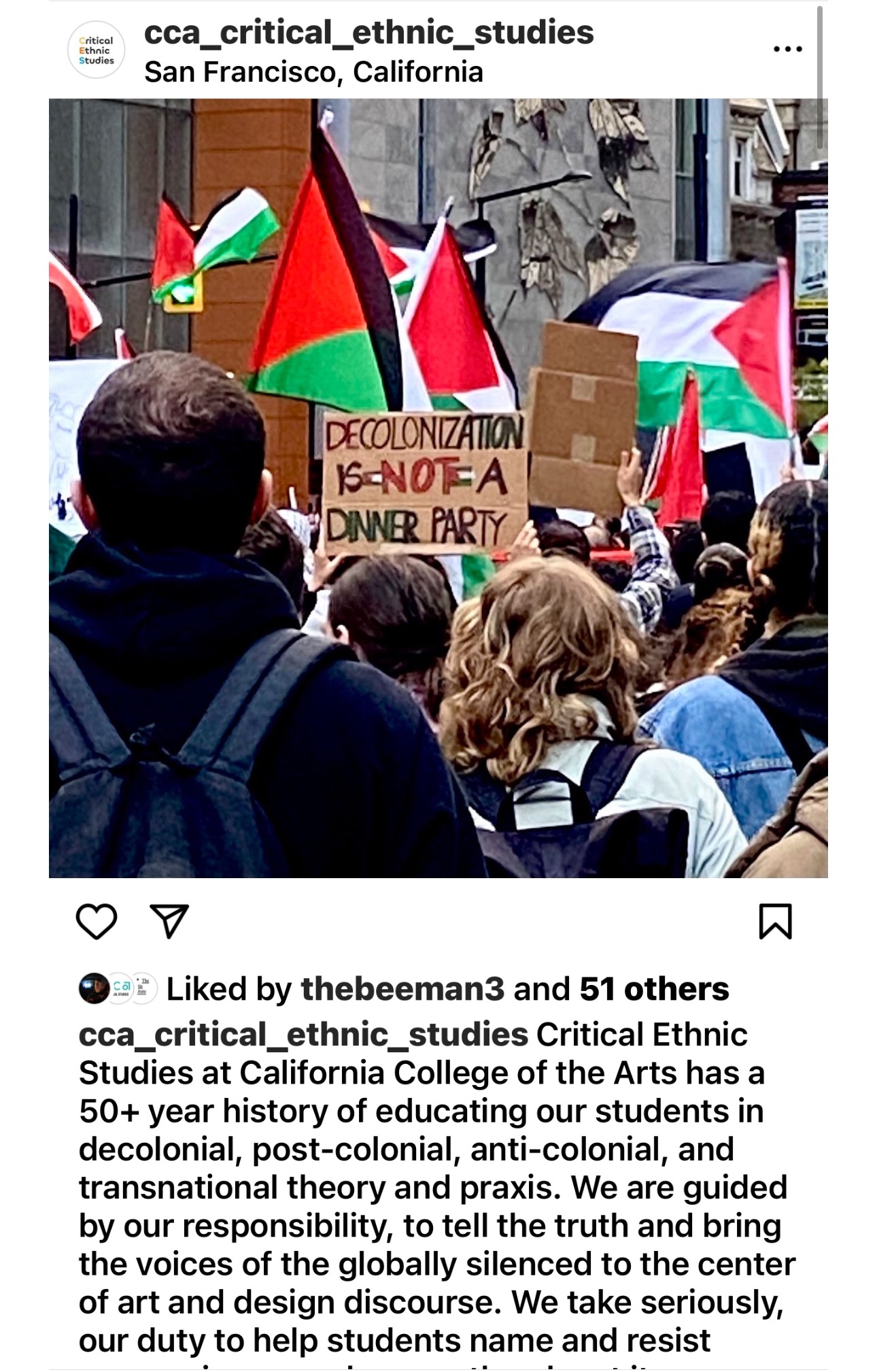
The caption accompanying the photo condemned Israel’s bombardment of Gaza and expressed support for Palestinian self-determination without mentioning Hamas’ Oct. 7 massacre of 1,200 Israelis. “Our program has a stellar record of teaching the historical and contemporary context of Israel’s colonial legacy in Palestine,” the caption read. “And now we watch, along with the world with horror and deep grief, the collective punishment, civilian killings, attacks on humanitarian support, forced displacement & internet shutdowns.”
The caption also called for other art and design colleges “to prioritize and intensify decolonial curriculum, pedagogies, and policies.”
Wornick contacted CCA leadership on Oct. 21 to express his outrage over the post, which he called antisemitic and “disgusting” for suggesting that the Hamas assault was justified. Over the next two months, he exchanged emails and participated in Zoom meetings with administrators. During one of those meetings, he described what he saw during a solidarity trip he made to Israel in mid-November with a group of Jewish philanthropists.
“They just listened and expressed a little bit of understanding, but they never expressed regret or concern or acceptance that this [post] was antisemitic,” Wornick said of the CCA administrators. They acknowledged that “this is a sensitive issue for your family” and said they would investigate the matter and follow up with him, he said.

In mid-December, Wornick said CCA President David Howse told him during a Zoom meeting that the college had decided not to delete the post and said it was a free speech issue.
Howse, who was appointed to his role in October, did not respond to J.’s request for comment.
Incensed, Wornick published an essay on the Times of Israel blogging platform on Dec. 21 titled “College Stands By Anti-Semitic Instagram Post.” In the essay, he threatened to revoke his family’s bequest to CCA unless it takes the following actions: delete the post, issue a formal apology, discipline those responsible for the post and allow a third party to review CCA’s ethnic studies curriculum for antisemitism.
Wornick also criticized the chair of the Critical Ethnic Studies department, Shylah Pacheco Hamilton. It is unclear whether Hamilton wrote or approved the Instagram post, or if another member of the department was responsible for it. On Oct. 11, she reposted a link on her personal X account to a website blaming “Israeli settler-colonialism and apartheid” for the war.
Hamilton did not respond to J.’s request for comment.
The day after Wornick’s essay was published, the “Decolonization Is Not a Dinner Party” post disappeared from CCA’s Critical Ethnic Studies Instagram account. According to Wornick, it had been “liked” by other CCA departmental accounts before being deleted.
In a statement to J., CCA said of the post: “It is neither a statement on behalf of all of CCA nor does it represent the collective opinion of the CCA community or the College’s leadership.”
However, the statement continued, the college removed it pending an investigation by “an outside party” into whether it violated any of CCA’s policies. A spokesperson for CCA, which was founded in 1907 and offers undergraduate and graduate degrees, declined to say whether the college plans to take the other steps that Wornick outlined in order to guarantee that it receives his family’s bequest.

Wornick, who lives in Lafayette, told J. that he is not optimistic the college will comply and that he is prepared for a legal battle once the family formally cancels the bequest. “I think it would be very damaging to them, but bring it on,” he said. “We have the will and the pocketbook to fight it publicly.”
He added, “I like to take on enemies, and I’m a very, very outspoken Zionist, and I’m very proud of it and I don’t believe in hiding who I am and what I believe in.”
Wornick’s concerns go beyond a single Instagram post. He said he has heard from two CCA faculty members that the culture at the college has become increasingly hostile toward Jewish students and faculty, though he declined to share their names. “Artists are very worried about being outed as Zionists,” he said. “They think it could be career ending.”
When he visited campus with his wife and mother on Oct. 24 to view an exhibition of work by a Wornick Award recipient, he said the bulletin boards were covered with pro-Palestinian posters, which made him uncomfortable. He also shared photos with J., taken by someone else, of a bulletin board that appears to be covered with lists of the names of people killed in Gaza next to a message reading, “Our tax dollars support ethnic cleansing.”
Throughout this situation, Wornick said, he has felt sad for his mother and late father, who in addition to being a patron of the arts was an amateur woodworker and furniture craftsman.
“My parents looked at helping CCA as part of their legacy because they care so deeply about the arts and nurturing young artists and students to be creative and enrich humanity for us,” he said. “It’s painful to imagine that my father put his love and effort and years of work to help the school, only for it to become another place to express hate against Israel and Jews.”