

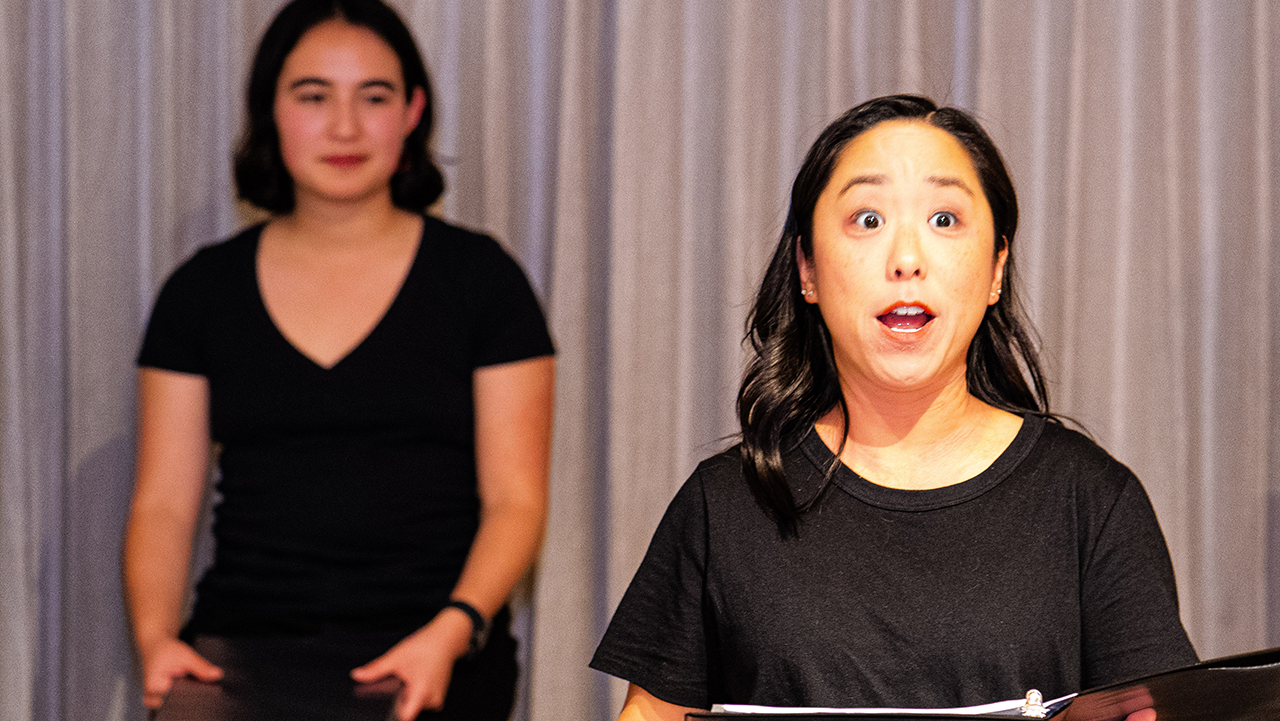
Upon entering the classroom at the Jewish Community Center of San Francisco for a performance of “What Do I Do With All This Heritage?” on Sunday, I found my seat and looked around to check out the audience demographics.
In the row in front of me, an elderly Chinese couple sat next to a white-appearing Jewish woman. As the women were chatting, the Chinese woman shared that she’s Jewish. The white-appearing woman commented, “You’re Jewish…,” then nodded her head and gave a pensive look, as if internalizing surprising information.
I found myself reflecting back to the same looks I’ve gotten when I tell people I’m a Jew from China.
The Jewish community is so often limited by what it thinks Jews look like that it fails to uphold the commandment of welcoming the stranger. But why should a Jew of color be the stranger at all? We have a right to feel as though we fully belong in the Jewish community, like everyone else.
This is precisely the mission that David Chiu, a mixed Cantonese and Litvak Jew and lead producer of the new show, set out to achieve.

“When I was growing up, an Asian Jew felt kind of like a punchline,” he told me in an interview. “It was something that was inherently strange and a little funny. I feel motivated to tell stories that show Asians as full-fledged human beings rather than clownish figures.”
In “What Do I Do With All This Heritage?” — produced by The Braid, a Los Angeles-based Jewish theater company, and the LUNAR Collective, the nation’s only organization by and for Asian American Jews, which I co-founded — we Asian Jews aren’t clownish figures or Jewish strangers. We are front and center.
Appropriately, this show premiered in May, which is both Asian American, Native Hawaiian and Pacific Islander Heritage Month and Jewish American Heritage Month. It includes 13 stories and an original song, all true tales written by Asian Jewish contributors. The producers opted for a salon theater format — no props, simple lighting, just the actors delivering dramatized renditions of the stories with binders in hand.
To my delight, the stories presented a wide range of Asian Jews, from the child of an interracial marriage who is “a quarter Jewish,” to a woman from the Bene Israel community in India, to five Jews by choice of different Asian heritage backgrounds.
What makes the stories so compelling is that they’re not only about Asian Jewish identity. Many of them are about Asian Jews going through life’s trials and tribulations. From getting caught in a lie as a teenager, to navigating the grief of infertility to parenting a disabled child, these stories could be about anyone. But paired with the joy, triumph and pain that comes with navigating two age-old traditions, as the show puts it, they are all the more poignant.
The show also includes stories that are, in fact, extraordinary: a budding Orthodox Jewish K-pop star, a later-in-life convert scrambling to schedule his own bris, someone observing Yom Kippur in rural Taigu, China.
“What Do I Do With All This Heritage?” was, at times, an unexpected rollercoaster of emotions, from deep sadness in one story to “I relate” chuckles in the next. I listened intently to writer Chelsea Eng’s heartbreaking tale of struggling with infertility and then minutes later broke into nonstop laughter as actor Kenzo Lee portrayed an anxious convert desperately calling around to find an observant Jewish doctor who can perform his bris, which he’d barely come to terms with himself.
In Leila Chomski’s story, I found myself hanging on every word, following the emotional journey of a teenager navigating her relationship to Orthodox Judaism and finding her K-pop dance aspirations at odds with Jewish modesty laws. One moment I was crying as Leila (played by Lillian McKenzie) shared a tender moment with her father, and the next I was cheering as she danced gleefully to a popular K-pop song.

After I was done processing the feeling of everything, everywhere, all at once, I was able to find the universality, and recognizable Jewishness, in many of the stories.
The show manages to humanize and demystify for the Jewish community what it is to be an Asian Jew, but it also tugs at the heartstrings and wins over the affection of its core audience — other Asian Jews. This is thanks to a community-centered production process that involved three writing workshops for the LUNAR Collective and the fact that nearly all the producers and half of the actors are Asian American Jews themselves. It is a true testament to “by us, for us.”
“I feel affirmed, proud and relieved,” audience member Anthony Witt, who is Chinese and Jewish, told me after the show. “It feels like the world is in such tumult, and being Jewish feels especially hard. The show reminded me that there’s a lot of light and love in the complexity of that. Being Jewish is not something to shy away from, but to step into.”
Maybe, with more shows like this, the existence of an elderly Chinese Jewish woman won’t be so surprising.